Alcohol & Medication Safety Calculator
Why This Matters
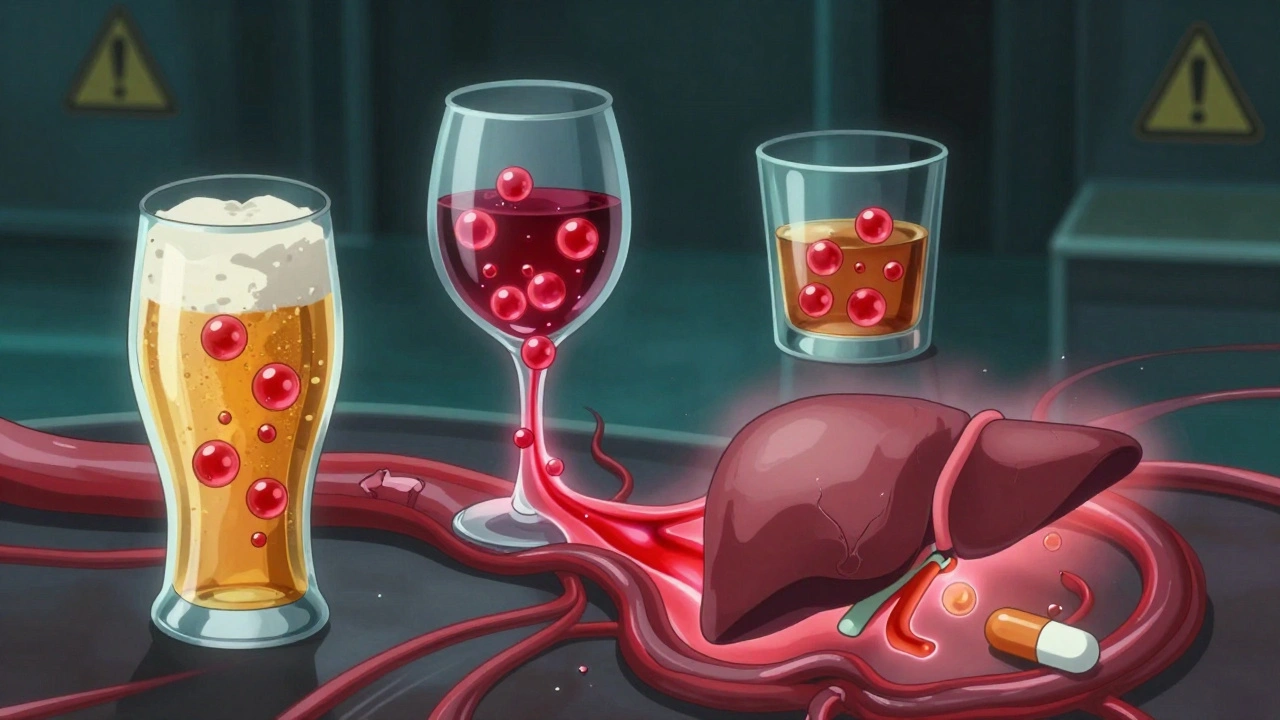
The article explains that all alcohol types carry identical risks when mixed with medication because they all contain the same amount of ethanol per standard drink. A standard drink = 14g ethanol (12oz beer, 5oz wine, 1.5oz spirits).
Millions of people take medications every day and drink alcohol without realizing how dangerous that mix can be. You might think a glass of wine with your pill is harmless, or that a single shot of whiskey won’t hurt if you’re on sleep meds. But here’s the truth: alcohol doesn’t care if it’s in your beer, wine, or bourbon. What matters is how much ethanol is in your blood-and that number rises just as fast from a shot as it does from a pint.
One Drink, Same Risk-No Matter the Bottle
A standard drink is a standard drink. That means 12 ounces of beer, 5 ounces of wine, and 1.5 ounces of spirits all contain about 14 grams of pure alcohol. That’s the number doctors and pharmacists use to measure risk. So if your prescription says "avoid alcohol," it doesn’t mean "avoid wine but drink beer." It means avoid all of them.The liver handles both alcohol and most medications using the same enzyme system-cytochrome P450. When alcohol is in your system, it slows down how fast your body processes your pills. That can make your medication build up to dangerous levels. Or, in some cases, it can make the drug break down too fast, so it stops working.
Take acetaminophen (Tylenol), for example. Two drinks-even if they’re beer-can increase your risk of liver damage by 300%. That risk is identical whether you drank a six-pack or two shots. There’s no safe type of alcohol here. Only the total amount matters.
Spirits: The Silent Danger
Spirits get a bad rap, and for good reason. People often think, "I only had one shot," not realizing that 1.5 ounces of 40% alcohol hits your bloodstream faster than 12 ounces of beer. Why? Because spirits are consumed quickly. You don’t sip a shot over 20 minutes like you might with a glass of wine. You knock it back in seconds.Emergency room data shows that 68% of alcohol-medication overdose cases involve spirits. That’s not because spirits are more toxic-it’s because they deliver the same ethanol dose in a fraction of the time. This rapid spike in blood alcohol concentration (BAC) can triple or even quadruple the sedative effects of medications like benzodiazepines, sleep aids, or opioids.
One patient in a Reddit thread described taking a single shot of vodka with his prescribed Xanax. He woke up hours later on the floor, confused, with no memory of falling. He didn’t pass out-he just went completely offline for hours. That’s not rare. It’s predictable.
Wine: The Misunderstood Choice
Many believe red wine is "healthier"-so it must be safer with meds. That’s a myth. Red wine contains polyphenols and tannins, which some think are protective. But when mixed with blood thinners like warfarin, those same compounds can increase bleeding risk by 15% compared to the same amount of alcohol from spirits.Wine also has a notorious reputation with antibiotics. People take a glass with metronidazole or tinidazole and end up with flushing, rapid heartbeat, vomiting, and nausea. That’s not an allergy. It’s a disulfiram-like reaction caused by alcohol blocking a key enzyme. The reaction happens with any alcohol-but because wine is often sipped slowly, people don’t connect the dots until they’re already sick.
One survey found 41% of users believed red wine was safer than other alcohols. Those same people had more severe reactions. Why? Because they felt safe drinking more. A glass becomes two. Two becomes a bottle. And then the body can’t keep up.
Beer: The False Sense of Security
Beer has the lowest alcohol content-about 5%. That leads people to think they can have "a few" without risk. But here’s the catch: most people don’t stop at one. The CDC says beer makes up 52% of all alcohol consumed in the U.S. That means most alcohol-medication interactions happen because someone drank four or five beers with their painkillers.NSAIDs like ibuprofen or naproxen already irritate the stomach lining. Add beer, and you’re stacking two gut irritants. One study of over 8,000 users found that 63% of stomach bleeding cases linked to alcohol and painkillers involved beer. People didn’t think it was a problem because "it’s just beer." But four beers = four standard drinks. That’s enough to cause internal bleeding, especially in older adults or those with a history of ulcers.
Even "non-alcoholic" beer (0.5% ABV) isn’t always safe. Some medications-like certain antibiotics or antifungals-can still react with trace alcohol. If your doctor told you to avoid alcohol entirely, that includes non-alcoholic beer too.
What You Can’t See: How Fast Alcohol Gets In
It’s not just how much you drink-it’s how fast. Carbonated drinks like champagne, sparkling wine, or mixed spirits with soda speed up how quickly alcohol enters your bloodstream. Why? Carbonation makes your stomach empty faster. That means your liver gets hit with a bigger, quicker dose.Studies show carbonated alcoholic drinks increase gastric emptying by 25%. That’s why people who drink vodka sodas or sparkling wine with meds often feel the effects faster-and more intensely-than those sipping still wine or beer.
Temperature matters too. Cold drinks are absorbed slightly faster than warm ones. So a chilled beer or ice-cold shot hits harder than room-temperature wine.
The Real Rule: Abstinence Is the Only Safe Option
Some people try to find loopholes: "Can I have one drink after my pill?" "What if I wait three hours?" The answer is simple: don’t risk it.Even if you wait hours between taking your medicine and drinking, alcohol can still interfere. Many medications stay in your system for days. Benzodiazepines, antidepressants, and painkillers can linger long after you feel their effects. Alcohol doesn’t just react with the pill you just took-it reacts with the one you took yesterday.
The American Pharmacists Association says it plainly: "The type of alcohol matters less than the total ethanol dose and timing." That’s why every major health organization-from the FDA to the WHO-recommends complete abstinence when you’re on high-risk meds.
What’s Changing in 2025
Hospitals and pharmacies are catching up. Electronic health records now include automated alcohol interaction alerts. In 2023, the FDA approved a new system that flags prescriptions for benzodiazepines, opioids, and certain antibiotics with specific warnings about spirits, wine, and beer-not just "alcohol."Medicare Part D now requires pharmacists to counsel patients on alcohol risks for 27 high-risk medications. That means when you pick up your Xanax, your pharmacist has to explain not just "don’t drink," but "a shot of whiskey is just as dangerous as a whole bottle of wine."
Apps like GoodRx’s "Alcohol Check" now let you scan your prescription and type in what you drank. It tells you if you’re at risk-based on the exact type and amount. These tools are 94% accurate. Use them.
What to Do Right Now
If you’re on medication, here’s what you need to do:- Check your prescription label. If it says "avoid alcohol," it means ALL alcohol.
- Ask your pharmacist: "Does this interact with beer, wine, or spirits?" Don’t assume they’re the same.
- Use a standard drink chart. Know what one drink looks like in each form.
- Never mix alcohol with sleep aids, painkillers, antidepressants, or antibiotics unless your doctor says it’s safe.
- If you’ve had a drink and feel dizzy, nauseous, or unusually tired after taking your meds-seek help. Don’t wait.
There’s no such thing as a "safe" alcohol type when you’re on medication. The only safe choice is none at all. Your liver doesn’t care what’s in the glass. It only cares how much ethanol it has to clean up-and how many pills it’s trying to process at the same time.

12 Comments
Just had a glass of wine with my antidepressants last week and felt like I was underwater for two hours. Didn’t even realize it was the combo until I read this. Thanks for spelling it out so clearly.
Stop pretending beer is safe. Four beers is four drinks. Your liver doesn’t care if it’s from a can or a bottle. If your script says no alcohol, then no alcohol. Period.
Oh please. Red wine is ‘healthier’? That’s the same nonsense people told us about ‘low-fat’ junk food. You think polyphenols magically cancel out ethanol’s effect on warfarin? Wake up. It’s still alcohol. Still dangerous. Still killing people who think they’re being ‘smart’.
My mom died from a bleed after mixing ibuprofen and beer. She thought ‘just two’ was fine. She didn’t know two beers = two standard drinks. Don’t let your family become a statistic. If your med label says ‘avoid alcohol,’ it means ALL of it. No exceptions. No loopholes. No ‘but I’m just having one.’
I’ve been on SSRIs for years and always avoided alcohol-but I didn’t realize non-alcoholic beer could still be risky. My pharmacist just told me this last month. Now I skip it entirely. Small changes matter.
Carbonation speeding up absorption? That’s wild. I always thought sparkling wine was just fancy. Now I get why I’d feel buzzed faster with champagne and my sleep meds. No more bubbles with prescriptions. Learned the hard way.
My dad took warfarin and drank red wine every night for years. He never had a problem. So why are we saying it’s dangerous? Maybe it’s not the alcohol-it’s the dosage. Or the person. Not everyone reacts the same.
GoodRx’s Alcohol Check saved my life. Scanned my Xanax script, typed in ‘one shot of vodka’-it screamed RED ALERT. I almost did it last Friday. Thank you for this tool. Everyone should use it.
Alcohol is the mirror of the soul. It reveals what we hide from ourselves. When we mix it with pills, we are not just poisoning our liver-we are silencing our inner voice. The body knows. It always knows.
I used to think spirits were the only danger. Then I had a stomach bleed after five beers and naproxen. Turns out, beer’s the silent killer. No one talks about it. But it’s everywhere. Just say no to all of it.
UK guidelines say the same thing. One drink = one risk. Doesn’t matter if it’s cider, gin, or lager. Your meds don’t care about the label. Just the ethanol. Simple.
As a pharmacist, I see this every day. People think they’re being responsible by choosing wine over whiskey. They’re not. The math doesn’t lie. Ethanol is ethanol. The only safe amount is zero. Please, for your own sake, don’t test it.
Write a comment