
One morning, you roll over in bed and suddenly the room spins. Not a little. Not like you had too much coffee. The world turns like a carousel, and you feel nauseous, shaky, scared. You sit up. The spinning stops. You think, "That was weird." But it happens again the next day. And the next. You avoid turning your head. You stop looking up at shelves. You don’t want to bend down to tie your shoes. You’ve been told it’s "just dizziness"-but it’s not. It’s BPPV.
What Exactly Is BPPV?
BPPV stands for Benign Paroxysmal Positional Vertigo. "Benign" means it’s not dangerous. "Paroxysmal" means it comes in sudden bursts. "Positional" means your head position triggers it. And "vertigo"? That’s the spinning sensation-not just lightheadedness, but the feeling that you or the room is moving when you’re perfectly still. This isn’t just bad luck. It’s a physical problem inside your inner ear. Inside each ear, there are tiny calcium crystals called otoconia. Normally, they sit in a part of the ear called the utricle, helping you sense gravity and straight-up-down movement. But sometimes, these crystals get loose. They drift into one of the three fluid-filled semicircular canals-tubes that detect head rotation. When you move your head, the crystals push on the fluid inside, tricking your brain into thinking you’re spinning. Your eyes dart involuntarily (that’s nystagmus), your balance goes haywire, and you feel like you’re on a rollercoaster that’s not moving. It’s not rare. In fact, it’s the most common cause of vertigo. Over half of all people who go to the doctor with dizziness have BPPV. It mostly hits adults over 50. Women are 1.5 to 2 times more likely to get it than men. And it’s not just old people-people in their 40s and even 30s can get it, especially after a head injury, inner ear infection, or just aging.How Do You Know It’s BPPV and Not Something Else?
Lots of things cause dizziness: low blood pressure, anxiety, migraines, even a stroke. So how do you tell if it’s BPPV? The clues are in the timing and triggers:- It lasts only 5 to 30 seconds-rarely over a minute.
- It happens only when you change your head position: rolling over in bed, looking up, bending down, or turning your head quickly.
- You don’t have hearing loss, ringing in your ears, or numbness. If you do, it’s probably not BPPV.
- You feel dizzy, but your vision doesn’t blur permanently, you don’t have slurred speech, and you don’t lose coordination.
Why Medications Don’t Work
You might have been prescribed meclizine or dimenhydrinate-drugs like Bonine or Dramamine. They’re meant to calm dizziness. But here’s the truth: they don’t fix BPPV. They just numb the symptoms. Studies show these drugs are only 18% effective for BPPV. That means 82% of people still feel dizzy even after taking them. Worse, they make you groggy, dry your mouth, and can mess with your balance even more. They’re like putting a bandage on a broken bone. It hides the pain, but the bone is still broken. The real fix? Move the crystals back where they belong. That’s where canalith repositioning comes in.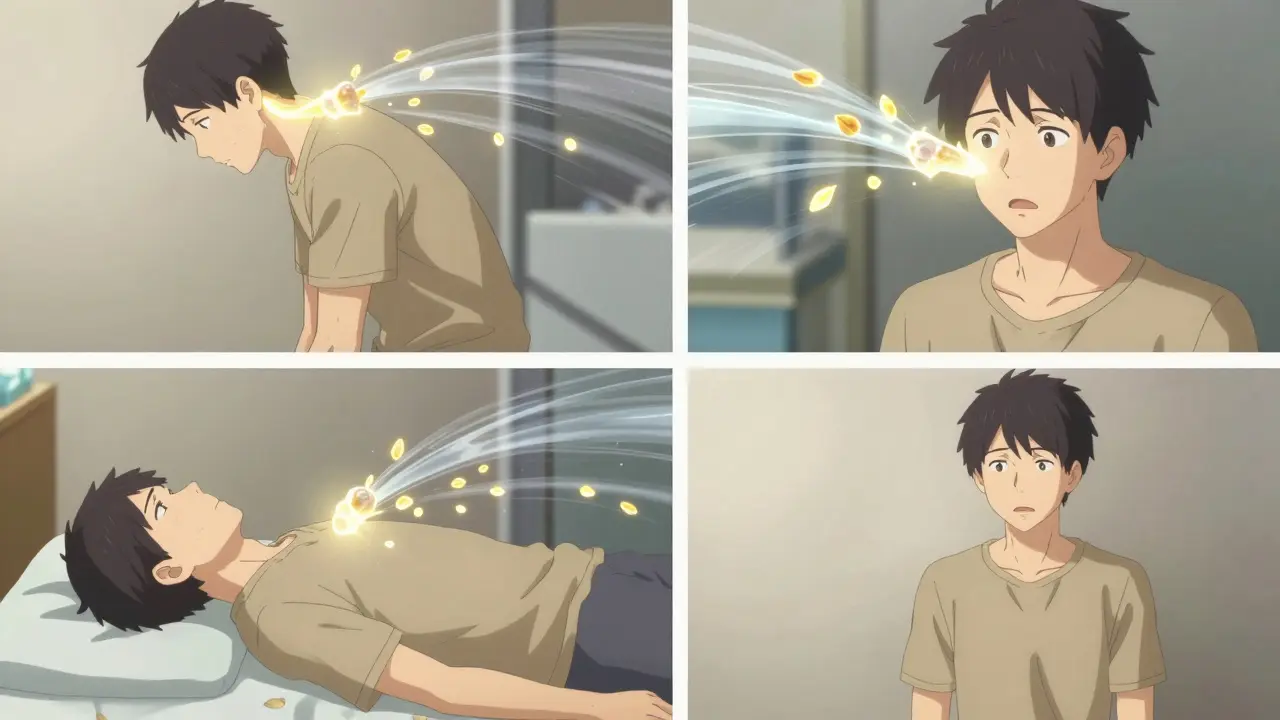
Canalith Repositioning: The Real Cure
Canalith repositioning isn’t surgery. It’s not drugs. It’s a series of slow, controlled head movements designed to guide the loose crystals out of the semicircular canal and back into the utricle, where they won’t cause trouble. The most famous method? The Epley maneuver. It’s been used since the 1980s and still works in 80-90% of cases when done right. Here’s how it works for posterior canal BPPV:- You sit upright on a table, with your legs extended.
- The doctor turns your head 45 degrees toward the affected side.
- They quickly lay you back, keeping your head turned and hanging slightly off the table.
- You stay there for 30 to 60 seconds until the dizziness passes.
- They turn your head 90 degrees to the opposite side, still lying down.
- You hold that for another 30 seconds.
- Then you roll onto your side, facing the floor, holding for 30 seconds.
- Finally, you sit up slowly, keeping your head slightly bent forward.
Can You Do It Yourself?
Yes. Many people do. There are thousands of YouTube videos showing the Epley maneuver. One study found that people who followed a video guide at home had a 72% success rate. That’s better than written instructions (45%) and close to what doctors achieve. But here’s the catch: you have to know which ear is affected. If you do the maneuver on the wrong side, you might make it worse. How do you tell? Try this: lie down quickly on your left side. If you get dizzy, your left ear is likely the problem. Do the same on your right. The side that makes you dizzy is the one to treat. If you’re unsure, see a professional. A misstep can turn one problem into two. Apps like DizzyFix use your phone’s motion sensors to guide you through the steps and even detect which ear is affected. They’re not perfect, but they’re better than guessing.What Happens After Treatment?
After the maneuver, you’re usually told to avoid lying flat for 24 to 48 hours. Some doctors recommend sleeping propped up on pillows. Others say it doesn’t matter. The truth? The crystals are already out of the canal. The rest is just superstition. You might feel a little off for a day or two. That’s normal. Your brain is relearning what’s real. Don’t rush back into yoga or spinning classes. Give yourself time. Recurrence is common. About 15% of people get it back in a year. After five years, it’s 35%. After ten, it’s 50%. That doesn’t mean you’re doomed. It just means you should know the signs. If you feel that familiar spin after rolling over, do the Epley maneuver again. Most people learn to handle it themselves after the first episode.
What About Prevention?
There’s no guaranteed way to stop BPPV. But some research suggests low vitamin D levels might be linked to higher recurrence. One 2022 study found that taking 1,000 IU of vitamin D daily reduced repeat episodes by 24% in people who were deficient. Also, avoid sudden head movements if you’ve had it before. Don’t lie flat on your back for long periods. Sleep with your head slightly elevated. Be careful when you’re cleaning high shelves or looking up at the sky.When to See a Specialist
Most cases get better with one or two repositioning sessions. But if:- Your dizziness lasts longer than a minute,
- You have hearing loss, ringing, or pressure in your ear,
- You feel numbness, weakness, or trouble speaking,
- Or the maneuver doesn’t help after three tries,
Final Thoughts
BPPV is frustrating, scary, and disruptive. But it’s also one of the easiest vestibular disorders to fix. You don’t need surgery. You don’t need lifelong medication. You just need to know what’s happening-and how to move the crystals back. The next time you roll over and the world spins, don’t panic. Don’t reach for a pill. Remember: it’s not your brain. It’s not your heart. It’s just a few tiny crystals in your ear that got out of place. And you know exactly how to put them back.
10 Comments
Been there. Rolled over one morning and thought I was dying. Did the Epley on YouTube and it was gone in two days. No pills needed.
Stop recommending YouTube videos as medical advice. That’s irresponsible. The Epley maneuver requires proper diagnosis first-misidentifying the canal can turn a simple case into a chronic nightmare. This isn’t a TikTok hack.
Hey, I get where you're coming from-but honestly, a lot of folks don’t have access to specialists. I’ve seen people in rural India use guided apps and get relief when no doctor was nearby. Knowledge is power, even if it’s not perfect. Just be careful, and if it doesn’t work, go see someone. No shame in that.
While anecdotal success with home maneuvers is documented in several peer-reviewed studies, the methodological limitations of self-administered protocols-particularly in the absence of vestibular nystagmus confirmation via Frenzel goggles-raise significant concerns regarding diagnostic accuracy and long-term efficacy. The 72% success rate cited is not generalizable without stratification by canal type and prior physician verification.
Of course people try DIY fixes. That’s why we’re in a healthcare crisis. You don’t get to play doctor because you watched a video. People die from misdiagnosed vertigo. You think your dizziness is BPPV? Maybe it’s a stroke. Maybe it’s MS. You’re lucky you didn’t kill yourself.
It’s not the crystals that are loose it’s the system that lets people believe they can self-diagnose a neurological vestibular disorder with a phone app and a YouTube tutorial
It’s fascinating how the biomedical reductionism of BPPV as merely ‘displaced otoconia’ obscures the phenomenological rupture in embodied perception-when the vestibular apparatus fails to cohere with proprioceptive and visual input, the Cartesian mind-body dualism collapses, and one is left in a state of ontological disorientation that no Epley maneuver can truly resolve. The ritual of repositioning is less a physiological correction and more a symbolic reassertion of control over a body that has betrayed its own architecture.
For anyone reading this who’s scared to try the maneuver-don’t be. I’ve taught this to my mom, my neighbor, even my cousin who’s 78. It’s not magic, it’s physics. And if you’re nervous, just go to a PT. Most insurance covers it. You don’t have to suffer because you’re scared to move your head.
In India, we call this ‘sirf soojhna’-just a trick of the mind. But this post shows it’s deeper. The body remembers where it shouldn’t. Science doesn’t erase tradition, but it gives us tools to heal it. I’ve seen grandmothers do the Epley after their grandkids showed them the video. They laugh while dizzy. That’s resilience.
Thank you for this clear, evidence-based breakdown. I’ve referred several patients to this resource. The distinction between symptom suppression and mechanical correction is critical-and too often ignored in primary care. The 82% failure rate of antihistamines for BPPV should be standard knowledge.
Write a comment