Dose Titration Schedule Generator
Find Your Personalized Titration Schedule
Select your medication to see a step-by-step titration schedule designed to minimize side effects while maximizing effectiveness.
Titration Schedule
| Dose | Duration | Key Considerations |
|---|
Track Your Progress
Monitor your symptoms and side effects as you adjust your dose. Share this information with your healthcare provider for better guidance.
Important Titration Tips
Never adjust your dose without consulting your healthcare provider. Side effects can be temporary but may also signal something serious. Wait at least 3-7 days between dose changes to accurately assess side effects.
Why Dose Titration Matters More Than You Think
Ever started a new medication and felt like you were hit by a truck? Headaches, nausea, dizziness, or worse-sometimes it’s not the drug itself, but how fast you got to the full dose. That’s where dose titration comes in. It’s not a fancy medical term you can ignore. It’s the smart, slow way to find the right amount of medicine for your body without wrecking your day.
Most people think if a pill works at 20mg, why not start there? But that’s like turning a water hose to full blast right away-you’re asking for trouble. Dose titration means starting low and going slow. It’s not about being cautious. It’s about being smart. And for many drugs, especially those used for ADHD, depression, epilepsy, or heart failure, skipping this step isn’t just risky-it’s dangerous.
How Dose Titration Actually Works
Dose titration isn’t guesswork. It’s a step-by-step process built on decades of clinical research. You begin at a fraction of the target dose-often 25% to 50%-and slowly increase it every few days or weeks. Why? Because your body needs time to adjust. Some medications, like stimulants for ADHD, hit your system fast. Others, like antidepressants or antiseizure drugs, take weeks to build up in your bloodstream.
For example, if you’re prescribed Adderall for ADHD, a common titration starts at 5mg once daily. After 3-7 days, your doctor might bump it to 10mg. If you’re tolerating it, another increase after another week. This can go on for 4-6 weeks. For non-stimulants like atomoxetine, it’s even slower-8 to 12 weeks. That’s not because doctors are slow. It’s because rushing can trigger anxiety, insomnia, or even heart palpitations.
It’s the same with lamotrigine for epilepsy. Jumping straight to 100mg could land you in the hospital with Stevens-Johnson syndrome-a life-threatening skin reaction. The FDA-approved schedule? Start at 25mg once every other day for two weeks, then slowly increase over five weeks. That’s not a suggestion. It’s a safety rule.
Medications That Absolutely Need Titration
Not all drugs need this careful approach. But for the ones that do, skipping titration isn’t just a mistake-it’s a pattern. Here are the big ones:
- ADHD meds (Adderall, Vyvanse, Ritalin): 78% of patients need dose adjustments during their first titration phase. Starting at full dose? You’re 3x more likely to quit because of side effects.
- Antidepressants (SSRIs like sertraline, fluoxetine): Nausea, dizziness, and emotional blunting are common early on. Titration cuts those side effects by up to 60%.
- Antiseizure drugs (lamotrigine, perampanel): Lamotrigine’s schedule is non-negotiable. Perampanel starts at 2mg/day and increases by 2mg weekly-no shortcuts.
- Heart failure drugs (beta-blockers like carvedilol): The American Heart Association says gradual up-titration cuts dropout rates from 45% to just 18%. That’s huge.
- Cancer drugs (venetoclax): For chronic lymphocytic leukemia, the titration schedule is strict: 20mg → 50mg → 100mg → 200mg → 400mg over five weeks. Skip a step? Risk of tumor lysis syndrome spikes.
- Anticoagulants (warfarin): Unlike newer drugs like apixaban, warfarin needs weekly blood tests (INR) and tiny dose tweaks. 67% of patients need adjustments in the first month.

The Real-World Cost of Skipping Titration
People who skip titration don’t just feel bad-they drop out of treatment. On Reddit’s r/ADHD community, 68% of medication posts mention titration struggles. One user wrote: “My doctor started me at 10mg Adderall. I had panic attacks for two weeks. I quit. Didn’t try meds again for two years.”
That’s not rare. A 2022 survey by ADDitude Magazine found that 74% of ADHD patients who followed titration reported manageable side effects. Only 41% of those who didn’t did. That’s a 33-point gap. And it’s not just ADHD. In depression treatment, patients who rushed their SSRI dose were 2.5x more likely to stop taking it entirely.
Doctors aren’t always at fault. Some don’t have time. Others assume patients will read the label. But the label isn’t always clear. Generic methylphenidate? Minimal titration guidance. Vyvanse? A 12-page guide from the manufacturer. That’s not fair. And it’s not safe.
How to Do Titration Right: Your Practical Guide
If you’re starting a new medication that requires titration, here’s how to make it work:
- Start with a baseline. Write down your symptoms before you begin. How bad is your focus? Your mood? Your sleep? This helps you spot changes later.
- Track everything. Use a simple journal. Rate side effects on a scale of 1-10: dizziness, stomach upset, fatigue, anxiety. Note the time you take the pill. Did you eat? Did you sleep? Small details matter.
- Wait at least 3-7 days between changes. Don’t rush. Side effects can take days to show up. If you feel worse after a dose increase, hold off. Don’t assume it’s “just adjustment.”
- Communicate with your doctor. Send your journal entries before your next appointment. Don’t wait for them to ask. Most doctors appreciate it-and it saves time.
- Use food and timing. Taking meds with food cuts stomach upset. Taking them at the same time every day helps your body adapt. Even a 30-minute window matters.
Patients who kept a side effect journal were 78% more likely to stick with their treatment, according to Healthgrades. That’s not magic. It’s data. And data gives your doctor power to adjust smarter.

What’s New in Titration: Tech Is Helping
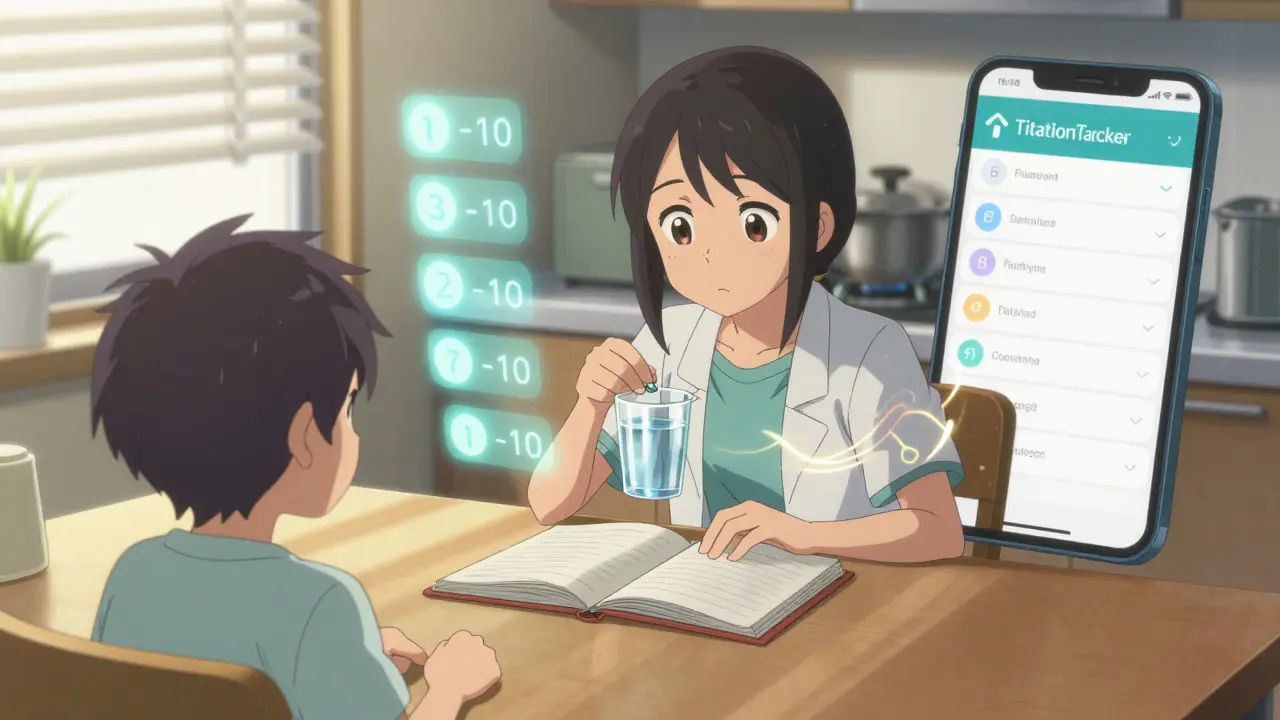
It’s 2026. You don’t have to do this alone. In January 2023, the FDA cleared the first AI-powered titration app: TitrationTracker. It asks you daily: “Rate your energy,” “Any dizziness?” “Sleep okay?” Then it predicts the best next dose. In a 1,200-patient trial, users had 32% fewer side effects than those on standard care.
Even better? Genetic testing is starting to guide starting doses. Right now, 28 medications-including some antidepressants and blood thinners-have FDA-backed genetic guidelines. If you have a certain gene variant, you might need half the usual starting dose. By 2025, that list will grow to 40. By 2030, experts predict 75% of high-risk meds will use genetic titration as standard.
But here’s the catch: these tools aren’t everywhere. In low-income countries, only 22% have formal titration protocols. In the U.S., 87% of prescriptions now include titration instructions-but only 68% of individual doctors follow them consistently. So even with tech, you still need to be your own advocate.
When Titration Isn’t the Answer
Titration isn’t magic. It doesn’t work for everything. If you’re having a heart attack, a seizure, or an allergic reaction-you don’t titrate. You treat fast. Emergency meds like epinephrine or benzodiazepines for status epilepticus are given in full doses immediately. There’s no time to wait.
And sometimes, being too slow can hurt. Dr. Alan F. Schatzberg, former president of the American Psychiatric Association, warns that overly cautious titration can delay relief for someone with severe depression. If you’re suicidal or can’t get out of bed, waiting 8 weeks to feel better isn’t acceptable. In those cases, doctors may start higher-then fine-tune later.
So titration isn’t always the rule. But it’s the default for most chronic conditions. Ask your doctor: “Is this medication one that needs slow titration?” If they say no, ask why. If they don’t know, get a second opinion.
Final Thought: Your Body, Your Dose
Dose titration isn’t about being patient. It’s about being in control. You’re not just taking a pill. You’re learning how your body reacts to it. That’s personal medicine. That’s power.
Don’t let a rushed prescription cost you weeks of feeling awful-or worse, make you quit a drug that could change your life. Start low. Go slow. Track it. Talk about it. And don’t be afraid to push back if your doctor skips the steps. You’re not being difficult. You’re being smart.
What is dose titration and why is it important?
Dose titration is the process of slowly adjusting a medication’s dosage to find the lowest effective amount that controls symptoms while minimizing side effects. It’s important because many drugs have a narrow therapeutic window-meaning the dose that works is very close to the dose that causes harm. Starting low and increasing gradually reduces the risk of serious side effects like anxiety, liver damage, or life-threatening skin reactions.
How long does dose titration usually take?
It varies by drug. Stimulants like Adderall often take 4-6 weeks to fully titrate. Non-stimulants like atomoxetine or antidepressants can take 8-12 weeks. Cancer drugs like venetoclax follow a fixed 5-week schedule. The key is patience: each dose increase needs at least 3-7 days to assess effects. Rushing defeats the purpose.
Which medications require the most careful titration?
Medications with narrow therapeutic indices need the most care. These include lamotrigine (risk of Stevens-Johnson syndrome), venetoclax (tumor lysis syndrome), warfarin (bleeding risk), beta-blockers for heart failure, and ADHD stimulants. These drugs have well-documented titration schedules approved by the FDA. Never skip them.
Can I adjust my dose on my own if I feel side effects?
No. Never change your dose without talking to your doctor. Side effects can be temporary, or they can signal something serious. Stopping or skipping doses can cause withdrawal or rebound symptoms. If you’re having trouble, keep a journal and bring it to your next appointment. Your doctor can adjust safely-or switch you to a different medication.
Is dose titration only for mental health drugs?
No. While it’s common with ADHD and depression meds, it’s also standard for epilepsy drugs, heart failure medications, blood thinners, cancer treatments, and even thyroid hormones like levothyroxine. Any drug where the difference between a helpful dose and a harmful one is small requires titration.
Are there tools to help with titration?
Yes. The FDA-cleared TitrationTracker app uses AI to analyze your daily symptom reports and suggest optimal dose changes. Some clinics now use pharmacogenetic testing to determine your starting dose based on your genes. These tools aren’t everywhere yet, but they’re growing fast-and they make titration safer and faster.

8 Comments
I started on 10mg Adderall because my doctor said 'it's fine'-ended up in the ER with a heart rate of 140. Took me six months to work up the courage to try meds again. This post? Lifesaver. I wish I’d read this before I nearly quit my job over panic attacks. Start low. Always.
For anyone reading this and thinking, 'I don’t have time for this'-you’re not saving time, you’re stealing your own peace. I’ve watched patients go from suicidal to stable, not because of magic pills, but because we gave their bodies space to adapt. Titration isn’t bureaucracy-it’s compassion in action. And yes, it’s worth every slow, frustrating day.
While the general advice here is sound, it’s important to note that individual metabolic rates vary significantly. Genetic testing for CYP2D6 and CYP2C19 variants can inform starting doses for SSRIs and stimulants with >80% accuracy. Not all providers are aware of this-patients should request pharmacogenetic screening if available.
You’re all missing the point. Titration isn’t about safety-it’s about control. The system wants you dependent, so it makes you suffer slowly. If your body can’t handle the full dose, maybe the drug isn’t right for you. Why not just find a better one? The entire titration model is a corporate-designed gatekeeping mechanism disguised as medical wisdom. You’re being trained to accept suffering as normal.
78% of patients need adjustments? That’s not a feature-it’s a flaw. If a drug requires that much trial and error, it shouldn’t be first-line. Why not just develop better drugs instead of teaching people how to survive bad ones? Also, journals? Cute. I’ve seen 300 of them. 90% are inconsistent, poorly kept, and ignored by doctors anyway. It’s performative self-care.
Let me tell you about my cousin. She had severe depression, started on 10mg sertraline, felt like a zombie for three weeks, almost quit. Then her doctor switched her to 25mg every other day for ten days, then 25mg daily. Took six weeks, but by week eight? She was hiking again. She didn’t just survive-she came back to life. That’s what titration does. It doesn’t just reduce side effects. It restores dignity. Don’t rush the comeback.
Actually, the FDA doesn’t 'clear' apps like TitrationTracker-that’s misleading. It’s a 510(k) clearance for Class II devices, not approval. And pharmacogenetic testing? Only applicable to about 12% of the population because most people don’t have actionable variants. Also, levothyroxine titration is usually done every 6 weeks, not 'slowly'-it’s standardized. You’re overstating the complexity. Most docs know what they’re doing.
I just want to say-you’re not alone. I was the guy who quit meds after one bad week because I thought I was broken. Turns out, I just needed to go from 5mg to 10mg over 14 days, not 24 hours. That’s all it took. You’re not weak. You’re not lazy. You’re just learning how your body speaks. And guess what? It’s worth listening to. Keep going. Even if it’s slow. Even if it’s messy. You’re doing better than you think.
Write a comment