MAOI Safe Time Calculator
This tool calculates the minimum safe waiting period before taking decongestants or stimulants after stopping MAOI antidepressants. This is critical because combining MAOIs with decongestants can cause a deadly hypertensive crisis.
One dose of an over-the-counter cold medicine could kill you if you're taking an MAOI antidepressant. This isn't a hypothetical risk. It’s a well-documented, deadly interaction that has caused strokes, brain hemorrhages, and deaths - even when people took just one pill.
What Happens When Ephedrine Meets an MAOI?
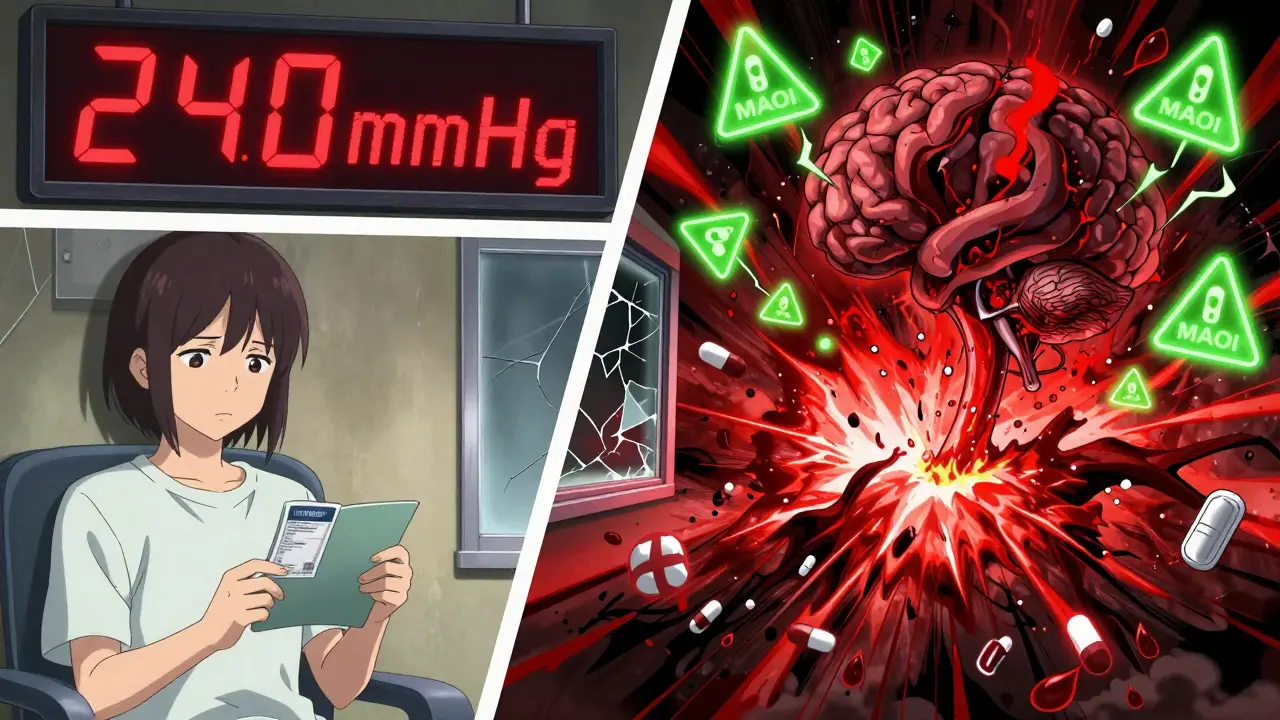
Ephedrine is a stimulant found in many cold and allergy medications. It works by triggering your body to release norepinephrine, a chemical that tightens blood vessels and raises blood pressure. MAO inhibitors - drugs like phenelzine (Nardil), tranylcypromine (Parnate), and isocarboxazid (Marplan) - block the enzyme that normally breaks down norepinephrine, serotonin, and dopamine. When you combine them, your body can't clear the excess norepinephrine. The result? A runaway surge of pressure in your blood vessels.This isn’t just high blood pressure. It’s a hypertensive crisis: systolic pressure shooting past 180 mmHg, sometimes over 240 mmHg, in under an hour. The symptoms hit fast: a splitting headache starting at the back of your skull, blurred or white-out vision, chest tightness, nausea, vomiting, sweating, and a racing or irregular heartbeat. In severe cases, it triggers bleeding in the brain - subarachnoid hemorrhage - which can be fatal within minutes.
Why This Interaction Is So Deadly
The danger isn’t just from ephedrine itself. It’s how it works with MAOIs. Normally, your liver and gut break down most of the tyramine you eat - from aged cheese, cured meats, or fermented foods - and they also clear excess norepinephrine. MAOIs shut down that cleanup system. Ephedrine doesn’t just raise norepinephrine levels - it forces your nerve cells to dump even more of it. The combination is like turning on a firehose while blocking the drain.Even small amounts of ephedrine can trigger this. A single 25 mg dose - the amount in many OTC decongestants - is enough. That’s less than half the dose in some cold pills. In 1965, a woman took one 25 mg tablet of ephedrine while on nialamide (an MAOI). Within 30 minutes, she had a brain hemorrhage and died. That case was the first to prove the link. Since then, dozens more have followed.
In 2018, a 32-year-old man on phenelzine took a 25 mg ephedrine pill for a stuffy nose. His blood pressure hit 240 mmHg. He suffered a brain bleed. He survived, but barely. His story isn’t rare. Between 2015 and 2020, the FDA recorded 37 cases of this interaction - nine of them fatal. Reddit forums are filled with posts from people who thought they were safe because they "only took one pill." One user wrote: "I felt like my head was going to explode. My vision went white. I thought I was dying."
It’s Not Just Ephedrine - Other Decongestants Are Just as Dangerous
Many people don’t realize that pseudoephedrine, phenylephrine, and phenylpropanolamine - all common in cold medicines - act the same way as ephedrine. They’re all sympathomimetics. That means they all trigger norepinephrine release. If you’re on an MAOI, none of them are safe.Even some weight loss supplements, energy pills, and nasal sprays contain these ingredients. Labels don’t always make it obvious. "Natural" stimulants like bitter orange extract (synephrine) can be just as risky. If it’s meant to "open up your sinuses," "boost energy," or "suppress appetite," it’s probably dangerous with an MAOI.
How Long Does the Risk Last After Stopping an MAOI?
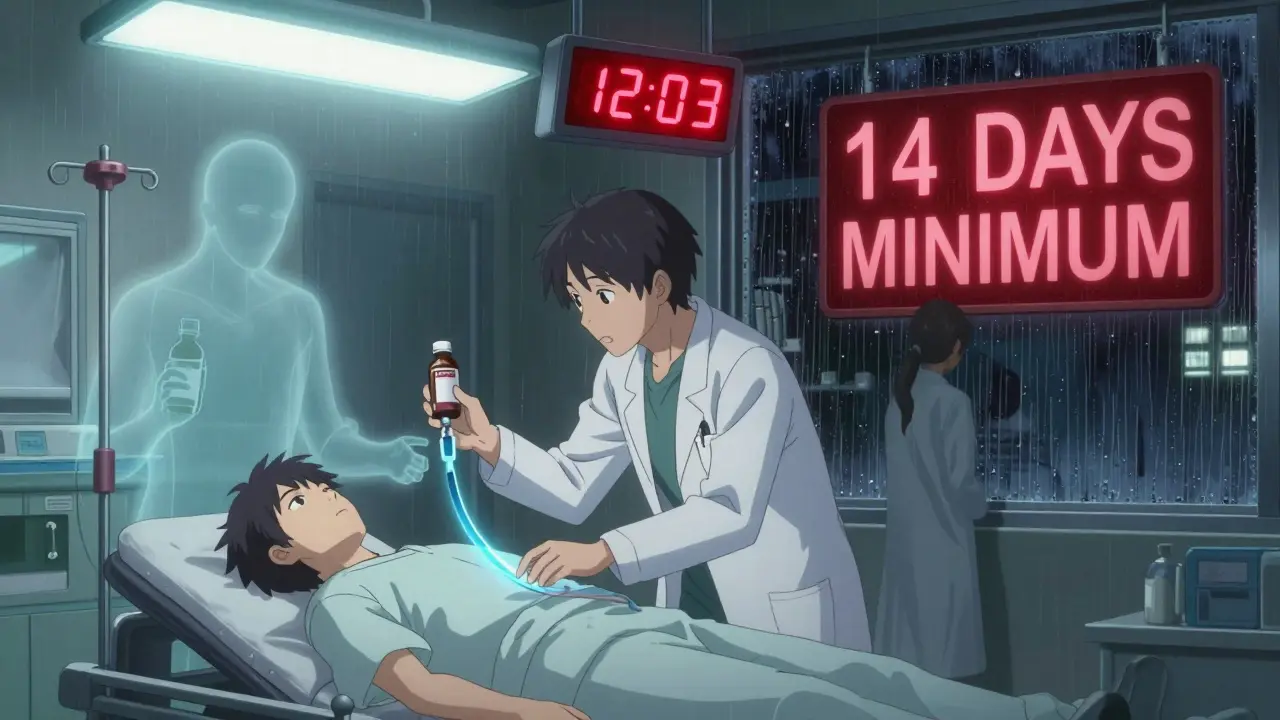
This is where people get tripped up. You can’t just stop your MAOI and take ephedrine the next day. Monoamine oxidase enzymes take weeks to regenerate. For irreversible MAOIs like Nardil or Parnate, the risk lasts at least 14 days after your last dose - and in some cases, up to three weeks. Even if you feel fine, your body is still vulnerable.Reversible MAOIs like moclobemide are safer because they wear off in 24 to 48 hours. But they’re rarely prescribed in the U.S. Most people on MAOIs are on the irreversible kind. That means the 14-day rule isn’t optional - it’s life-or-death.
What Happens in an Emergency?
If someone on an MAOI develops a hypertensive crisis, time is everything. Standard blood pressure meds like nifedipine (a calcium channel blocker) are dangerous here. They can cause a sudden, dangerous drop in pressure, leading to stroke or heart attack.The only safe emergency treatment is intravenous phentolamine - a drug that blocks norepinephrine receptors. It’s given slowly in a hospital setting. There’s no home remedy. No cherry juice. No cold compresses. If you suspect this interaction, call 911 immediately. Tell them: "The patient is on an MAOI and took a decongestant. They’re having a hypertensive crisis."
Who’s at Risk - And Why It Keeps Happening
MAOIs make up less than 1% of antidepressant prescriptions today. That’s because SSRIs came along and were easier to use. But for some people - especially those with treatment-resistant depression, atypical depression, or panic disorder - MAOIs are the only thing that works. Around 500,000 Americans still take them.Here’s the problem: most doctors who prescribe MAOIs are psychiatrists. But most people who accidentally take ephedrine get it from their primary care doctor, pharmacist, or just buy it over the counter. A 2021 study found that 22% of patients on MAOIs were still prescribed or bought a contraindicated drug within 30 days of starting treatment. Often, it was because the prescribing doctor didn’t know the risk.
Patients aren’t always warned clearly either. Many think "I’m on antidepressants, so I just avoid alcohol and cheese." They don’t realize their sinus medicine is the real danger.
How to Stay Safe
If you’re on an MAOI, here’s what you must do:- Never take any cold, flu, allergy, or weight-loss medication without checking with your psychiatrist or pharmacist.
- Keep a printed list of all contraindicated drugs in your wallet or phone. Include ephedrine, pseudoephedrine, phenylephrine, phenylpropanolamine, and synephrine.
- Carry an MAOI alert card. The Mayo Clinic recommends this - 87% of patients who used one avoided dangerous interactions.
- Wait at least 14 days after your last MAOI dose before using any stimulant, decongestant, or energy booster.
- If you’re prescribed a new medication - even for a toothache or headache - ask: "Is this safe with MAOIs?"
There’s no gray area. This isn’t a "be careful" situation. It’s a "never do this" rule.
What’s Changing? New MAOIs and Better Safety Tools
In 2023, the FDA approved a new reversible MAOI called befloxatone. Early data shows it has a 90% lower risk of causing hypertensive crisis because it breaks down in just six hours. That’s promising. But it’s not yet widely available.Researchers are also testing wearable blood pressure patches that could warn users of sudden spikes - potentially giving people minutes to act before a crisis hits. These tools might help in the future. But right now, the only proven protection is avoidance.
Some experts argue MAOIs should be pulled from the market entirely. They point to 127 deaths from MAOI-drug interactions since 2000. Others say they’re irreplaceable for certain patients. The truth? They’re a last-resort tool. And like any powerful tool, they demand respect.
Final Warning
If you’re on an MAOI, you’re not just managing depression. You’re managing a hidden time bomb. One pill - from a friend, a pharmacy, a website - can be enough to kill you. There’s no second chance. No recovery from a brain bleed if you wait too long.Don’t assume you know what’s safe. Don’t trust labels. Don’t rely on memory. If it’s not on your approved list - don’t take it. Your life depends on it.
Can I take ephedrine if I stopped my MAOI a week ago?
No. For irreversible MAOIs like Nardil or Parnate, you must wait at least 14 days after your last dose. The enzyme that breaks down norepinephrine takes that long to regenerate. Taking ephedrine too soon can still trigger a hypertensive crisis, even if you feel fine.
Are all decongestants dangerous with MAOIs?
Yes. Ephedrine, pseudoephedrine, phenylephrine, and phenylpropanolamine all carry the same risk. Even "natural" decongestants like bitter orange extract (synephrine) can trigger a crisis. Never assume a product is safe just because it’s labeled "natural" or "herbal."
Is it safe to use nasal sprays with MAOIs?
Only if they contain no sympathomimetic amines. Most OTC nasal sprays - even those labeled "non-drowsy" - contain pseudoephedrine or phenylephrine. Always check the active ingredients. Saline sprays are safe. Anything else needs approval from your psychiatrist.
Can I drink alcohol while on an MAOI?
Alcohol itself isn’t directly linked to hypertensive crisis with MAOIs, but it can worsen side effects like dizziness and low blood pressure. More importantly, many mixed drinks contain tyramine-rich ingredients like aged cheese, cured meats, or fermented products. The safest approach is to avoid alcohol entirely while on an MAOI.
What should I do if I accidentally took ephedrine while on an MAOI?
Call 911 or go to the nearest emergency room immediately. Do not wait for symptoms. Even if you feel fine, your blood pressure could spike suddenly. Tell medical staff you took ephedrine and are on an MAOI. Do not take any blood pressure medication on your own - especially nifedipine - as it can cause dangerous drops in pressure.
Are newer MAOIs like Emsam safer?
The transdermal patch form of selegiline (Emsam) carries a lower risk, especially at the lowest dose (6 mg/24hr), because it primarily inhibits MAO-B, not MAO-A. But at higher doses, it still blocks MAO-A and can cause hypertensive crisis. You should still avoid ephedrine and other sympathomimetics. Never assume a patch is completely safe.
Can I take pain relievers like ibuprofen or acetaminophen with MAOIs?
Yes. Ibuprofen, acetaminophen, and naproxen are generally safe with MAOIs. But avoid combination products that include decongestants - like Tylenol Sinus or Advil Cold & Sinus. Always read the full ingredient list. If it says "sinus," "cold," or "decongestant," it’s likely unsafe.

15 Comments
Just read this and my hands are shaking. I’m on phenelzine and took a Sudafed last winter because I thought "it’s just one pill". I didn’t know. No one told me. I felt like my skull was going to split open. I thought I was having a stroke. I didn’t go to the hospital. I just lay on the floor until it passed. That was a close one.
Why isn’t this on every OTC box? Why isn’t the pharmacy screaming at you? This isn’t a warning-it’s a death sentence waiting to happen.
OMG I KNEW THIS WAS A THING BUT NO ONE TAKES IT SERIOUSLY. I HAVE A FRIEND WHO DIED FROM THIS. SHE TOOK A COLD TABLET. ONE. TABLET. AND HER BRAIN BLEW OUT LIKE A WATER BALLOON. SHE WAS 28. HER KIDS ARE 3 AND 5 NOW. THIS ISN’T A SIDE EFFECT. THIS IS A MURDEROUS OVERSIGHT.
WHY AREN’T PHARMACISTS REQUIRED TO SHOW A VIDEO BEFORE CHECKOUT? WHY AREN’T DOCTORS SENT TO JAIL FOR NOT WARNIN’ PEOPLE? I’M SO ANGRY.
The pharmacovigilance infrastructure in the US is catastrophically broken. The pharmacokinetic profile of irreversible MAOIs necessitates a 14-day washout period due to covalent enzyme inhibition, yet the OTC decongestant supply chain remains unregulated with respect to contraindicated sympathomimetic amines. The cognitive dissonance between clinical guidelines and consumer accessibility is a systemic failure of risk communication.
Furthermore, the normalization of polypharmacy in primary care-where PCPs prescribe antibiotics, NSAIDs, and decongestants without psychiatric consultation-creates a perfect storm for iatrogenic hypertensive crises. This is not negligence. This is institutionalized lethal ignorance.
😭 I just told my mom she can’t take her NyQuil anymore. She’s on Nardil and thought "it’s just for sleep." She cried. I cried. We both felt so stupid. I made a printable card with all the banned meds and laminated it. I keep one in my wallet and one in her purse. If you’re on an MAOI, DO THIS. It’s not dramatic. It’s survival.
Also-saline spray is your BFF. 🙏
People think this is about "being careful." It’s not. It’s about society failing people who are already broken. MAOIs are the last resort for people with depression so severe that SSRIs didn’t just fail-they made it worse. And then we hand them a bottle of pseudoephedrine like it’s candy. We don’t warn them. We don’t train pharmacists. We don’t even mandate warning labels.
This isn’t an accident. It’s neglect dressed up as convenience. And the bodies pile up quietly because no one wants to admit we’re killing our most vulnerable patients with bureaucracy.
It is a matter of grave concern that such a well-documented pharmacological interaction remains inadequately communicated to the general public. In the United Kingdom, the Medicines and Healthcare products Regulatory Agency (MHRA) has issued formal guidance since 1992, yet compliance remains inconsistent. The absence of mandatory pharmacist counseling, coupled with the proliferation of unregulated dietary supplements containing synephrine, constitutes a public health failure of the highest order.
One must ask: if the risk is known, why is the mitigation so passive?
It’s strange how we treat some dangers like myths and others like facts. We know that one pill can kill, yet we treat it like a footnote. We don’t put it on the same level as opioids or benzodiazepines. But the math is the same: one dose, irreversible damage.
Maybe the problem isn’t the drug. Maybe it’s that we’ve stopped seeing people as people who need protection, and started seeing them as users who should know better. But not everyone reads labels. Not everyone has a psychiatrist on speed dial. Not everyone knows what MAO-A inhibition even means.
We need systems that protect people from themselves, not just warnings that assume they’re smart enough to survive.
I took a DayQuil last year and didn’t feel anything so I thought I was fine. Then I read this and realized I got lucky. Like, stupidly lucky. I’m not touching anything with pseudoephedrine ever again. Even if I have to breathe through my mouth for a week. Worth it.
Also-why does every cold medicine say "non-drowsy" like that’s a good thing? I just want to sleep.
My dad’s on an MAOI. He’s 72. He takes his meds like clockwork. But last winter he bought a nasal spray because his nose was stuffed. I found it in his bathroom. He didn’t know. He thought "it’s just a spray." I had to sit him down and explain it like he was a kid. He cried. I cried. We made a list. Now I check every medicine he buys. It’s exhausting. But I’d rather be exhausted than bury him.
INDIA HAS NO IDEA ABOUT THIS. MY COUSIN TOOK PHENYLEPHRINE AND HAD A STROKE. SHE WAS 24. NO ONE TOLD HER. THE PHARMACIST JUST GAVE HER THE MEDICINE AND SAID "IT’S FOR COLD." I’M SO MAD. WHY IS THIS NOT ON TV? WHY ISN’T THIS ON EVERY MEDICINE BOTTLE IN ENGLISH AND HINDI? WE ARE DYING BECAUSE NO ONE CARES.
MAOIs are high-risk. That’s why they’re last-line. If you’re on one, you’re already in the danger zone. Don’t add more risk. Just don’t. Simple.
Stop pretending you’re special. You’re not. One pill kills. End of story.
So let me get this straight. I can take a whole bottle of Adderall, but one Sudafed and I’m a corpse? 🤔
Who designed this system? A sadist with a PhD? Because this is the most ironic thing I’ve ever heard. You can’t have a cold, but you can have a chemical warzone in your brain? Thanks, medicine.
The real tragedy isn’t the interaction. It’s that we’ve made depression treatment a game of Russian roulette. We have drugs that work for people who’ve tried everything else, but we treat them like nuclear waste instead of life-saving tools. We don’t build support systems. We don’t train the frontline providers. We just hand out pills and hope they read the fine print.
What if the real problem isn’t the drug? What if it’s that we refuse to accept that some people need more than a quick fix? That they need a whole system behind them? We don’t do that. We just tell them to be careful.
I’ve been on Parnate for 8 years. I’ve never taken anything risky. I carry my list. I show it to every doctor. I even have a sticker on my phone case that says "MAOI - DO NOT PRESCRIBE DECONGESTANTS."
But here’s the thing-I’m still scared. Every time I get a cold, I feel like I’m walking into a minefield. And no one else gets it. Not my family. Not my coworkers. Not even my therapist. I have to be the expert on my own survival.
This post? This is the first time I’ve felt seen. Thank you.
I’m a pharmacist. I’ve seen this happen. I’ve watched people walk out with Sudafed and not realize what they’re holding. I’ve tried to warn them. Sometimes they get mad. Sometimes they don’t listen. I don’t have the authority to refuse to fill it. I just have to say "you might want to check with your doctor."
It’s not enough. But I keep trying. Because someone has to.
Write a comment