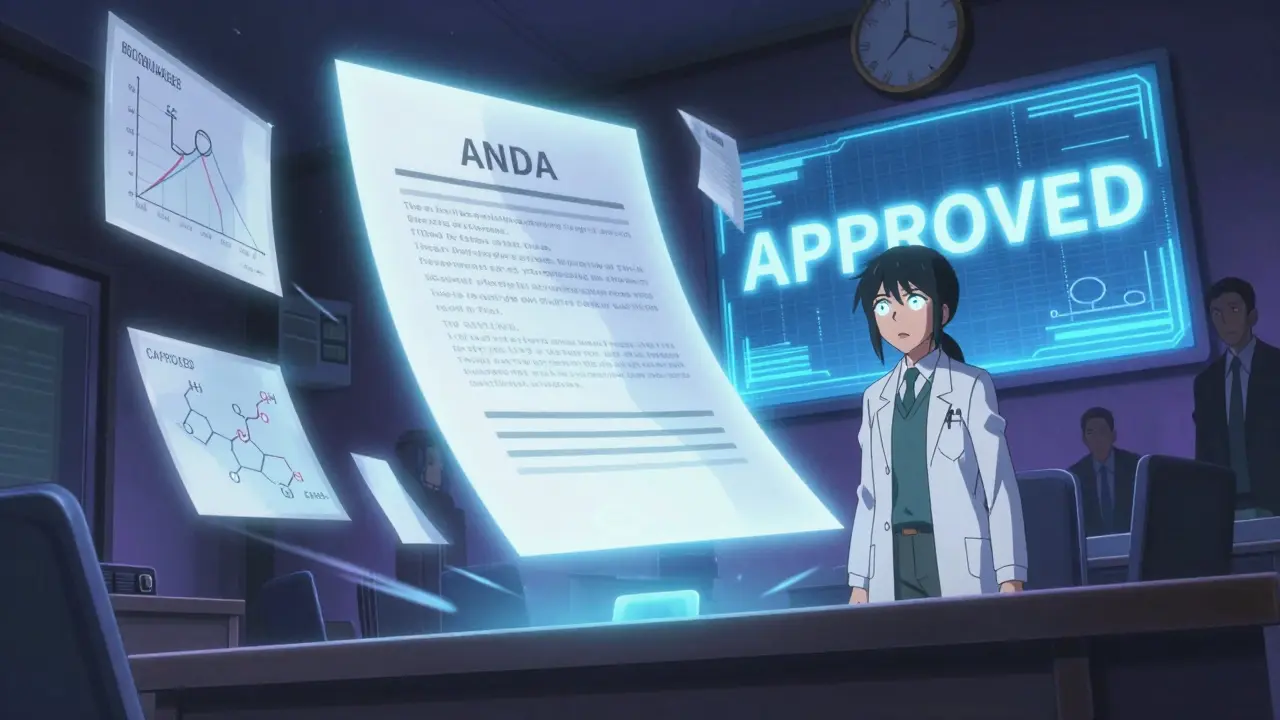
When you pick up a generic pill at your local pharmacy, it’s easy to assume it’s just a cheaper version of the brand-name drug. But behind that simple label is a complex, tightly regulated journey that starts with a paperwork-heavy application called an ANDA and ends with a bottle on the shelf. This isn’t just about saving money - it’s about how the U.S. healthcare system makes affordable medicine possible for millions.
What Is an ANDA, Really?
An Abbreviated New Drug Application (a regulatory submission to the FDA that allows generic drug manufacturers to prove their product is identical in quality, safety, and effectiveness to a brand-name drug) is the key that unlocks access to the U.S. market for generic medications. It’s called "abbreviated" because it doesn’t require the same massive clinical trials that brand-name drugs go through. Instead, generic makers rely on the FDA’s existing data from the original drug - known as the Reference Listed Drug (the approved brand-name drug that serves as the benchmark for generic comparison) - and focus on proving one thing: bioequivalence.
Bioequivalence means your body absorbs the generic drug at the same rate and to the same extent as the brand. That’s it. No new safety studies. No repeat of Phase III clinical trials. Just precise chemistry, consistent manufacturing, and solid evidence that the generic performs like the original. This streamlined approach, created by the Hatch-Waxman Act of 1984, cut drug development time from 10-15 years down to 3-5 years and slashed costs from over $2 billion per drug to just $2-5 million.
The ANDA Submission Process: Paperwork That Saves Lives
Filing an ANDA isn’t a form you fill out in an afternoon. It’s a 500+ page dossier packed with technical details. Manufacturers must prove:
- The active ingredient matches the brand-name drug exactly - same chemical structure, same purity.
- The dosage form (pill, liquid, injection) and strength are identical.
- The route of administration (oral, topical, etc.) is the same.
- The product meets strict quality standards - no contamination, no variation in potency.
- The labeling is nearly identical to the brand’s, with only minor exceptions allowed.
All of this must be submitted electronically through the FDA’s Electronic Submissions Gateway (the secure online system used by drug companies to file regulatory documents with the FDA). The FDA’s Center for Drug Evaluation and Research reviews every submission. Under the Generic Drug User Fee Amendments (GDUFA) (a funding and performance system that sets timelines for FDA review of generic applications), the average review time is 30 months. But if your drug addresses a shortage or is the first generic version available, you can get priority review - sometimes cutting that time in half.
Here’s the catch: about 40% of first-time ANDAs get rejected. The FDA issues a "Complete Response Letter" - basically saying, "You missed something." Common mistakes? Incomplete manufacturing data, flawed bioequivalence studies, or labeling that doesn’t match the brand exactly. Experts say pre-ANDA meetings with the FDA can reduce these errors by 30%. That’s why smart companies talk to regulators early, even before they start testing.
Patents, Exclusivity, and the Race to Be First
Generic manufacturers don’t just wait for patents to expire. They watch them like a clock. When a brand-name drug’s patent is about to end, companies scramble to be the first to file an ANDA with a Paragraph IV certification (a legal challenge to a patent, claiming it’s invalid or won’t be infringed). If they win, they get 180 days of exclusive rights to sell the generic - no competition. That’s a huge financial incentive.
In 2022, six different companies filed ANDAs for the same generic version of Eliquis (apixaban), a blood thinner with $10 billion in annual sales. Whoever got approved first would control the market for half a year. That’s the kind of pressure that drives innovation - and legal battles. Some companies even delay approval by challenging patents in court, stretching out the timeline. The FDA tries to balance competition with fairness, but the system is still a minefield.
Approval Isn’t the Finish Line - It’s Just the Starting Line
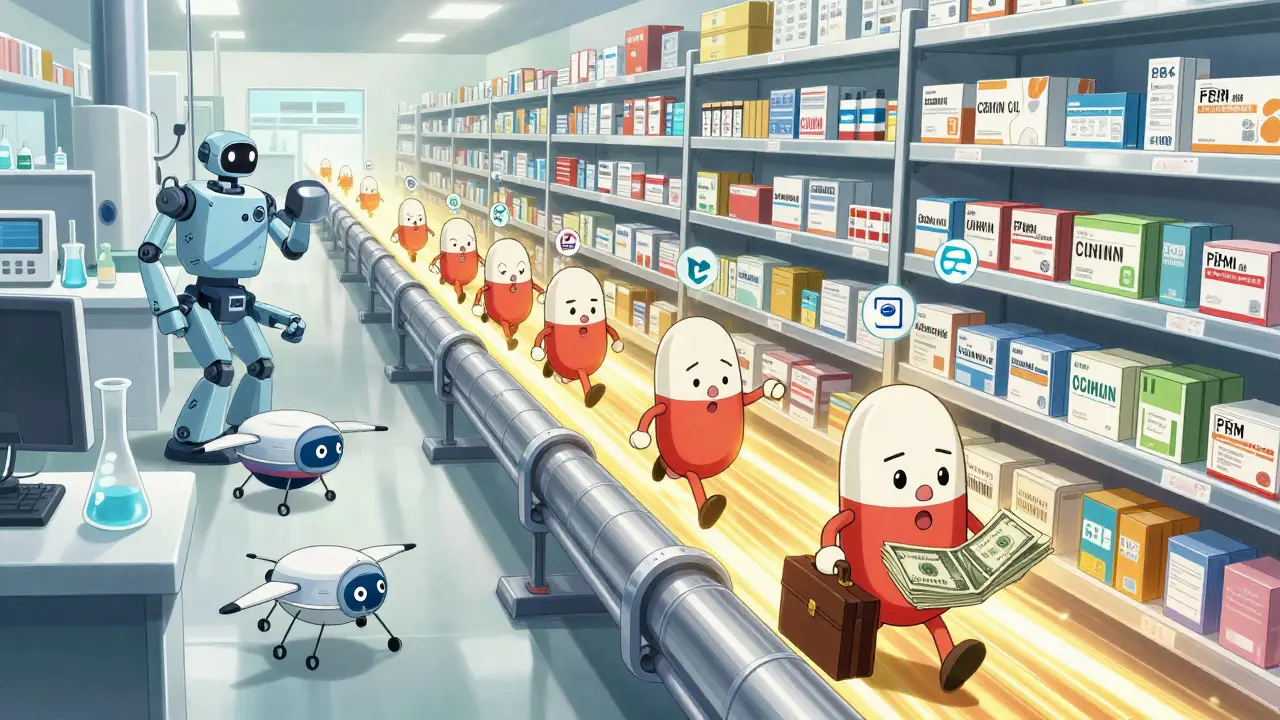
Getting FDA approval feels like a win. But for most generic companies, it’s only half the battle. According to a 2022 survey of 45 manufacturers, 78% said the real challenge came after approval. Why? Because the FDA doesn’t decide who sells your drug. Pharmacies, insurers, and pharmacy benefit managers (PBMs) do.
Pharmacy Benefit Managers (Third-party administrators that negotiate drug prices and manage formularies for insurers and employers) like Express Scripts, OptumRx, and CVS Health control which drugs get placed on insurance formularies. If your generic isn’t on the preferred tier - the top tier where patients pay the least - it won’t sell. And getting there? That means offering deep discounts - often 20-30% below your initial price. One sourcing manager on Reddit said, "If you don’t cut your price hard enough, your generic might as well not exist."
Take Teva’s generic EpiPen. They got FDA approval in August 2019. But it didn’t hit pharmacy shelves until March 2020. Why? Because they had to negotiate with PBMs, adjust pricing, and get on formularies. That six-month delay is typical.
The Journey to the Pharmacy Shelf
Once a generic is approved and contracted, it still has to get to your local pharmacy. Here’s how it breaks down:
- Manufacturing Scale-Up: Moving from small test batches to full production takes 60-120 days. Quality control can’t be compromised - one bad batch means recalls.
- Payer and PBM Negotiations: This takes 30-90 days. The drug must be placed on a preferred tier to be widely dispensed.
- Distribution: Most generics go through wholesalers like AmerisourceBergen, McKesson, or Cardinal Health. Integrating a new product into their systems takes 15-30 days.
- Pharmacy System Updates: Pharmacies need to update their software to recognize the new drug code, train staff, and stock shelves. This usually takes 7-14 days.
The average time from FDA approval to first sale? 112 days. But it varies. A generic for high blood pressure? Around 87 days. A complex inhaler or topical cream? More like 145 days. Complex drugs have more regulatory hurdles, more manufacturing challenges, and more resistance from PBMs.
Why This Matters - And Why It’s Growing
In 2023, over 90% of all prescriptions filled in the U.S. were for generic drugs. They save patients and insurers $313 billion every year. The generic market hit $124.7 billion in 2022, and by 2028, experts predict generics will make up 93% of prescriptions.
The FDA is pushing harder than ever to approve more generics - especially complex ones like nasal sprays and injectables. In 2022 alone, they approved 892 generic drugs, a 12% jump from the year before. And with new rules like the Data Standards for Drug Applications (a 2024 requirement for standardized electronic submissions to improve FDA review efficiency), the process is slowly becoming faster and more predictable.
But the pressure is real. Generic drug prices have dropped 4.7% every year since 2015. Manufacturers are squeezed between shrinking margins and rising costs. Some are turning to AI to predict bioequivalence results or automate chemistry testing - hoping to cut development time by 25-30% in the next five years.
Still, the system works. Every time you choose a generic, you’re not just saving money. You’re participating in a massive, tightly regulated system that brings life-saving medicine to millions - from a paperwork-heavy application in a lab, all the way to your pharmacy counter.
What’s the difference between an ANDA and an NDA?
An NDA (New Drug Application) is for brand-name drugs and requires full clinical trials, animal studies, and safety data - costing over $2 billion and taking 10-15 years. An ANDA (Abbreviated New Drug Application) is for generics and skips those steps. Instead, it only proves bioequivalence to an already-approved drug, cutting costs to $2-5 million and time to 3-5 years.
Why do some generic drugs take longer to reach pharmacies after FDA approval?
It’s not the FDA that delays it - it’s the business side. Getting on insurance formularies, negotiating with pharmacy benefit managers, scaling up production, and integrating into pharmacy systems can take 3-6 months. Complex drugs like inhalers or creams take even longer because they’re harder to manufacture and get approved.
Can a generic drug be different from the brand-name version?
Legally, no - not in how it works. Generics must have the same active ingredient, strength, dosage form, and route of administration. They can differ in inactive ingredients like fillers or dyes, but those don’t affect how the drug works in your body. The FDA requires proof that the generic performs the same way as the brand.
Are generic drugs as safe as brand-name drugs?
Yes. The FDA holds generics to the same quality standards as brand-name drugs. They’re made in the same type of facilities, tested for purity and potency, and monitored for safety. Over 90% of prescriptions in the U.S. are generics - and millions of people use them safely every day.
Why are some generic drugs cheaper than others?
It’s about competition. If multiple companies make the same generic, prices drop fast. But if only one company has approval (or if there’s a patent barrier), prices stay higher. Also, complex generics - like patches or injections - cost more to make, so they’re not always the cheapest.
What Comes Next?
The future of generics isn’t just about more drugs - it’s about smarter, faster approval. The FDA’s push for standardized electronic submissions and AI-assisted development could shrink approval times even further. But as drug prices keep falling, manufacturers will need to innovate not just in chemistry, but in how they navigate the payer system. The real challenge now isn’t getting approved - it’s getting paid for.

10 Comments
Generic drugs are literally lifesavers. No one talks about how much money they save families every single month. I’ve been on generics for years and never had an issue. The system works.
In India we see this every day. The same pills made in the same factories but labeled differently. The FDA process is strict but fair. People need to stop fearing generics. They are not second class.
Why do we even let companies delay generics with patent games? It's a scam. The system is rigged for big pharma and we're the ones paying. Stop pretending this is about health and not profit.
Let’s be real - the ANDA process is less a scientific milestone and more a bureaucratic ballet. Imagine filing 500 pages of specs just to prove you can make a pill that doesn’t explode in your stomach. The FDA’s review is like a medieval trial with a spreadsheet instead of a dragon.
I work in supply chain for a regional wholesaler. What most people don’t realize is that the delay after FDA approval isn’t about manufacturing - it’s the pharmacy software updates. One wrong NDC code and the whole system rejects the batch. It’s not sexy but it’s critical.
It’s fascinating how much of this hinges on PBM negotiations. I mean, we’re talking about a system where the FDA approves a drug, but a private corporation decides whether it’s worth dispensing. That’s not healthcare - that’s corporate arbitrage.
I’ve seen firsthand how generics change lives. My mom couldn’t afford her blood pressure med until the generic hit. Now she’s stable. The system isn’t perfect, but it’s one of the few places where policy actually works for people. Kudos to the FDA and the manufacturers who play by the rules.
The entire ANDA framework is a regulatory fiction. Bioequivalence is a proxy metric at best. We’re not testing pharmacokinetics in diverse populations. We’re not accounting for gut microbiome variance. The data is cherry-picked. This isn’t science - it’s regulatory theater designed to keep prices low for the benefit of insurers and PBMs. The real cost? Patient safety.
The real innovation isn’t in the pills - it’s in the data. Standardized electronic submissions are going to cut review times dramatically. I’ve been in this industry 20 years. The shift from paper to digital is the quiet revolution that’ll make generics faster and more reliable than ever.
I appreciate the thorough breakdown. It’s easy to take generics for granted, but the precision and oversight involved are remarkable. This is regulatory excellence in action - not perfect, but functional and deeply necessary.
Write a comment