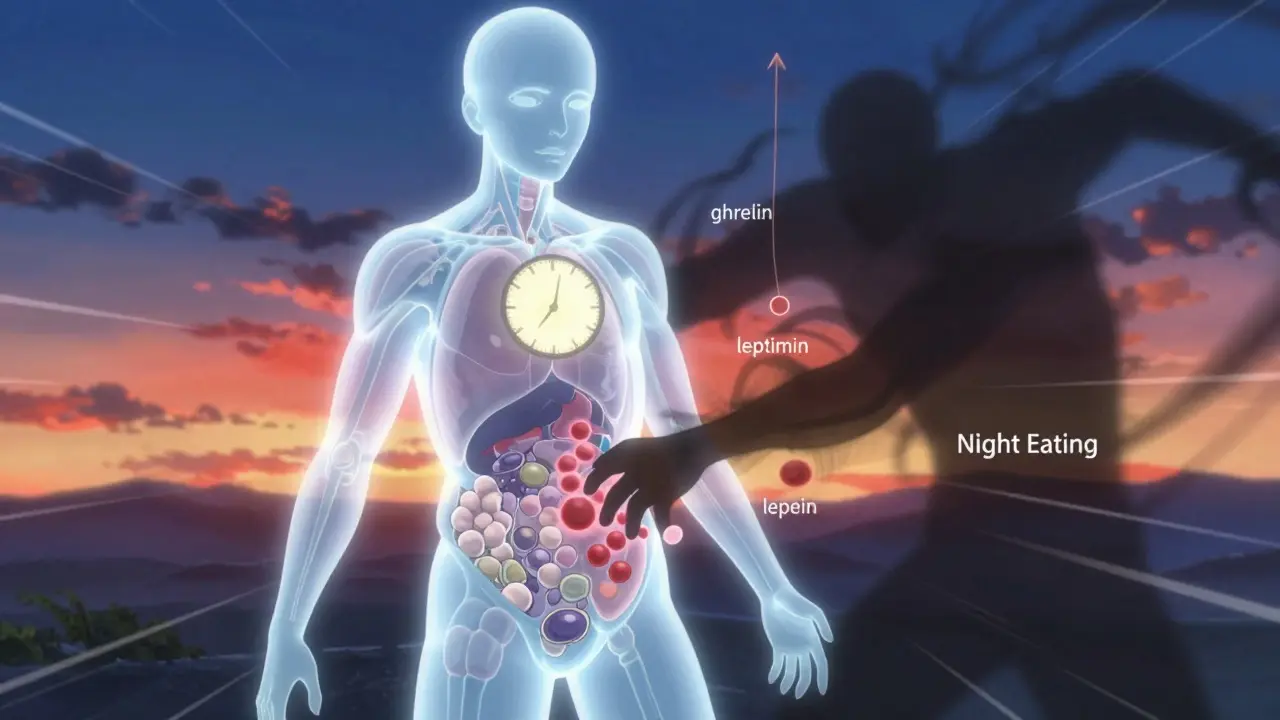
Most people think weight gain is just about eating too much or not moving enough. But what if the real issue isn’t your plate - it’s your sleep schedule? If you’ve tried cutting calories, counting macros, or hitting the gym hard and still can’t lose weight, your body’s internal clock might be the hidden culprit. Circadian rhythm - your body’s 24-hour biological timer - doesn’t just tell you when to sleep. It controls when your body burns calories, stores fat, and even when you feel hungry. When this clock gets out of sync, your metabolism slows down, cravings spike, and fat sticks around - no matter how hard you try.
Why Your Body Burns Fewer Calories at Night
Your body doesn’t run on the same energy settings all day. In fact, research shows that during the biological night - even if you’re awake - your body naturally burns fewer calories. A 2014 study in PNAS found that people working night shifts burned about 3% less energy per day than those on a normal schedule, even when eating the same meals. That’s roughly 55 fewer calories burned each day. Sounds small? Over a year, that adds up to nearly 20,000 extra calories - the equivalent of gaining 5.7 kg (12.5 lbs) just from your body’s natural rhythm, not from eating more. But here’s the twist: when you’re sleep-deprived, your body actually burns slightly more energy - about 100 extra calories a day. Sounds good, right? Not quite. At the same time, you end up eating over 250 extra calories daily. Why? Because lack of sleep messes with two key hormones: ghrelin, which makes you hungry, and leptin, which tells you you’re full. When you’re tired, ghrelin spikes and leptin drops. Your brain starts screaming for quick energy - carbs, sugar, snacks. A University of Chicago study showed that after just four nights of 4 hours of sleep, people’s cravings for high-carb foods jumped by 33%. Their brains lit up like they were looking at a prize when they saw pictures of cookies and chips.When You Eat Matters More Than What You Eat
It’s not just about how much you eat - it’s when. Your liver, pancreas, and fat cells all have their own internal clocks that sync with your brain’s master clock. When you eat late at night, those organs are still in “sleep mode.” They’re not ready to process food efficiently. A 2014 study found that eating dinner during a night shift reduced the thermic effect of food - how many calories your body burns digesting it - by 17%. That means your body wastes more of the food you eat as fat instead of fuel. This isn’t just theory. People who eat their main meals after 8 p.m. are 25% more likely to be overweight than those who eat earlier, even if their total calories are the same. A 2023 trial in Nature Metabolism proved it: when people aligned their meals with their natural circadian rhythm - eating only during daylight hours - they lost 24% more weight over six months than people on the same calorie diet but eating at random times. The timing alone made the difference.Shift Workers and the Hidden Weight Trap
About 20% of the global workforce works nights, rotating shifts, or irregular hours. For them, weight gain isn’t a coincidence - it’s almost inevitable. A 2013 study from Brigham and Women’s Hospital tracked shift workers for two years. Those on night shifts gained 2.5 kg more than day workers - even though they ate the same amount. Why? Their bodies were constantly out of sync. Their insulin sensitivity dropped by 20-25% during nighttime hours, meaning their bodies couldn’t handle sugar properly. Glucose stayed in the blood longer, got stored as fat, and hunger kept coming back. On Reddit’s r/ShiftWork forum, 78% of over 1,200 respondents said they gained weight after starting night shifts. One nurse with 12 years of night work said: “I gained 35 pounds in my first year. I wasn’t eating more - I was just hungry at 3 a.m. and my body demanded snacks.” That’s not weakness. That’s biology. Your brain thinks it’s daytime when it’s dark outside, and it’s screaming for fuel.
Time-Restricted Eating: The Simple Fix
You don’t need to starve yourself or buy expensive supplements. The most effective, science-backed fix is time-restricted eating (TRE): eating all your meals within a 10-hour window each day - and keeping that window during daylight hours. A 2019 study from the Salk Institute found that overweight adults who ate only between 8 a.m. and 6 p.m. lost 3-5% of their body weight in 12 weeks - without changing what they ate. They just stopped eating after 6 p.m. Another study of 450 users on the Zero app found those who stuck to a 10-hour eating window lost 3.2 kg more than those who didn’t. The best part? Hunger drops off after 7-10 days. Your body adapts. But timing matters. Morning people (early risers) do better with an 8 a.m. to 6 p.m. window. Night owls? Try 10 a.m. to 8 p.m. A 2020 trial in Obesity showed morning types lost 23% more weight with an early window than with a late one. Your chronotype - your natural sleep-wake preference - determines what works best for you.Why Most Diets Fail Without Sleep Alignment
Traditional weight loss plans ignore timing. They tell you to eat less and move more. But if you’re sleeping at 3 a.m. and eating at 1 a.m., your body isn’t listening. It’s stuck in survival mode. Even if you’re eating clean, if your meals are scattered across the night and early morning, your metabolism stays confused. Your insulin stays high. Fat storage stays active. Your energy stays low. The Endocrine Society’s 2019 review found that circadian disruption accounts for 5-10% of obesity risk in shift workers - independent of diet and exercise. That’s not small. That’s a major driver. And it’s why people who follow strict diets but keep poor sleep schedules often hit walls. Their bodies are fighting against their own biology.
What You Can Do Today
You don’t need to quit your job or sleep 10 hours a night. Start small:- Try eating within a 10-hour window - even if it’s 10 a.m. to 8 p.m.
- Avoid food after 8 p.m. if you can. Even one late snack disrupts your liver’s rhythm.
- Get morning sunlight within 30 minutes of waking. It resets your internal clock faster than any supplement.
- Keep your sleep and wake times within 30 minutes of each other, even on weekends.
- If you work nights, eat your largest meal before your shift, not after. Avoid heavy meals between midnight and 6 a.m.
The Bigger Picture: Circadian Health Is the Next Frontier
The global market for circadian health tools - from smart lights to sleep trackers - is expected to hit $2.8 billion by 2030. Kaiser Permanente’s pilot program for night shift workers cut weight gain by 42% just by adjusting light exposure and meal timing. The FDA now requires drug trials for obesity to consider timing of treatment. Fitbit’s 2024 update even includes a circadian alignment score that predicts 18% of weight change. This isn’t a trend. It’s science. Your body wasn’t built for 24/7 life. It was built for sunlight, rest, and rhythm. When you align your eating and sleeping with that rhythm, your metabolism works with you - not against you.Weight loss isn’t always about willpower. Sometimes, it’s about timing. And the right timing? It starts with sleep.
Can poor sleep cause weight gain even if I eat healthy?
Yes. Even if you eat healthy foods, sleeping poorly or at the wrong times disrupts your metabolism. Your body burns fewer calories at night, your hunger hormones go haywire, and your insulin sensitivity drops. This leads to fat storage even with a clean diet. Studies show people who sleep less than 6 hours a night consume over 250 extra calories daily - mostly from carbs and snacks - without realizing it.
Does working night shifts make you gain weight?
Yes, and it’s not just because you’re tired. Night shift work misaligns your internal clock with your eating and sleeping schedule. This lowers your daily energy expenditure by about 3% and impairs how your body processes sugar and fat. Research shows shift workers gain 2.5 kg more over two years than day workers, even when eating the same meals. The body simply can’t metabolize food efficiently during biological night hours.
What is time-restricted eating, and does it help with weight loss?
Time-restricted eating (TRE) means eating all your meals within a 10-hour window each day - ideally during daylight hours. Studies show it helps with weight loss because it aligns food intake with your body’s natural metabolic rhythm. In one 12-week trial, overweight adults lost 3-5% of their body weight without changing what they ate - just by stopping food intake after 6 p.m. Hunger usually drops after 7-10 days, and results are stronger when you eat earlier in the day.
Should I eat dinner if I work nights?
Yes - but timing matters. Eat your largest meal before your shift starts, not after. Avoid heavy meals between midnight and 6 a.m., when your body is naturally in rest mode. If you must eat during your shift, choose protein and fiber-rich foods over carbs and sugar. Your body will process them better than a late-night pizza or chips. The goal is to avoid eating when your liver and pancreas are supposed to be shutting down for the night.
How does morning sunlight help with weight loss?
Morning sunlight resets your circadian clock by signaling your brain to stop producing melatonin and start releasing cortisol - the hormone that wakes you up and boosts metabolism. People who get sunlight within 30 minutes of waking have better sleep quality, lower nighttime hunger, and improved insulin sensitivity. One study found that just 20 minutes of morning light improved metabolic markers as much as a 30-minute walk. It’s a free, simple tool that helps your body know when it’s time to burn fuel - not store fat.
Final Thought: Your Body Knows the Right Time
You don’t need a perfect diet. You don’t need to be a fitness guru. You just need to give your body the rhythm it was designed for. Sleep at night. Eat during the day. Avoid food when your body is supposed to be resting. That’s it. The science is clear. The tools are simple. And the results? They’re measurable, lasting, and often faster than you think.
8 Comments
People still don’t get it. It’s not about willpower. It’s about biology. I’ve seen so many friends starve themselves, track every calorie, and still gain weight - all while sleeping at 3 a.m. and snacking on granola bars at midnight. Their bodies aren’t broken. They’re just out of sync. This post nails it. No magic pills. Just rhythm.
This is just another version of ‘eat early, lose weight’ dressed up with fancy studies. I’ve tried time-restricted eating. Didn’t work. I lost nothing. Maybe it works for people who already have perfect sleep hygiene - which most of us don’t. Don’t sell this like it’s a cure-all.
I work nights as a nurse, and this article made me cry a little. Not because it’s sad - because it’s true. I gained 30 pounds in my first year. I thought it was stress. Turns out, it was my liver. I started eating my big meal before my shift, no food after 4 a.m., and got morning sun when I woke up. Lost 12 pounds in 3 months. Not because I ate less. Because I ate at the right time. Thank you for writing this. I’m sharing it with my whole unit.
It’s funny how we’ve forgotten that humans evolved under a sun. We didn’t invent circadian rhythms - they invented us. Now we live in a world of LED screens and 24/7 convenience, and wonder why our bodies rebel. This isn’t diet advice. It’s a return to biological truth. 🌅 We’re not machines. We’re biological symphonies. And when you play the wrong note, the whole thing goes off-key.
Crystal above is right to be skeptical - but wrong to dismiss it. The science is solid. The PNAS study, the Salk Institute trial, the Nature Metabolism paper - they’re not flukes. I’m a data guy. I tracked my sleep and meals for 6 months. When I shifted to a 10-hour window (7 a.m. to 5 p.m.), my fasting glucose dropped 15 points. My cravings vanished. I didn’t feel hungry. I didn’t feel deprived. I just felt… normal. If you’re stuck on a plateau, try this before another detox or keto phase. It’s cheaper and way more effective.
Wait, wait, wait. So if I eat at 8 p.m., I gain weight? But I’ve been eating dinner at 9 p.m. for 15 years and I’m lean as a rail. What’s your sample size? Who are you even talking to? Not everyone’s a night shift worker. Not everyone’s metabolically broken. You’re generalizing like it’s a one-size-fits-all law of physics. 😑
The notion that circadian misalignment is a primary driver of obesity is statistically insignificant when weighed against caloric surplus, sedentary behavior, and processed food consumption. The studies cited are observational, often underpowered, and fail to control for socioeconomic confounders. The FDA’s recent inclusion of timing in trials is procedural, not evidentiary. This is reductionist pseudoscience masquerading as breakthrough. Do not mistake correlation for causation.
Shane, your data tracking sounds amazing. I’m trying the 10-hour window now - 9 a.m. to 7 p.m. - and it’s already easier than I thought. No more midnight cookie raids. I just feel… calmer. I used to think I needed willpower. Turns out, I just needed rhythm. Thank you for sharing your experience. It helps.
Write a comment