
Getting the wrong medication or the wrong dose from your pharmacy isn’t just a mistake-it’s a safety risk. Maybe you picked up your blood pressure pill and noticed the label says something completely different. Or your child’s antibiotic came in a dose that’s twice what the doctor ordered. These aren’t rare. In the U.S., medication errors affect over 1.5 million people every year. The good news? You can report it. And when you do, it doesn’t just help you-it helps prevent the next person from getting hurt.
What Counts as a Pharmacy Error?
A pharmacy error isn’t just about getting the wrong drug. It includes:- Wrong medication (like getting metformin instead of insulin)
- Wrong dose (10 mg instead of 5 mg)
- Wrong patient (your prescription given to someone else)
- Wrong instructions (missing directions like “take with food”)
- Wrong form (pills instead of liquid when you can’t swallow pills)
- Missing or incorrect expiration date
- Drug interactions not flagged (like mixing blood thinners with certain antibiotics)
Even if no harm happened, it’s still an error. These are called “near-misses.” They’re just as important to report because they show where the system is breaking down before someone gets hurt.
Who Should You Report It To?
You don’t have to choose just one place. In fact, reporting to multiple systems gives you the best chance of making real change.1. The Pharmacy Itself
Start by going back to the pharmacy. Ask to speak with the pharmacist in charge. Bring your prescription, the medication bottle, and any paperwork. Most pharmacies have an internal process to review errors. Some will even call your doctor to confirm the right prescription. This step is fast and often leads to immediate correction.
2. Your State Board of Pharmacy
Every state has one. In California, for example, the Board of Pharmacy handles over 1,800 complaints a year. They investigate, and if they find negligence, they can suspend or fine the pharmacist. You can file online at www.pharmacy.ca.gov (or your state’s equivalent). You’ll need to provide:
- Your name and contact info
- Pharmacy name and location
- Date of the error
- Copy of the prescription
- Photo or description of the medication container
Some states, like California, now let you track your complaint online. You’ll get an acknowledgment within 14 days.
3. The FDA’s MedWatch Program
This is the federal system for reporting adverse events and medication errors. You don’t need to be a doctor to use it. Anyone can file. Go to the MedWatch portal or call 1-800-FDA-1088. Fill out Form 3500 (for consumers). You’ll be asked:
- What happened
- What medication was involved
- What symptoms or side effects you experienced
- Whether you saw a doctor afterward
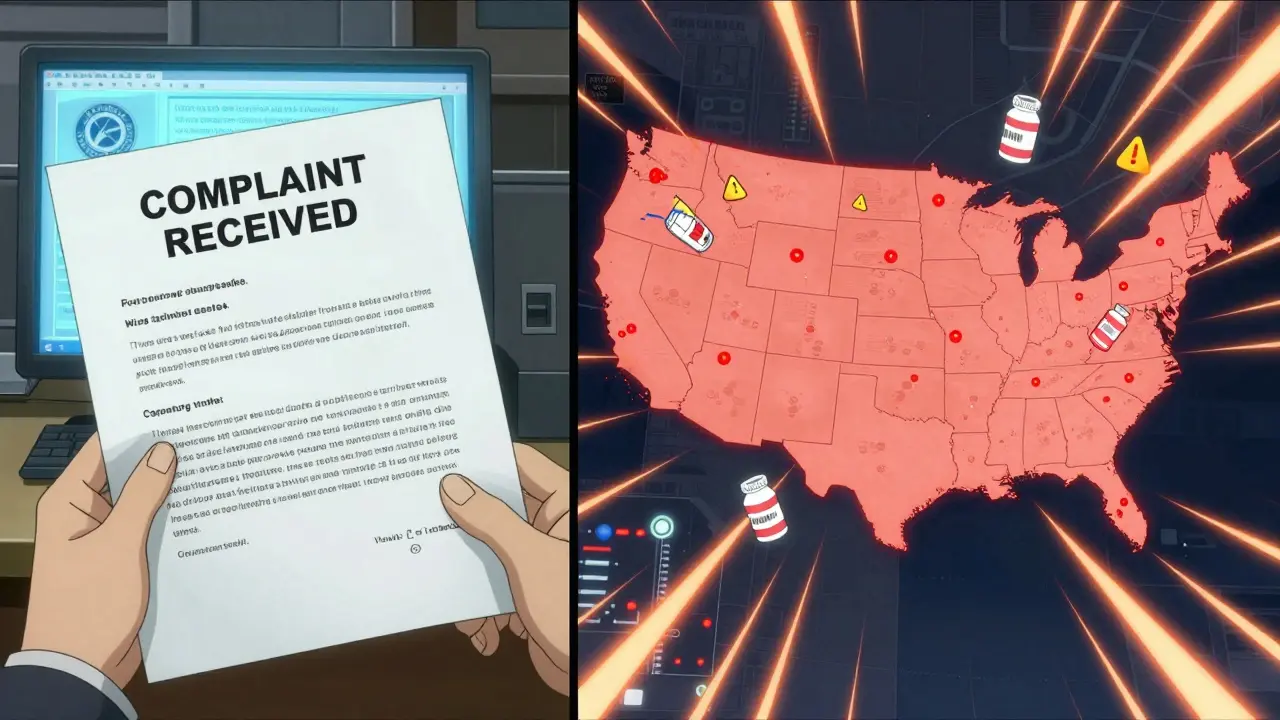
Over 1.3 million reports come in each year. The FDA doesn’t investigate every single one, but they use the data to spot patterns-like if a certain batch of pills keeps showing up with wrong labels.
4. The Institute for Safe Medication Practices (ISMP)
ISMP runs the National Medication Error Reporting Program (MERP). It’s confidential, and they don’t share your name with the pharmacy. Their team calls people back to get details: Was the pharmacy busy? Was the pharmacist distracted? Did the computer system glitch? They analyze over 12,000 reports a year and publish safety alerts that pharmacies across the country use to fix their systems. Call 1-800-233-7767 or submit online. Their reporting form asks for more context than others-this is where you explain why you think it happened.
5. The Joint Commission (if it was a hospital pharmacy)
If the error happened in a hospital, nursing home, or clinic, report it through their Patient Safety Event Reporting System. This is separate from retail pharmacies. You can report online or call 1-800-994-6610. They focus on system failures, not blame.
What Happens After You Report?
People often think reporting is pointless. But here’s what actually happens:- Within 1-3 days: You’ll get an acknowledgment (email, letter, or phone call).
- Within 2-8 weeks: The agency reviews your report. If it’s serious, they may contact the pharmacy for a formal response.
- Within 3-6 months: If the error was systemic-like repeated mislabeling-they may require the pharmacy to retrain staff, change their scanning system, or even install new software.
- Public impact: ISMP and the FDA publish safety alerts. For example, after several reports of insulin dosing errors, ISMP issued a national warning about look-alike insulin vials. Pharmacies nationwide changed their storage systems.
But here’s the truth: most of the time, you won’t hear back directly. The FDA says 71% of people who report through MedWatch never get a follow-up. That doesn’t mean your report didn’t matter. It means the system is designed to analyze trends-not respond to individuals. Your report might be one of 200 others about the same error. Together, they trigger change.
What You Can Do to Make Your Report More Powerful
A vague report like “I got the wrong pill” won’t do much. A detailed one can save lives.- Save everything: Keep the pill bottle, prescription receipt, and doctor’s note. Even if you threw it away, take a photo of the label now.
- Write it down: What time did you pick it up? Was the pharmacist rushed? Did they seem distracted? Did the computer beep when scanning? These details help experts find the root cause.
- Use the NCC MERP scale: This is how experts rate error severity. You don’t need to know the scale, but ask yourself: Did this error have the potential to cause harm? Was it caught before you took it? Did it cause injury? The more severe, the more urgent the response.
- Report near-misses: If you caught the mistake before taking the pill, still report it. That’s how systems improve.
A 2022 University of Michigan study found that reports with attached documentation were 3.7 times more likely to lead to corrective action. So don’t skip the bottle.
Why So Few People Report (And Why You Should Anyway)
Only about 14% of serious medication errors are ever reported. Why?- “I didn’t know how.” 41% of people in a 2023 survey said they didn’t report because they didn’t know where to go.
- “It won’t make a difference.” 29% think it’s pointless.
- “I’m scared of retaliation.” 18% worry the pharmacy will treat them badly next time.
But here’s what you need to know: reporting is protected. Under federal law (Patient Safety and Quality Improvement Act of 2005), information you give to ISMP or a Patient Safety Organization (PSO) is confidential. The pharmacy won’t know you reported them. And if you report to your state board, they’re required to keep your identity private unless you give permission.
One woman in Ohio reported a mislabeled blood thinner. Three months later, her local pharmacy installed a new barcode scanner. She didn’t know it was because of her report-until she saw the sign on the wall: “New safety system implemented after patient feedback.”
What’s Changing in 2026?
The system is getting better:- Mobile reporting: The FDA is launching a new app in Q2 2024 to make reporting faster and easier.
- Standardized language: In January 2023, the NCC MERP updated terminology so all reports use the same words-making data easier to analyze.
- More states requiring reports: 37 states now require some level of error reporting by pharmacies, up from 22 in 2018.
- AI detection: By 2027, AI systems in pharmacies will catch 25-30% more errors before they reach you-reducing the need for reports, but making the ones that do come in even more critical.
These changes mean your report matters more now than ever.
What If You Don’t Report?
If you stay quiet, the error stays hidden. The same pharmacist might make the same mistake again. Another patient might not be as lucky as you. One study found that pharmacies with no reporting system had 3 times more repeat errors than those that encouraged feedback.You didn’t cause the error. The system did. Reporting it isn’t about punishing someone-it’s about fixing something broken before it hurts someone else.
Can I report a pharmacy error anonymously?
Yes, you can report anonymously to ISMP MERP and the FDA’s MedWatch. Your name is never required. However, if you report to your state board of pharmacy, you’ll usually need to provide contact info so they can follow up. Even then, your identity is protected by law and won’t be shared with the pharmacy unless you give permission.
How long do I have to report a pharmacy error?
You can report anytime, but deadlines apply for certain systems. In California, you must file with the State Board of Pharmacy within 12 months. For the FDA’s MedWatch, there’s no deadline-but the sooner you report, the faster they can spot trends. If the error involved a HIPAA violation (like your medical info being shared without consent), you have 180 days to file with the Department of Health and Human Services.
Will reporting get me in trouble with my pharmacy?
No. Federal law protects your right to report. Pharmacies cannot legally retaliate against you for reporting an error. If you’re concerned, report to ISMP or the FDA-they don’t share your identity. Even if you report directly to the pharmacy, they’re required to handle your complaint professionally. Most pharmacists appreciate feedback because they want to keep patients safe too.
What if the pharmacy denies the error happened?
Pharmacies sometimes deny mistakes, especially if they’re afraid of liability. But if you’ve saved the bottle, prescription, and receipt, you have proof. State boards and the FDA can request pharmacy records, including surveillance footage and dispensing logs. A single report might be ignored, but multiple reports about the same pharmacy trigger formal investigations. Don’t give up.
Should I report even if I didn’t take the wrong medication?
Yes. These are called “near-misses,” and they’re just as important. A near-miss tells you the system failed-someone almost got hurt. If enough people report near-misses, pharmacies are forced to fix the root problem: bad labeling, understaffing, or outdated software. The American Society of Health-System Pharmacists says near-miss reporting is critical to preventing future harm.
Next Steps: What to Do Right Now
If you just experienced a pharmacy error:- Stop. Don’t take the medication.
- Save. Take a photo of the pill bottle, prescription, and receipt.
- Call. Contact your pharmacist and ask for clarification.
- Report. Submit a report to ISMP MERP (1-800-233-7767) and your state board of pharmacy.
- Follow up. Check your email or mail for acknowledgment. If you don’t hear back in 14 days, call again.
You’re not just protecting yourself. You’re helping build a safer system for everyone.

15 Comments
Pharmacies are a joke. I got my insulin labeled as blood thinner once. Didn't report. Why bother?
This is so important. If you see something, say something. One report might seem small, but together they save lives. You're not just helping yourself-you're helping your neighbor, your parent, your kid. Keep speaking up.
YES!!! This is the kind of info we NEED more of!!! I’ve been telling my friends for years-SAVE THE BOTTLE, TAKE A PHOTO, REPORT IT!!! Don’t wait until someone gets hurt. Near-misses are your superpower to fix the system!!!
The FDA’s MedWatch portal is a bureaucratic black hole. If you want real change, report to ISMP. Their MERP system is the only one that actually analyzes root causes, not just collects data. Most state boards are underfunded and undertrained-don’t waste your time unless you have concrete evidence.
The system is broken because we let it be. People want to blame pharmacists but the real problem is profit over safety. No one gets paid to fix the algorithm. They get paid to dispense. That’s the truth. You reporting won’t change that. But it makes you feel better.
I’m a pharmacist’s assistant, and I’ve seen how chaotic it gets during flu season-double shifts, broken scanners, tired staff. But I’ve also seen how a single report, with a photo and clear details, leads to real change. Please don’t assume it’s pointless. Your clarity matters.
Wait-so if I caught the error before taking it, I should still report? Even if I didn’t get hurt? That seems like overkill… but I guess if enough people do it, maybe the system wakes up?
In India, we don’t even get labels right half the time. Pills come in plain white packets with no name, no dose, no nothing. Reporting? Who do you even report to? The local chemist owns the whole block. But I get it-someone has to start. Maybe I’ll try ISMP.
I reported a wrong dose for my dad’s heart med last year. Got zero follow-up. But then three months later, the pharmacy changed their entire labeling system. I didn’t know it was because of me… until I saw the new stickers on the bottles. So yeah. It matters.
I GOT THE WRONG MEDS AND NO ONE CARES. MY MOM ALMOST DIED BECAUSE OF THIS. I WENT TO THE PHARMACY AND THEY LAUGHED. I FILED A COMPLAINT. THEY SAID IT WAS A ‘CLERICAL ERROR.’ I’M STILL ANGRY. WHY DO WE HAVE TO BE THE ONES TO FIX THIS?
I just took a pic of my bottle before I threw it away. Should I still report? It was a 10mg instead of 5mg but I didn’t take it. Feels weird to report something that didn’t hurt me
This post made me cry 😭 I reported my niece’s wrong antibiotic dose last year. We didn’t know where to go. Then we found ISMP. They called us back. We felt heard. 💙 Please report. Even if it’s small. You’re not alone.
The fact that you need to save the bottle and take a photo to prove a pharmacy messed up says everything about how broken this system is. You shouldn’t need evidence. They should be held accountable without you having to become a detective. This isn’t safety-it’s damage control.
In the UK, we have the Yellow Card system. It works. No drama. No bureaucracy. Just a simple form. Why does America make everything so complicated? You report, they fix, everyone moves on. Simple. Efficient. Not this chaotic mess.
I used to think reporting was pointless too. Then I realized: if every person who made a mistake had to explain it to someone they loved, the system would change overnight. This isn’t about blame. It’s about care. And care, when shared, becomes strength.
Write a comment