
You walk into your doctor's office, rattle off your prescription meds, and think you're done. But if you popped an aspirin for a headache or swallowed a handful of gummies for sleep, you just left out half the story. This isn't just about being polite; it’s about staying alive. A startling statistic from the National Health and Nutrition Examination Survey shows that while 37.9% of U.S. adults used dietary supplements in 2020, only 36% actually told their doctors about them. That gap is where dangerous things happen. When we fail to share what we take, we create blind spots that can lead to severe liver damage, unexpected bleeding, or medications that simply stop working.
Why Your Doctor Needs to Know About Your Gummy Bears
Most people assume that because they bought something at a pharmacy without a prescription, it’s safe to keep private. It’s not. The Dietary Supplement Health and Education Act (DSHEA) of 1994 created a regulatory framework where dietary supplements do not require pre-market approval by the FDA, unlike conventional drugs. This means there is no government agency checking every bottle before it hits the shelf. Consequently, your provider has no way of knowing what’s in your system unless you tell them.
Consider the stakes. Research published in the Journal of the American Medical Association Internal Medicine found that 23% of hospital patients experienced potential medication-supplement interactions, with nearly 8% classified as severe. These aren't hypothetical risks. In 2022 alone, the FDA documented over 1,000 supplement-related adverse event reports, including 52 deaths directly linked to improper use or interactions. If you’re taking St. John’s Wort, for instance, you might be unknowingly reducing the effectiveness of up to 37 different prescription medications by altering how your liver metabolizes them. Hiding this fact doesn’t protect your privacy; it jeopardizes your health.
The Difference Between Drug Facts and Supplement Facts
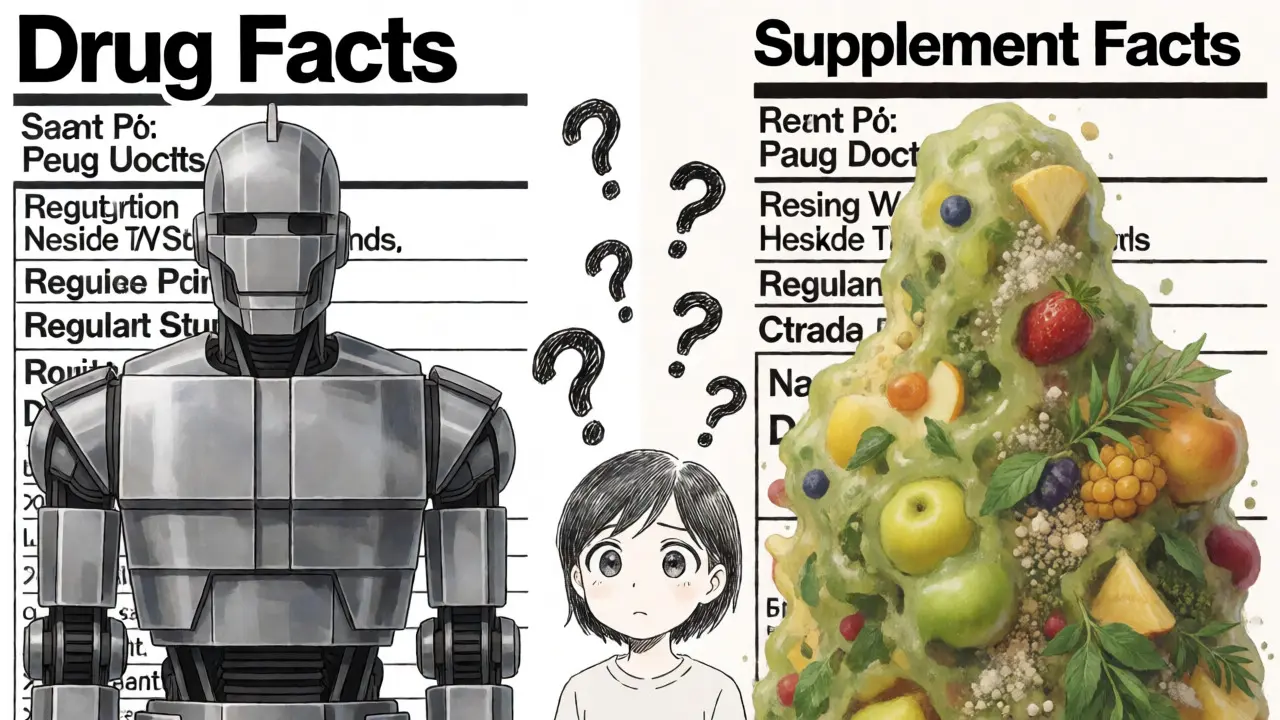
One major reason for miscommunication is confusion about labels. Many consumers mistakenly believe that "Drug Facts" and "Supplement Facts" are interchangeable. They are not. The American Liver Foundation notes that 68% of consumers incorrectly assume these labeling systems are equivalent. Here is why that distinction matters for your conversation with your provider:
- Drug Facts Labels: Found on OTC medicines like Tylenol or Advil. These list active ingredients by therapeutic dose and include strict warnings about side effects and interactions.
- Supplement Facts Labels: Found on vitamins, herbs, and minerals. These list ingredients by weight but do not require the same rigorous clinical testing or standardized serving sizes.
Because there are no federal laws limiting the serving size of a dietary supplement, two bottles of "Vitamin D" could contain vastly different amounts depending on the brand. When you tell your doctor, "I take Vitamin D," you haven't given them enough information to assess risk. You need to specify the exact product, the milligram dosage, and the frequency. Without this precision, your provider is guessing.
A Simple Protocol for Accurate Disclosure
So, how do you ensure you’re sharing accurately? The National Institutes of Health Office of Dietary Supplements (NIH ODS) recommends using a standardized record, such as their "My Dietary Supplement and Medicine Record." Don’t rely on memory. Memory fails under stress, especially when you’re sitting in an exam room trying to remember if you took fish oil yesterday or last week.
Here is a practical checklist to follow before your next appointment:
- List Everything: Include prescriptions, OTC pain relievers, cold medicines, vitamins, minerals, herbal products, probiotics, and even topical creams or eye drops.
- Use Exact Names: Write down the brand name and the specific product name. "Generic Multivitamin" is vague; "Centrum Silver Adults 50+" is precise.
- Specify Dosage and Frequency: Note the strength (e.g., 500mg) and how often you take it (e.g., twice daily with meals).
- State the Purpose: Why are you taking it? Is it for energy, joint pain, or general wellness? This helps your provider understand if the supplement is masking symptoms or interacting with treatment goals.
Studies show that using written medication lists reduces documentation errors by 64% compared to verbal reporting alone. It takes ten minutes to prepare this list at home, but it saves critical time during your consultation.
Overcoming the Barriers to Sharing
If you’ve been hesitant to speak up, you’re not alone. A study in the Journal of Ethics identified three main reasons people hide supplement use: the practitioner didn’t ask, the patient believed the practitioner didn’t need to know, or the patient feared judgment. Let’s tackle these head-on.
First, don’t wait to be asked. Providers are busy, and electronic health records (EHRs) often lack dedicated fields for supplements. In fact, only 31% of primary care EHRs have specific slots for this data, leading to higher rates of undocumented interactions. Take the initiative. Start your visit by saying, "Before we start, I want to update my full medication list, including the supplements I’m taking."
Second, drop the assumption that "natural" equals "irrelevant." Natural compounds are chemically active. As Dr. Paul Watkins from the University of North Carolina School of Medicine warns, botanical products like kava or comfrey can cause severe liver damage when combined with certain medications. Your provider isn’t judging your lifestyle choices; they are assessing chemical compatibility.
Finally, recognize the value of collaboration. Providers who specifically ask about supplement use receive significantly higher patient satisfaction ratings. By opening the dialogue, you help your pharmacist or doctor identify issues early. For example, pharmacists are trained to spot interactions that physicians might miss during brief visits. In one analysis, pharmacists identified 3.2 times more potential supplement-drug interactions than physicians did during medication reviews.
Real-World Consequences of Poor Communication
Let’s look at what happens when this communication breaks down. Consider a case study from the Journal of Patient Safety: a 68-year-old woman was on warfarin, a blood thinner. She was also taking 1,000mg of fish oil daily for heart health. Fish oil can increase bleeding risk. Because she hadn’t disclosed the high-dose fish oil, her warfarin dosage wasn’t adjusted properly. Had she shared this detail earlier, her provider could have monitored her INR levels more closely, potentially avoiding life-threatening complications.
On the other end of the spectrum, consider the tragic case of a 45-year-old woman who died from acute liver failure after taking kava supplements while on antipsychotic medication. Her providers were unaware of the supplement use until post-mortem analysis revealed it. These examples underscore that accurate sharing isn’t bureaucratic red tape-it’s a safety net.
| Method | Accuracy Rate | Risk of Interaction Oversight | Provider Preference |
|---|---|---|---|
| Verbal Recall Only | Low (High error rate) | High (Misses details/doses) | Neutral |
| Written List (NIH ODS Format) | High (Reduces errors by 64%) | Low (Clear specs provided) | Preferred (Saves time) |
| EHR Self-Entry | Moderate (Depends on user diligence) | Moderate (May lack field specificity) | Variable (Often incomplete) |

Leveraging Technology for Better Tracking
The landscape is changing. Healthcare systems are beginning to integrate better tools for this purpose. Epic Systems, a major EHR provider, implemented specific supplement documentation fields in 2020 after data showed that 42% of medication error reports involved undocumented supplement use. Looking ahead, new AI-powered screening tools are emerging that cross-reference thousands of supplement products against prescription databases automatically.
While you wait for universal adoption of these tech solutions, you can take control now. Keep a digital copy of your medication list in your phone’s notes app. Update it whenever you start or stop a product. When you see a new specialist, hand them this list rather than assuming your primary care physician’s notes will transfer perfectly. Interoperability between different hospital systems is still imperfect, so carrying your own "source of truth" is the smartest move.
Frequently Asked Questions
Do I really need to tell my doctor about vitamins?
Yes. Vitamins and minerals are biologically active. High doses of Vitamin E, for example, can interact with blood thinners, and excess Vitamin A can affect liver function. Since supplements aren't regulated as strictly as drugs, your provider needs to know exactly what you're taking to prevent toxicity or interaction.
What if I forget what I'm taking?
Bring the actual bottles to your appointment. This is the most accurate method. If you have too many, take photos of the Supplement Facts panels on your phone. This allows your provider to read the exact ingredient list and dosages, eliminating guesswork.
Will my insurance cover supplements?
Generally, no. Most health insurance plans do not cover over-the-counter supplements unless they are medically necessary and prescribed by a doctor for a specific condition. However, some Flexible Spending Accounts (FSAs) may allow reimbursement with a Letter of Medical Necessity. Always check with your plan administrator.
Is it okay to take supplements without telling my pharmacist?
No. Pharmacists are experts in drug interactions. Studies show they identify significantly more potential interactions than physicians during medication reviews. Informing your pharmacist ensures they can run a comprehensive check against your entire regimen, not just your prescriptions.
What should I do if I experience side effects from a supplement?
Stop taking the supplement immediately and contact your healthcare provider. Report the incident to the FDA through their MedWatch program. Providing detailed information about the brand, batch number, and symptoms helps track adverse events and improves safety data for everyone.

11 Comments
Finally someone says it. Most people treat their bodies like a dumpster for random pills they saw on Instagram. It is embarrassing how little basic health literacy exists in this country right now. :|
ugh too much reading. just tell them or dont. whatever.
This is exactly why Western medicine is failing us!! We need to stop relying on these corrupt FDA systems that allow poison to be sold as "supplements" without proper testing. In India we have Ayurveda which has been proven for thousands of years and you don't see these stupid interaction deaths because our system respects the body's natural balance unlike your greedy pharmaceutical corporations who want to sell you more drugs to fix the damage from the first drug. You Americans are so arrogant thinking you know everything but you can't even regulate what goes into your own mouths properly. Shameful. The whole system is rigged against the common man while doctors get paid to ignore real health solutions.
I appreciate the passion here, Pramay. It’s true that traditional systems offer valuable perspectives on holistic health. However, the core issue highlighted in the article isn't about which system is superior, but rather about communication gaps between patient and provider. Regardless of whether one uses Ayurvedic herbs or Western supplements, the biological reality remains that compounds interact with each other. Being open about all substances taken, regardless of origin, ensures safety. It’s less about choosing sides and more about creating a complete picture for the healthcare team to work with effectively. That transparency protects everyone involved.
The statistic regarding EHRs lacking dedicated fields is infuriatingly accurate. My primary care physician spent four minutes with me last week and asked nothing about my regimen. I had to physically hand him a printed list because his screen was cluttered with billing codes. This isn't a patient failure; it is a systemic design flaw that prioritizes administrative throughput over clinical accuracy. Until providers are incentivized to look at the whole patient, not just the complaint code, we will continue to see preventable adverse events. The burden should not fall entirely on the patient to navigate a broken interface.
OMG yes!! 🤯 The stigma around supplements is so real though. Like if you take adaptogens or nootropics, some doctors look at you like you're doing witchcraft 💀 but actually it's just chemistry! Also, bringing bottles is genius. I started taking photos of labels because my memory is trash lol. 📸✨ Safety first babes!
That point about pharmacists identifying three times more interactions than physicians really resonated with me. It feels like we often undervalue the expertise sitting right behind the counter at our local pharmacy. I've found that having a candid conversation with my pharmacist about my herbal teas and vitamins has saved me from several potential mishaps. It’s comforting to know there’s another layer of safety net available if we choose to utilize it. We really need to view healthcare as a collaborative team effort rather than a solitary decision made in isolation.
Wait... hold on... are we seriously saying that patients are responsible for remembering every single thing they swallow?? Because honestly... most doctors barely remember what they prescribed last month... let alone what random gummy bear some guy took in 2019... seems like a lot of pressure on the consumer... when the system itself is clearly fragmented... and frankly... poorly managed...
I wonder if this lack of disclosure is also tied to cost? Many people feel silly paying out of pocket for something their insurance won't cover, so maybe they hide it to avoid judgment about their spending habits. Or perhaps they fear being labeled as 'non-compliant' if they deviate from the standard protocol. It would be interesting to dig deeper into the psychological barriers beyond just forgetting. Are people afraid of being seen as 'woo-woo'? 🧐
the interoperability point is key. carrying your own source of truth is smart. i keep a digital note updated weekly. saves headaches when seeing specialists who use different platforms. simple but effective strategy.
Hey everyone, great discussion here! I think we should focus on empowerment rather than blame. Taking charge of your health record is a powerful step. Don't be shy to speak up. Your health matters most. Stay safe and happy healing friends! 😊
Write a comment