
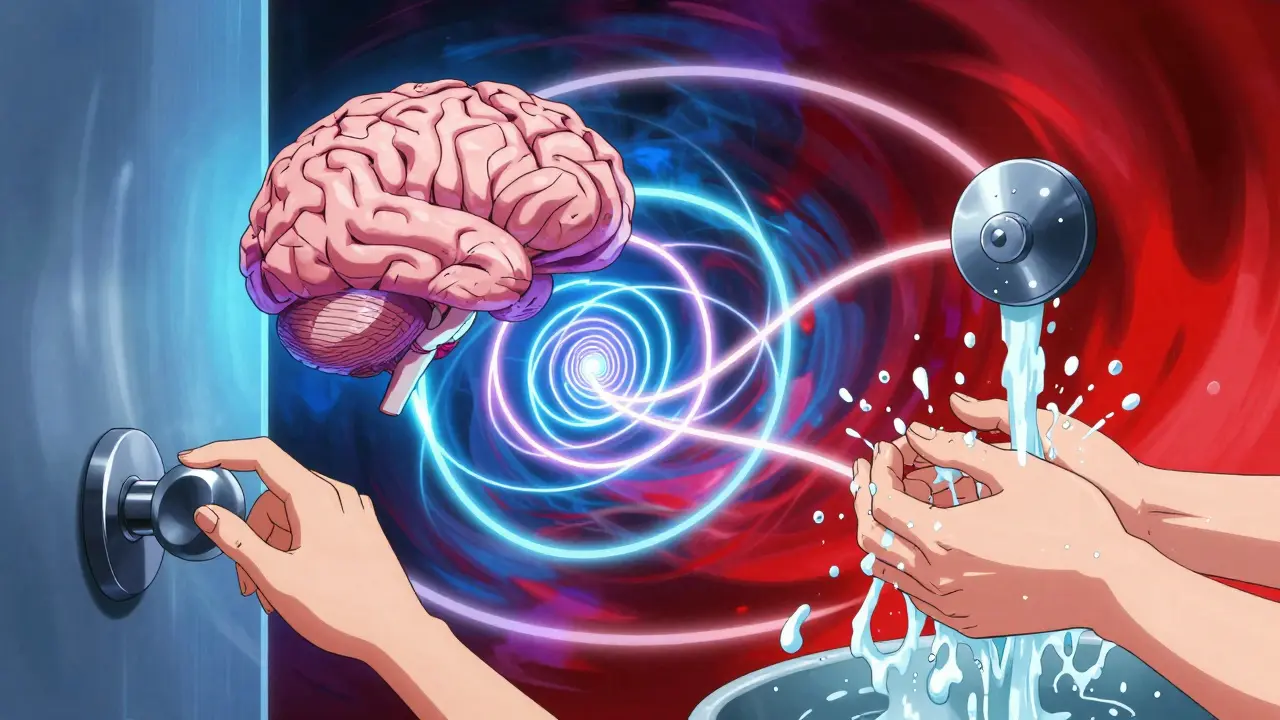
You’re standing in your kitchen. You just washed the counter. You know you did it. But a voice in your head whispers, "Did you miss a spot? What if that bacteria kills someone?" Your heart races. You wash it again. Then again. The anxiety dips for a second, then spikes higher than before. This isn’t just being neat. This is Obsessive-Compulsive Disorder (OCD), a neurobiological condition defined by persistent, unwanted intrusive thoughts and repetitive behaviors performed to reduce distress. It’s a trap where trying to fix the feeling only makes the problem worse.
If you or someone you love struggles with these cycles, you aren’t crazy, and you aren’t broken. You are stuck in a biological feedback loop that science now understands deeply. The good news? There is a proven way out. It’s called Exposure and Response Prevention (ERP), the gold-standard psychological treatment for OCD that involves systematic confrontation with triggers while resisting compulsions. Let’s look at how this disorder works, why traditional talk therapy often fails, and how ERP rewires the brain to stop the noise.
The Anatomy of an Intrusive Thought
First, we need to bust a myth: having weird, scary, or violent thoughts does not mean you are dangerous. In fact, almost everyone has them. The difference lies in what happens next. For most people, an intrusive thought pops up, feels annoying, and fades away. For someone with OCD, that thought hits like a lightning bolt.
Intrusive thoughts, unwanted, spontaneous mental images or impulses that cause distress are the engine of OCD. They fall into specific categories:
- Contamination fears: Worrying about germs, chemicals, or bodily fluids. This affects about 25% of patients.
- Harm obsessions: Fear of accidentally hurting yourself or others. This impacts 20-25% of cases. People often fear they might snap and hurt a loved one, despite having no history of violence.
- Symmetry and ordering: A need for things to be "just right." About 15-20% of patients experience this.
- Taboo thoughts: Distressing images related to sexuality, religion, or identity. These affect 10-15% of patients and often cause intense shame because they conflict so sharply with the person’s values.
The key here is Ego-dystonicity, the state where obsessive thoughts feel alien and contradictory to one's true self-concept and values. If you are a loving parent, the thought of harming your child is horrifying precisely because it is the opposite of who you are. That conflict creates massive anxiety. Your brain mislabels this internal discomfort as external danger. It screams, "Danger! Do something!" And that leads to the compulsion.
The Vicious Cycle: Obsession, Emotion, Compulsion
OCD isn’t just random anxiety; it’s a predictable circuit. Researchers describe it as a three-part loop:
- Obsession: The intrusive thought enters your mind. It’s illogical and distressing.
- Emotion: You feel intense anxiety, disgust, or fear. Your body reacts as if you are facing a tiger.
- Compulsion: You perform a behavior (washing hands, checking locks) or a mental act (counting, praying, reviewing memories) to neutralize the anxiety.
Here is the trap: the compulsion provides temporary relief. But it doesn’t solve the problem. It teaches your brain that the thought was indeed dangerous and that the ritual was necessary to survive. Next time, the anxiety comes back faster and stronger. You have reinforced the neural pathway. According to data from the National Alliance on Mental Illness (NAMI), untreated OCD can consume more than one hour daily, becoming socially crippling over time.
Why Talk Therapy Often Fails
Many people try standard cognitive behavioral therapy (CBT) or general talk therapy first. Unfortunately, this often backfires. Why? Because talking about the obsession keeps the brain engaged in rumination. Analyzing the logic of the thought feeds the beast. If you spend hours discussing why you shouldn’t be afraid of germs, you are still focusing on germs. You are still engaging with the obsession.
Traditional therapy also lacks the behavioral component needed to break the habit loop. Without stopping the compulsion, the anxiety never gets a chance to naturally subside. The International OCD Foundation notes that only 10% of therapists in the U.S. are trained in evidence-based OCD treatment. This gap means many patients receive well-meaning but ineffective care for years. On average, patients wait over 10 years for a correct diagnosis and proper treatment.
How ERP Rewires the Brain
Exposure and Response Prevention (ERP), a structured psychotherapy technique involving gradual exposure to feared stimuli while preventing the associated compulsive response is different. It doesn’t ask you to think differently; it asks you to act differently. Developed from the work of Dr. Victor Meyer and refined by Dr. Edna Foa, ERP is based on the principle of Habituation, the process by which anxiety naturally decreases over time when exposed to a trigger without performing a safety behavior.
Here is how it works in practice:
- Create a Fear Ladder: You and your therapist list triggers from least to most anxiety-provoking. Rate them on a scale of 0-100. Touching a doorknob might be a 30. Shaking hands with a stranger might be a 70.
- Expose: You intentionally face the trigger. If you have contamination OCD, you touch the doorknob.
- Prevent Response: This is the hard part. You resist washing your hands. You sit with the anxiety. You let it rise, peak, and eventually fall on its own.
Over time, your brain learns that nothing bad happened. The alarm system stops triggering. Neuroimaging studies by Dr. Jamie Feusner at UCLA show that successful ERP reduces hyperactivity in the orbitofrontal cortex and caudate nucleus-the brain regions responsible for error detection and fear processing. You aren’t just coping; you are physically changing your brain’s wiring.
| Treatment Type | Mechanism | Efficacy Rate | Key Limitation |
|---|---|---|---|
| ERP Therapy | Behavioral habituation via exposure | 60-80% symptom reduction | Requires high motivation; initial anxiety spike |
| SSRI Medication | Chemical regulation of serotonin | 40-60% response rate | Side effects in 30% of patients; doesn't teach skills |
| Combination (ERP + SSRI) | Neurochemical support + behavioral learning | 80-85% response rate | Higher cost; complex management |
| General Talk Therapy | Cognitive discussion of symptoms | Low efficacy for core symptoms | Can reinforce rumination |

Navigating the Challenges of ERP
ERP is not easy. It requires courage. About 70% of patients report increased distress in the first two to three weeks. This is normal. It’s called the "extinction burst." Your brain is fighting back because it wants the old safety rituals. Dropout rates are around 25%, mostly due to this discomfort.
To succeed, you need a specialist. General therapists often lack the training to guide you through the hierarchy effectively. Look for credentials from the International OCD Foundation (IOCDF). If you live in a rural area, consider telehealth. Remote ERP has grown significantly, with 45% of patients now receiving some treatment online. Apps like nOCD, approved by the FDA in 2023, offer digital therapeutic guidance, showing 55% efficacy in mild cases. However, human-led ERP remains superior for moderate to severe cases.
Also, manage expectations. ERP doesn’t eliminate intrusive thoughts forever. Everyone will still have weird thoughts. The goal is to remove the power those thoughts have over your actions. You learn to say, "I notice I’m having the thought that I didn’t lock the door. I don’t need to check. I can live with the uncertainty."
New Frontiers in OCD Care
Science is advancing rapidly. The DSM-5-TR (2022) now recognizes "Pure O"-primarily obsessional OCD without visible rituals-as a distinct presentation. This helps millions who suffer from mental compulsions like silent counting or memory reviewing. New treatments are emerging too. Transcranial Magnetic Stimulation (TMS) showed 45% response rates in treatment-resistant cases in a 2023 study. Stanford University is using machine learning to predict ERP success with 78% accuracy based on brain scans. Early intervention is critical: starting treatment within two years of symptom onset doubles recovery rates.
If you are struggling, remember this: OCD thrives on secrecy and shame. Breaking the cycle starts with seeking help from those who understand. You don’t have to fight the thoughts alone. With the right tools, specifically ERP, you can reclaim your life from the noise.
What is the difference between normal intrusive thoughts and OCD?
Everyone experiences occasional strange or unwanted thoughts. The difference lies in the reaction. In OCD, these thoughts trigger extreme anxiety, disgust, or fear that disrupts daily functioning. People with OCD engage in compulsions (mental or physical) to neutralize the distress, whereas non-OCD individuals typically dismiss the thought and move on.
How long does ERP therapy take to work?
ERP typically runs for 12 to 20 weekly sessions. Patients assign themselves 1-2 hours of daily "homework" exposures. While initial anxiety may increase in the first 2-3 weeks, most patients see significant symptom reduction (60-80%) upon completing the protocol. Effects are often maintained long-term.
Is medication better than ERP for OCD?
ERP is considered the gold-standard psychological treatment. Medications like SSRIs help regulate brain chemistry but do not teach coping skills. Combination therapy (ERP + medication) yields the highest efficacy (80-85%), but ERP alone is more effective than medication alone (40-60%). Medication can also cause side effects in 30% of patients.
What is "Pure O" OCD?
"Pure O" refers to Obsessive-Compulsive Disorder where compulsions are primarily mental rather than visible. Examples include silently repeating phrases, mentally reviewing past events for errors, or counting in one's head. It affects about 20% of patients and is recognized as a distinct presentation in the DSM-5-TR.
Can ERP be done online?
Yes. Telehealth ERP has become widely accepted, with 45% of patients receiving remote care. Digital therapeutics like the FDA-approved nOCD app also provide guided ERP. However, working with a licensed specialist via video call is generally recommended for moderate to severe cases to ensure proper support during high-anxiety exposures.
