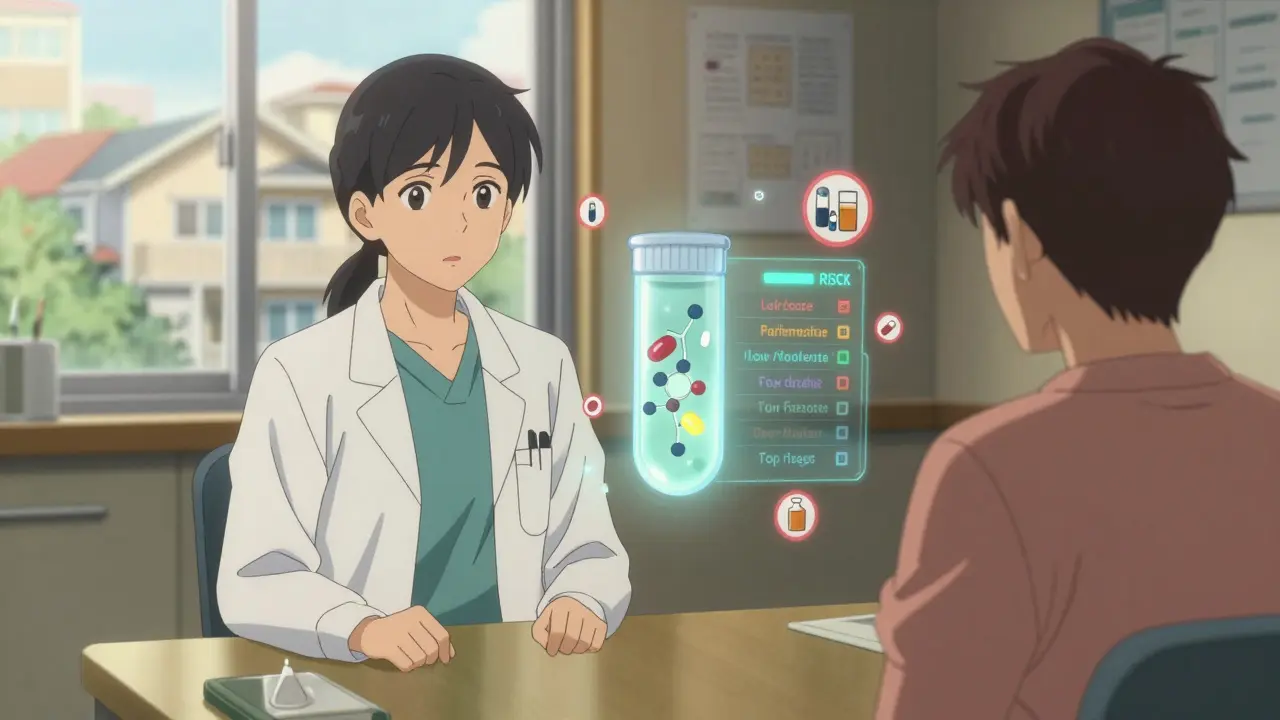
Opioid Risk Stratification Calculator
This tool uses the Opioid Risk Tool (ORT) framework to determine appropriate monitoring frequency based on clinical factors. It helps clinicians make informed decisions about urine drug screening schedules for patients on opioid therapy.
Patient Risk Factors
Risk Assessment Guidelines
- 0-1 points: Low-risk
- 2-3 points: Moderate-risk
- 4-5 points: High-risk
- Low-risk: Annual urine test
- Moderate-risk: Every 6 months
- High-risk: Quarterly testing plus validity checks
Enter your patient's information above to calculate their risk level.
When someone is prescribed opioids for chronic pain, doctors don’t just hand out pills and hope for the best. They need to know if the patient is taking the medication as directed-and if they’re using anything else that could turn deadly. That’s where urine drug screens come in. It’s not about suspicion. It’s about safety. Every year, over 80,000 people in the U.S. die from opioid overdoses. Many of those deaths happen because someone is mixing prescribed painkillers with other drugs they didn’t tell their doctor about-like fentanyl, benzodiazepines, or alcohol. Urine testing gives providers hard evidence, not guesses.
Why Urine Tests? It’s Not Just About Catching People
Urine drug testing isn’t a punishment. It’s a tool. Think of it like checking your blood pressure before adjusting a heart medication. If you’re on long-term opioids, your body can react unpredictably. You might metabolize oxycodone faster than average. Or you might unknowingly take a counterfeit pill laced with fentanyl. A simple urine test can catch both. The practice started in addiction treatment centers decades ago, but today it’s standard in pain clinics across North America. The CDC, ASAM, and AAFP all recommend it. Why? Because studies show that when patients know they’ll be tested, they’re less likely to misuse drugs. And when doctors see what’s really in the system, they can make smarter choices-like switching medications, adding counseling, or reducing doses before something goes wrong.How the Tests Work: Immunoassays vs. Confirmatory Testing
Not all urine tests are created equal. Most clinics start with an immunoassay-a quick, cheap screen that costs around $5 per test. It’s fast, usually ready in hours. But here’s the catch: it can be wrong up to 30% of the time. A patient taking prescribed hydrocodone might test negative because the test doesn’t recognize it. Or someone drinking poppy seed bagels might trigger a false positive for morphine. The real problem? Fentanyl. Standard immunoassays were designed to catch morphine, codeine, and oxycodone. Fentanyl? It’s chemically different. For years, patients on fentanyl patches were being falsely labeled as non-adherent. That changed in 2023 when the FDA approved the first fentanyl-specific immunoassay with 98.7% sensitivity. Still, many labs haven’t upgraded. That’s where confirmatory testing comes in. Gas chromatography/mass spectrometry (GC/MS) or liquid chromatography/mass spectrometry (LC-MS) can identify exact substances down to the molecule. These tests cost $25 to $100 each, but they’re the only way to know for sure. A 2017 study found that 72% of patients who tested negative on a standard opiate screen actually had hydrocodone in their system. LC-MS caught it. Without it, the doctor might have cut the dose-or worse, accused the patient of lying.What Gets Missed-and Why It Matters
Some drugs are sneaky. Hydrocodone? Often invisible on basic screens. Synthetic cannabinoids? Many tests won’t catch them either. Even amphetamines can be tricky: most screens detect d-amphetamine but miss methylphenidate or MDMA. And don’t forget about buprenorphine. A 2021 study found that 23% of patients on this medication for opioid use disorder were wrongly flagged as non-adherent because their urine test didn’t recognize it. This isn’t just a technical glitch. It leads to real harm. Patients report being denied refills, threatened with dismissal from care, or even reported to authorities-all because a $5 test said they weren’t taking their meds. One Reddit user, ChronicPainWarrior22, shared how they were accused of drug use despite taking their prescribed oxycodone daily. Their test came back negative. Later, a confirmatory test proved they’d been taking it all along. Clinicians are catching on. Many now order LC-MS for patients on fentanyl, methadone, or buprenorphine. But not all labs offer it. And insurance doesn’t always cover it. So patients are stuck between a flawed system and their need for pain relief.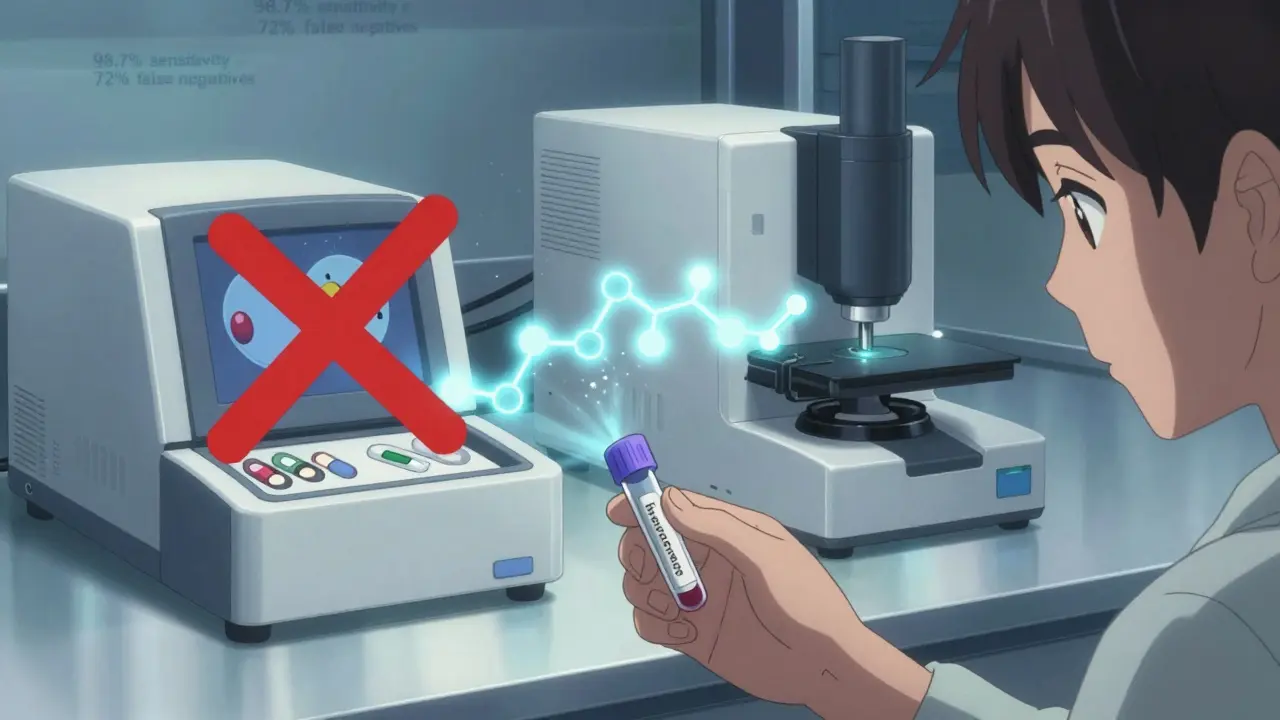
Risk Stratification: Not Everyone Needs the Same Testing
Testing everyone the same way doesn’t make sense. A 72-year-old on low-dose oxycodone after hip surgery isn’t the same risk as a 35-year-old with a history of addiction taking high-dose morphine. That’s why risk stratification matters. The Opioid Risk Tool (ORT) is a simple five-question survey used in clinics. It asks about family history of substance abuse, personal history of mental illness, age, and past misuse. Based on the answers, patients are labeled low, moderate, or high risk. - Low-risk: Annual urine test.- Moderate-risk: Every six months.
- High-risk: Quarterly testing, plus specimen validity checks. This isn’t just theory. A 2023 AMA guideline adopted this tiered approach. Clinics using it saw fewer false alarms and better patient trust. One doctor in Halifax reported cutting unnecessary tests by 60% after switching to risk-based screening. More patients stayed in care. Fewer left feeling judged.
What’s in the Urine? The Validity Check
Before even testing for drugs, labs check if the sample is real. Diluted urine? pH too high or too low? Creatinine too low? These are red flags. Someone might be trying to swap samples or water down their urine to hide drug use. Most labs now include validity testing as standard. The guidelines are clear: if a sample is invalid, the test can’t be trusted. Repeat testing is required. And if it happens more than once? That’s a signal to talk-about addiction, mental health, or barriers to care-not to punish.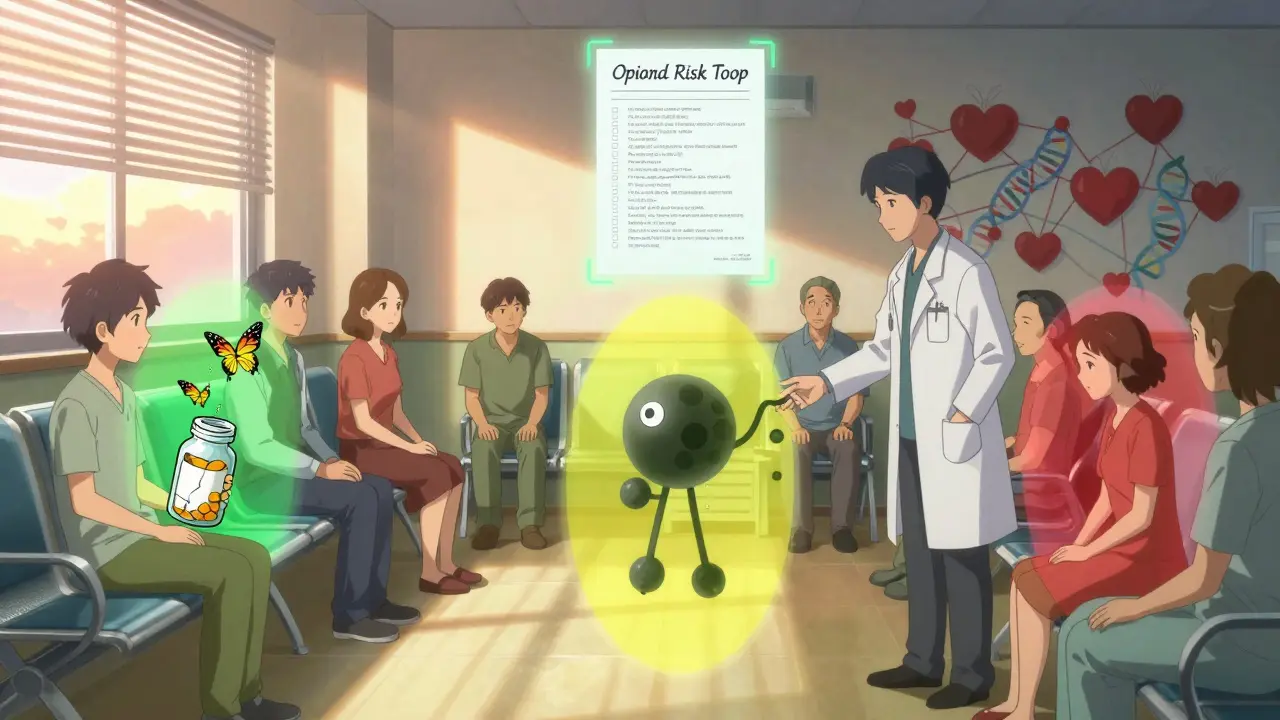
Who’s Doing the Testing? The Market Is Concentrated
In 2022, the U.S. urine drug testing market hit $3.1 billion. Five companies control 87% of it: Quest Diagnostics, LabCorp, BioReference, Aegis Sciences, and Millennium Health. Medicare alone processed nearly 39 million tests that year. But access isn’t equal. Rural clinics often send samples to distant labs. Wait times can be two weeks. In that time, a patient might stop taking their meds-or worse, start using something riskier. Some clinics now use point-of-care devices that give results in 15 minutes. Seven such devices are in FDA review as of late 2023. They’re not perfect yet, but they’re getting closer.What’s Next? AI, Better Tests, and Smarter Policies
The future is here. The University of Pittsburgh’s Opioid Adherence Prediction Engine (OAPE) uses AI to analyze patterns in urine tests, prescription fills, and behavioral data to predict who’s at risk of misuse before it happens. It’s in phase 3 trials and could change how we monitor patients. The CDC is updating its guidelines for late 2024. Expect stronger recommendations for LC-MS testing in patients on synthetic opioids. More states are passing laws requiring testing-but they’re also starting to require risk-based approaches to avoid over-testing. The bottom line? Urine drug screens are here to stay. But they’re not magic. They’re tools. Used well, they save lives. Used poorly, they drive people away from care. The goal isn’t to catch people doing wrong. It’s to help them stay safe.Do urine drug tests prove someone is addicted?
No. A positive test for an illicit drug doesn’t mean someone has an addiction. It means they used something not prescribed. Addiction is a medical diagnosis based on behavior, not a single test. Many people use drugs occasionally without being dependent. The goal of testing is to identify risks and offer support-not to label or punish.
Can I be tested without my consent?
In most cases, no. Doctors must get informed consent before ordering a urine drug screen. However, some states require testing as part of chronic opioid therapy agreements. Patients are usually given a written policy explaining when and why testing happens. If you’re unsure, ask your provider for their testing protocol.
Why do I test negative for my prescribed opioid?
There are several reasons. The most common: your test used an outdated immunoassay that doesn’t detect your specific drug. Hydrocodone, for example, often doesn’t show up on standard opiate screens. Or you metabolize the drug unusually fast. Your dose might be too low for detection. Or you took it at a time that didn’t align with the test window. Always ask for confirmatory testing if results don’t match your medication history.
Is blood testing better than urine testing?
Not for routine monitoring. Blood tests show recent use-usually within hours. Urine tests show use over the past few days, which is more useful for tracking adherence. Blood is only used in emergencies, like overdose cases or when someone can’t produce urine. For long-term opioid therapy, urine remains the gold standard.
What if I have a valid prescription for a drug that shows up on the test?
That’s normal. Many patients take benzodiazepines for anxiety, muscle relaxants for spasms, or antidepressants for mood. As long as you’ve disclosed these medications to your provider and they’re prescribed appropriately, there’s no issue. The test isn’t there to catch legal prescriptions-it’s there to catch undisclosed or dangerous combinations, like opioids with alcohol or benzodiazepines.
How often should I be tested?
It depends on your risk level. Low-risk patients (no history of substance use, stable mental health) need testing once a year. Moderate-risk (past misuse, mental health conditions) every six months. High-risk (active addiction, high-dose opioids) should be tested quarterly. The Opioid Risk Tool helps determine this. Random testing is more effective than scheduled testing because it reduces manipulation.
What to Do If You’re on Opioids
If you’re taking opioids long-term:- Always tell your provider about every medication, supplement, or substance you use-even over-the-counter drugs.
- Ask which test your clinic uses. If it’s only an immunoassay, ask if confirmatory testing is available for your medication.
- Know your risk score. If you’re labeled high-risk, ask what support services are available.
- If you test negative for a drug you’re taking, insist on a GC/MS or LC-MS confirmation.
- Don’t panic if a test flags something. Use it as a chance to talk-not to hide.

13 Comments
This is spot on. Urine tests aren't about trust-they're about survival. I've seen too many patients get dropped for a false negative on hydrocodone. No one deserves to be punished because a $5 test doesn't recognize their meds.
I'm a nurse in Ontario and I've seen this mess first-hand. Labs still using 2010-era immunoassays? Come on. We had a guy on buprenorphine flagged as 'non-compliant'-turns out his test didn't even look for it. He nearly lost his job. We pushed for LC-MS. Took 3 months. He's stable now. This system is broken. We need better tools, not more suspicion.
Man i wish more docs got this. I was on oxycodone for 5 years after a car wreck. One time my test came back negative. I was ready to scream. Turns out the lab just didn't test for it. I had to beg for a GCMS. Took 2 weeks. I almost quit meds cause i felt like a criminal. This stuff needs to change. Not everyone's trying to get high.
Let me be clear: urine testing is a surveillance tool disguised as medical care. The CDC? ASAM? These are not neutral bodies. They are extensions of the pharmaceutical-industrial complex. They profit from testing. They profit from fear. And they profit from the stigma that keeps patients silent. The real danger isn't fentanyl-it's the system that turns pain into a crime.
I think they just want to control us. They say its for safety but really its about power. Why do they need to know what's in my body? What if i just want to take my medicine in peace? This is how they start taking away rights. One test at a time.
If you're taking opioids long term you should expect to be tested. Full stop. No one owes you pain relief. You made your choice. Now deal with the rules. If you can't follow basic medical protocols then maybe you shouldn't be on these drugs. This isn't a right. It's a privilege earned by compliance.
Bro the system is rigged. I got flagged for 'non-adherence' because my test missed hydrocodone. My doc almost cut me off. I had to pull my medical records, print the prescription, and show up with a signed letter from my pharmacy. I felt like a felon. Meanwhile the lab made $5 off that test. Meanwhile I lost 3 days of work. This ain't medicine. This is a racket.
There's something deeply human here. We're not just talking about drug metabolites. We're talking about people in pain who just want to live without shame. The fear of being judged, of being labeled, of being dismissed-it's worse than the pain sometimes. A test shouldn't be a verdict. It should be a conversation starter.
I'm Irish and we don't do this much over here. We focus on care not control. I had a mate on methadone and they never tested him. Just talked. Check in. Adjust. He's been clean for 7 years. Maybe the answer isn't more tests. Maybe it's more trust.
The data is clear. Risk stratification reduces false positives by 60% and increases retention. LC-MS is not a luxury. It's clinical necessity. The market consolidation means rural clinics get stuck with outdated tech. We need policy intervention. Not more blame. More access. More equity.
This is the kind of info we need to spread. So many people don't know their rights. Ask for confirmatory testing. Know your risk score. Speak up. You're not being paranoid-you're being smart. Keep fighting. You're not alone.
I've been on opioids for 12 years. I've had 3 different doctors. Only one ever explained why they tested me. The rest just handed me a cup. I didn't know about GC/MS until I read this. Thank you. This changed how I talk to my new doc. I asked. They agreed to upgrade. It felt like a win.
This whole system is a psyop. The labs, the CDC, the clinics-they're all in bed with Big Pharma. They want you dependent. They want you tested. They want you afraid. They profit from your fear. The fentanyl crisis? Manufactured. The testing? A tool of control. Wake up. This isn't medicine. It's a prison disguised as a clinic.
Write a comment