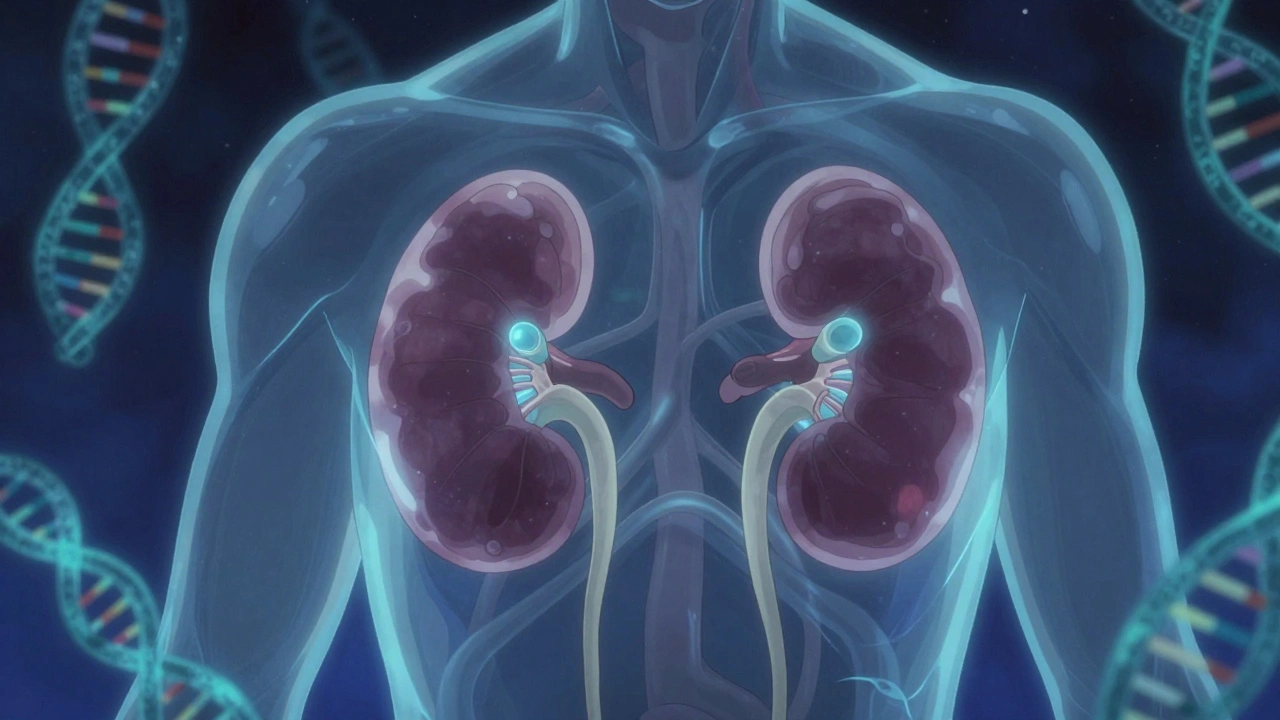
Polycystic kidney disease (PKD) isn’t just about cysts in the kidneys-it’s a lifelong genetic battle that affects how your body works from the inside out. Around 600,000 people in the U.S. have it, and for many, it starts quietly, with no symptoms until their 30s or 40s. By then, dozens or even hundreds of fluid-filled sacs have grown inside the kidneys, slowly replacing healthy tissue. The kidneys, which normally weigh about half a pound, can balloon to over 30 pounds in advanced cases. This isn’t a rare curiosity; it’s the most common inherited kidney disease in the world and the fourth leading cause of kidney failure in America.
Two Types, One Root Cause
There are two main types of PKD, and they’re as different as night and day. The most common-autosomal dominant polycystic kidney disease, or ADPKD-makes up over 98% of cases. You only need to inherit one bad copy of either the PKD1 or PKD2 gene to get it. If one of your parents has ADPKD, you have a 50% chance of getting it too. PKD1 mutations are the worst offenders, causing symptoms to show up earlier and progress faster than PKD2. About 10% of ADPKD cases come from brand-new mutations, with no family history at all. That’s why someone might get diagnosed in their 30s and realize no one else in their family has ever had kidney problems.
The other type, autosomal recessive polycystic kidney disease (ARPKD), is far rarer-about 1 in 20,000 babies. To get ARPKD, you need two bad copies of the PKHD1 gene, one from each parent. Most parents don’t even know they carry it because they don’t have symptoms. When a child does inherit both bad copies, the disease hits hard and fast. Many babies show signs right after birth: enlarged kidneys, high blood pressure, and breathing problems. Some don’t survive infancy. Others live into childhood or adulthood, but with serious liver and kidney complications.
How It Progresses-And Why Timing Matters
ADPKD doesn’t wake up overnight. Cysts start forming before birth, but they grow so slowly that most people feel fine for decades. Symptoms usually creep in between ages 30 and 40: back or side pain, high blood pressure, blood in the urine, frequent kidney infections. By age 60, about half of people with ADPKD will have lost enough kidney function to need dialysis or a transplant. That’s not a guess-it’s backed by decades of tracking patients through studies like the HALT-PKD trial.
What’s scary is how unpredictable it is. Two people with the same PKD1 mutation can have wildly different outcomes. One might need a transplant at 45. Another might keep working, traveling, and raising kids into their 70s. Why? Scientists think other genes, lifestyle, and even random chance play a role. That’s why a family history isn’t a crystal ball-it’s a warning sign.
ARPKD is less variable but more brutal. Babies born with it often need intensive care. Those who survive past infancy face a lifetime of managing liver scarring and kidney problems. Some children need dialysis before they turn 10. The difference between ADPKD and ARPKD isn’t just age-it’s survival.
Diagnosis: When to Suspect PKD
Doctors don’t diagnose PKD by guessing. They use imaging. If you have a family history and are over 30, an ultrasound showing 10 or more cysts on each kidney is usually enough to confirm ADPKD. For younger people, the rules change: a 20-year-old with two cysts per kidney and a family history might still be monitored, not diagnosed. MRI scans give the clearest picture, especially when doctors need to measure how fast cysts are growing.
Genetic testing is now a real option. For around $1,200, labs like Invitae and Ambry can sequence the PKD1 and PKD2 genes. It’s not for everyone-but it’s life-changing for some. If you’re planning a family and have PKD, knowing exactly which gene you carry helps you understand the risk to your kids. It also helps if your symptoms don’t fit the usual pattern. One Reddit user shared it took seven years and three doctors to get diagnosed, even though his dad had PKD. Genetic testing could’ve cut that time in half.
Management: What Actually Works
There’s no cure for PKD. But that doesn’t mean nothing can be done. The most powerful tool in your arsenal is blood pressure control. High blood pressure doesn’t just come with PKD-it speeds up kidney damage. The goal? Keep it below 130/80 mmHg. Some studies show pushing it even lower-to 110/75-slows cyst growth by over 14% over five years.
Medications like ACE inhibitors and ARBs are the first line of defense. They’re cheap, well-studied, and work for most people. But for those with rapidly progressing disease, there’s one FDA-approved drug: tolvaptan (Jynarque). It blocks a hormone that makes cysts swell. In a major trial, it slowed kidney function decline by about 1.3 mL/min per year. That might not sound like much, but for someone in their 30s, it could mean delaying dialysis by a decade. The catch? It costs over $115,000 a year. Insurance covers it for qualifying patients, but side effects like extreme thirst and frequent urination make it tough to tolerate.
Monitoring is non-negotiable. Annual eGFR tests track kidney function. Imaging every 1-2 years shows how fast cysts are growing. Blood and urine tests catch infections early. And yes-pain is real. A 2023 survey of over 1,200 PKD patients found 78% struggled with chronic pain, often moderate to severe. It’s not just from cysts bursting-it’s from pressure, inflammation, and nerve damage. Pain management isn’t optional. It’s part of treatment.
The Emotional Toll and Real-Life Stories
PKD doesn’t just attack your kidneys. It attacks your peace of mind. In surveys, 63% of patients say they live with constant anxiety about kidney failure. That’s not fear-it’s a chronic stress response. One woman in her 40s told her doctor, ‘I don’t know if I’ll be alive to see my daughter graduate.’
But there are wins too. A man from Ohio started taking blood pressure meds at 28 after his dad went on dialysis. At 45, his kidney function is still at 65%. He’s hiking, coaching soccer, and sleeping through the night. That’s not luck. That’s early action.
On the flip side, many people face delays in diagnosis. One Reddit user wrote, ‘I had pain for years. Doctors called it ‘just muscle strain.’ I was 31 before someone looked at my kidneys.’ That’s not rare. It’s systemic. PKD is often invisible until it’s advanced. That’s why knowing your family history matters-and why doctors need to listen.
What’s Next? The Hope on the Horizon
Research is moving fast. Tolvaptan was the first drug to slow PKD progression. Now, over a dozen new drugs are in clinical trials. Lixivaptan, a cousin of tolvaptan, is expected to finish testing in 2024. Bardoxolone methyl showed promise in early trials, improving kidney function by nearly 5 mL/min over placebo. These aren’t cures-but they’re steps toward slowing the disease.
Gene therapy is still years away, but scientists are mapping how PKD1 and PKD2 mutations break kidney cell communication. That’s the real goal: fixing the root cause, not just the symptoms. For now, the best defense is awareness, early testing, and aggressive blood pressure control.
Living with PKD-What You Can Do Today
- Get tested if you have a family history-even if you feel fine.
- Check your blood pressure monthly. Keep it under 130/80.
- Avoid NSAIDs like ibuprofen. They stress your kidneys.
- Drink water. It helps slow cyst growth.
- Limit salt. It raises blood pressure and makes fluid retention worse.
- See a nephrologist early. Don’t wait for symptoms.
- Join a support group. The PKD Foundation and American Kidney Fund offer free resources.
PKD is not a death sentence. It’s a challenge-and one that’s increasingly manageable. The key isn’t waiting for a miracle drug. It’s acting now, before the cysts take over.
Is polycystic kidney disease inherited?
Yes, PKD is almost always inherited. Autosomal dominant PKD (ADPKD) is passed down when one parent has the mutated PKD1 or PKD2 gene-each child has a 50% chance of inheriting it. Autosomal recessive PKD (ARPKD) requires both parents to carry the PKHD1 gene mutation, with a 25% chance of a child developing the disease. About 10% of ADPKD cases result from new mutations, with no family history.
Can you get PKD if no one in your family has it?
Yes, but it’s rare. Around 10% of ADPKD cases happen because of a brand-new mutation in the PKD1 or PKD2 gene, meaning neither parent carries the mutation. This is called a de novo mutation. In these cases, the person is the first in their family to have PKD, but they can still pass it on to their children.
At what age does PKD usually start causing symptoms?
For ADPKD, symptoms typically appear between ages 30 and 40, though some people notice signs as early as their 20s. In rare cases, children with PKD1 mutations can develop high blood pressure and kidney problems before age 10. ARPKD, however, often shows symptoms right after birth or during early childhood, sometimes even before the baby is born.
Is there a cure for polycystic kidney disease?
No, there is no cure yet. But treatments can slow progression. The FDA-approved drug tolvaptan (Jynarque) helps reduce cyst growth in rapidly progressing ADPKD. Managing blood pressure, staying hydrated, and avoiding kidney stressors like NSAIDs can also delay kidney failure. For end-stage disease, dialysis or kidney transplant are the only options to restore function.
How is PKD diagnosed?
Diagnosis usually starts with imaging: ultrasound is the most common tool. For someone over 30 with a family history, having at least 10 cysts per kidney confirms ADPKD. MRI gives the most accurate measurement of cyst growth. Genetic testing can identify mutations in PKD1, PKD2, or PKHD1 and is especially useful for unclear cases, young patients, or family planning.
What’s the life expectancy for someone with PKD?
Many people with ADPKD live into their 70s or beyond. About half develop kidney failure by age 60, but with proper care, some delay dialysis until their 70s or 80s. ARPKD is more serious-infants with severe cases may not survive past infancy, but children who make it through early childhood often live into adulthood. Kidney transplant success rates are high, and most transplant recipients live 15-20 years or more with a functioning organ.
Can diet help manage PKD?
Diet won’t stop cysts, but it can protect your kidneys. A low-sodium diet helps control blood pressure. Staying well-hydrated with water may slow cyst growth. Avoiding processed foods, excess protein, and sugary drinks reduces kidney stress. Some studies suggest limiting caffeine and alcohol. Working with a renal dietitian is the best way to personalize your plan.
What medications should PKD patients avoid?
Avoid NSAIDs like ibuprofen (Advil, Motrin) and naproxen (Aleve)-they can reduce blood flow to the kidneys and worsen damage. Decongestants and certain herbal supplements (like licorice root) can raise blood pressure. Always check with your doctor before taking any new medication, even over-the-counter ones.
Polycystic kidney disease is a genetic condition with no easy answers-but it’s not a silent killer anymore. With early detection, smart management, and new drugs on the horizon, people with PKD are living longer, healthier lives than ever before. The next step isn’t waiting for a cure. It’s knowing your risk-and taking action before it’s too late.

10 Comments
People don’t realize how selfish it is to have kids when you know you carry a deadly gene. I mean, why risk condemning another human to decades of pain and dialysis just because you wanted to feel ‘complete’? It’s not just medical-it’s moral failure.
And don’t get me started on how the system lets this slide. Insurance companies push tolvaptan like it’s a miracle cure while ignoring the real issue: why aren’t we banning people with PKD from reproducing? It’s eugenics, but polite.
I’ve seen families where three generations got wrecked by this. It’s not ‘bad luck.’ It’s poor choices. Someone needs to draw the line.
And yes, I know I’m being harsh. But if you love your kid, you’d rather they never be born than suffer like your cousin did.
Stop romanticizing ‘living with PKD.’ It’s not a badge of honor. It’s a slow torture with a 50% chance of passing it on. Wake up.
De novo mutations are not ‘random chance.’ They’re evidence of environmental mutagens-glyphosate, PFAS, EMF radiation. The CDC knows. They just don’t tell you.
10% of cases? More like 70%. The rest are just misdiagnosed as ‘hypertension’ or ‘chronic back pain.’
Genetic testing is a trap. It’s a gateway to insurance discrimination. They’ll deny you coverage the moment they see PKD1.
Water? Hydration slows cysts? That’s a placebo. The real cure is alkaline diets and infrared saunas. But Big Pharma won’t fund that.
And don’t mention ‘lifestyle.’ I’ve seen healthy vegans die at 42. The gene wins. Always.
Okay but like… why does everyone act like PKD is some tragic Shakespearean play? It’s just… kidneys being weird.
I have a cousin with ADPKD and she’s out here hiking Machu Picchu at 52 and drinking beer like it’s water. Meanwhile, my yoga instructor who ‘ate clean’ and ‘meditated daily’ got kidney failure from diabetes. So… what’s the point of all this doom-scrolling?
Also, tolvaptan costs $115k? Bro. I pay $12 for my Adderall. Why does medicine always cost more than my rent?
And ‘avoid NSAIDs’? I’ve been taking ibuprofen for 15 years. My kidneys are fine. Maybe your doctor’s just scared of liability.
Also-did anyone else notice the post used ‘you’ like we’re all diagnosed? I’m 24. I’ve never had a cyst. Stop gaslighting me.
Also also-why is everyone so obsessed with ‘family history’? My mom’s side is full of people who died in car crashes. Should I not have kids because I might get hit by a bus too?
Just… chill. Drink water. Don’t panic. The cysts aren’t sentient. They don’t hate you.
Let me be perfectly clear-this is not a medical issue, it is a cultural collapse. In the golden age of American medicine, we did not allow genetic disorders to be passed down like a family heirloom. We had standards. We had responsibility. Now? We have TikTok influencers telling people to ‘embrace their journey’ while their kids are on dialysis at age 12.
And who pays for this? The American taxpayer. Medicaid. Medicare. The VA. You think your $115,000 drug is paid for by private money? No. It’s paid for by your neighbor’s taxes. By your child’s future Social Security.
And don’t even get me started on the ‘global perspective.’ India? China? They don’t have this luxury. They don’t have the infrastructure to treat every genetic defect. We’re drowning in entitlement. We treat disease like a consumer product.
Where is the patriotism? Where is the pride in a strong, genetically pure lineage? We used to test. We used to know. Now we’re just… hoping.
This isn’t science. It’s surrender.
And yet, we call ourselves the greatest nation on earth?
Pathetic.
I think the most important thing here isn’t the science-it’s the silence. So many people live with this alone. No one talks about the anxiety. The guilt. The way you stare at your kids and wonder if you’re the reason they’ll wake up one day with a kidney that weighs 30 pounds.
And yet-we’re told to ‘stay positive.’ To ‘take action.’ To ‘be proactive.’
But what if you’re just tired?
What if you don’t want to be a ‘warrior’? What if you just want to sleep through the night without thinking about your eGFR?
Maybe the real treatment isn’t a drug.
Maybe it’s permission to be human.
And maybe, just maybe, the people who say ‘you should’ve been tested’ don’t understand how terrifying it is to know you might be a walking time bomb.
I’m not here to fix it.
I’m here to say: you’re not broken for feeling broken.
The emotional burden of PKD is understated in clinical literature. The chronic hypervigilance-checking blood pressure daily, avoiding NSAIDs like they’re poison, scanning every ache for signs of rupture-it creates a persistent state of somatic anxiety.
It’s not just ‘worry.’ It’s a neurological adaptation to uncertainty. The body learns to expect catastrophe. Even in remission, the autonomic nervous system remains primed.
And the social isolation? Real. Friends stop asking ‘how are you?’ after the third time you say ‘still here.’
But here’s what’s rarely discussed: resilience isn’t about fighting. It’s about adapting. Finding joy in the quiet moments-the smell of rain, a shared laugh, a warm blanket.
Maybe the goal isn’t to stop the cysts.
Maybe it’s to outlive the fear.
And you’re already doing that.
Just by showing up.
Let me tell you something you won’t hear in a hospital
They want you to think this is genetic
It’s not
It’s corporate
They invented the gene
They patented the test
They made the drug expensive so you’d beg for it
They made the family history mandatory so you’d feel guilty
They made the pain ‘normal’ so you’d stop complaining
They made you think you’re fighting disease
When you’re really fighting a system that profits from your suffering
And don’t you dare say ‘but the science is real’
Science is a tool
And tools are used by people
Who get rich when you’re desperate
So yes
You’re being played
And the worst part?
You’re still reading their blog posts
Like they’re your friends
They’re not
They’re accountants
With white coats
Oh wow. So now we’re supposed to be ‘grateful’ for a drug that costs more than my car and makes me pee 20 times a day? And you think that’s progress?
Meanwhile, the government funds space telescopes and drone strikes but won’t cover a $115K pill unless you jump through 17 hoops.
And don’t even get me started on how they ‘diagnose’ you. ‘Oh, you have 10 cysts?’ That’s not science-that’s a coin flip. What if you have 9? Are you ‘pre-PKD’? Do you get a warning label?
And who wrote this article? A pharma rep with a thesaurus?
‘Aggressive blood pressure control’? That’s code for ‘take more pills until your kidneys stop working.’
And ‘join a support group’? Yeah, because talking about your trauma with strangers in Zoom rooms is the answer to genetic engineering.
Wake up. This isn’t medicine. It’s exploitation dressed in compassion.
They’re not saving you.
They’re monetizing your fear.
As a nephrologist from India, I see PKD in both urban and rural settings. In our system, access to MRI and genetic testing is limited, yet patients still survive through careful monitoring, hydration, and salt restriction.
What strikes me is not the disparity in technology, but the disparity in mindset.
In the West, the focus is on pharmacological intervention. In many developing nations, the focus is on community, family support, and holistic care.
Perhaps the real breakthrough is not a new drug-but a return to the human connection that medicine has lost.
Water is free.
Empathy is free.
And sometimes, those are the only prescriptions that matter.
My brother has ADPKD. Diagnosed at 32. Now 47. Still works as a carpenter. Still hikes. Still laughs too loud at bad jokes.
He takes his meds. He drinks water. He doesn’t stress about it.
He doesn’t post about it. Doesn’t need a support group. Doesn’t want to be a ‘warrior.’
He just lives.
And honestly?
That’s the most powerful thing I’ve seen.
Not the drugs.
Not the scans.
Just… showing up.
Every day.
That’s the real treatment.
Write a comment