
Beta-Blocker Psoriasis Risk Assessment Tool
Your Risk Assessment
Results
Your risk assessment will appear here after clicking the button above.
Recommended Next Steps
Discuss these findings with your dermatologist and cardiologist.
Safer Alternatives:
If you have psoriasis and were recently prescribed a beta-blocker for high blood pressure or heart issues, your skin flare might not be random. It could be the medication.
How Beta-Blockers Can Trigger Psoriasis Flares
Beta-blockers like metoprolol, propranolol, and atenolol are among the most common heart medications in the U.S., with over 60 million prescriptions for metoprolol alone in 2023. But for people with psoriasis, these drugs can turn a manageable condition into a full-blown flare. About 20% of psoriasis patients who take beta-blockers report worsening skin symptoms, according to DermNet NZ’s 2022 clinical update.
It’s not just about making existing psoriasis worse. In some cases, beta-blockers can trigger psoriasis in people who never had it before. The timeline is unpredictable-some notice changes within weeks, others after 18 months. That delay makes it easy to miss the connection. You might think your stress, diet, or weather changed, not the pill you started six months ago.
The science behind it isn’t fully understood, but researchers believe beta-blockers interfere with how skin cells grow and how immune cells behave. By blocking beta-adrenergic receptors, these drugs lower levels of cyclic AMP (cAMP), a chemical that helps regulate skin cell turnover and inflammation. When cAMP drops, keratinocytes multiply too fast, and immune cells go into overdrive-exactly what happens in psoriasis.
Which Beta-Blockers Are Most Likely to Cause Problems?
Not all beta-blockers carry the same risk. Some are more likely to trigger flares than others.
- Propranolol - Often linked to severe flares and even pustular psoriasis
- Metoprolol - The most prescribed beta-blocker in the U.S., and Banner Health calls it “one of the drugs most likely to cause psoriasis flares”
- Atenolol - Associated with psoriasiform pustulosis in case reports
- Pindolol - Known to transform plaque psoriasis into pustular forms
- Timolol - Used in eye drops for glaucoma, but can be absorbed systemically and trigger widespread psoriasis
Even topical timolol eye drops have caused psoriasis to spread across the body. That’s because the medication can enter the bloodstream through the tear ducts. It’s not just oral pills-any form of beta-blocker can be a problem.
And here’s the catch: if one beta-blocker triggers your flare, chances are another one will too. Banner Health’s 2023 guidance warns that switching from metoprolol to atenolol won’t solve the problem. The class effect is real.
Real Stories: Patients Who Connected the Dots
On MyPsoriasisTeam, one user wrote: “Started metoprolol for anxiety-related palpitations. Three months later, my scalp and elbows were covered. My dermatologist asked if I was on beta-blockers. I had no idea.”
A Reddit user, u/PsoriasisWarrior2024, shared: “After six months on metoprolol, my psoriasis went from covering 5% of my body to 30%. I thought it was stress. Turns out, it was the pill.”
These aren’t rare cases. A 2023 MedicalNewsToday survey found that 37% of psoriasis patients on beta-blockers reported worsening symptoms, compared to just 12% on other blood pressure meds. That’s a threefold difference.
But not everyone reacts the same. Some people take beta-blockers for years with no skin issues. That’s why it’s hard to predict who’s at risk. Genetics may play a role. Early results from a 2024 study at Johns Hopkins and Mayo Clinic suggest people with the HLA-C*06:02 gene variant are more likely to develop drug-induced psoriasis when taking beta-blockers. More research is needed, but this could one day help doctors choose safer meds before the skin even breaks out.
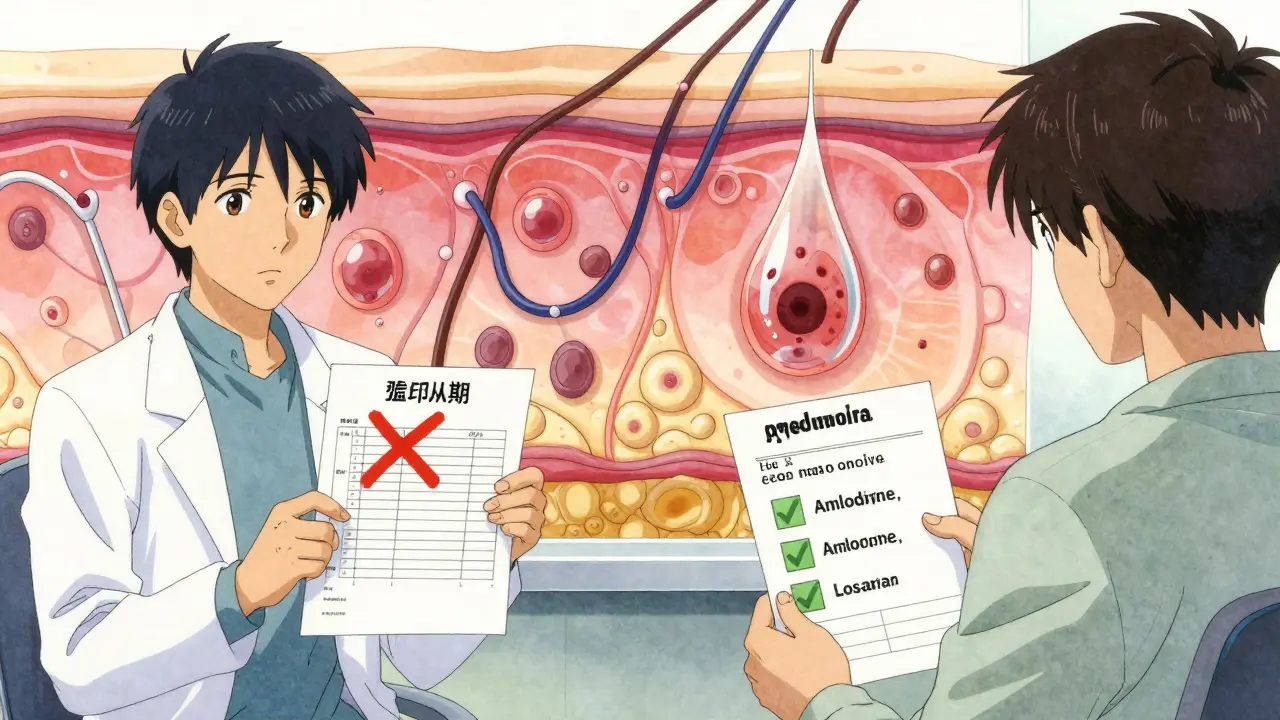
What to Do If You Suspect Your Medication Is Causing Flares
If you notice your psoriasis suddenly getting worse after starting a beta-blocker, don’t stop the medication on your own. High blood pressure and heart conditions can be deadly if left untreated. Instead, talk to your doctor-both your cardiologist and dermatologist.
The key diagnostic clue? Improvement after stopping the drug. If your skin clears up within weeks of discontinuing the beta-blocker, it’s likely the culprit. This is called “dechallenge,” and it’s the gold standard for confirming drug-induced psoriasis.
Doctors may suggest switching to a different class of blood pressure medication:
- Calcium channel blockers like amlodipine - Generally safe for psoriasis patients
- ARBs like losartan - Also low risk for skin flares
- ACE inhibitors like lisinopril - Can still cause skin issues, so use with caution
Studies show ARBs and calcium channel blockers are better tolerated by psoriasis patients than beta-blockers. In fact, some patients even see their skin improve after switching.
How to Manage the Flare While Switching Meds
While you and your doctor figure out a new treatment plan, you’ll need to manage the flare. Standard psoriasis treatments still apply:
- Topical steroids - Reduce inflammation and scaling
- Vitamin D analogues - Like calcipotriene, help normalize skin cell growth
- Phototherapy - UVB light therapy is effective and drug-free
- Systemic meds - For severe cases, options like methotrexate or biologics may be needed
Don’t wait until your skin is covered in plaques to act. Early intervention prevents complications like joint damage or infection. Keep a symptom journal: note when flares start, what you’re taking, and what seems to make it better or worse. This helps your doctors spot patterns faster.

Why This Matters More Than You Think
Psoriasis affects 8.1 million Americans. Beta-blockers are prescribed to tens of millions more. That means thousands of people are unknowingly making their skin worse every year.
The American Academy of Dermatology and the European Academy of Dermatology both now recommend that doctors ask psoriasis patients: “Are you on any beta-blockers?” during every checkup. It’s becoming standard practice.
And it’s not just about comfort. Severe psoriasis is linked to higher risks of heart disease, depression, and diabetes. If a medication meant to protect your heart is making your skin-and possibly your overall health-worse, that’s a serious trade-off.
That’s why research is moving toward safer alternatives. Pharmaceutical companies are testing new beta-blockers that target only heart receptors and avoid skin ones. In the future, genetic testing might help identify who’s at risk before they even start the pill.
Bottom Line: Don’t Ignore the Connection
If you have psoriasis and are on a beta-blocker, don’t assume your skin flare is just bad luck. Ask your doctor if your medication could be the cause. Bring up the timing-when did the flare start? Was it after you began the drug? Show them your symptom log. Push for a switch to a safer alternative if needed.
You don’t have to choose between heart health and skin health. With the right info and the right team, you can manage both.
Can beta-blockers cause psoriasis in people who never had it before?
Yes, though it’s less common than worsening existing psoriasis. Beta-blockers like metoprolol and propranolol have been linked to new-onset psoriasis in people with no prior history. The skin changes often look like plaque psoriasis but can sometimes appear as pustular or erythrodermic forms. The delay between starting the drug and the flare-anywhere from one to 18 months-makes it easy to miss the connection.
Is it safe to stop taking beta-blockers if my psoriasis flares up?
No, never stop a beta-blocker without talking to your doctor. These medications control blood pressure and heart rhythm, and stopping suddenly can cause rebound high blood pressure, heart attack, or arrhythmias. Instead, schedule a joint appointment with your cardiologist and dermatologist. They can evaluate whether switching to a different class of medication-like an ARB or calcium channel blocker-is safe for your heart.
Are all beta-blockers equally likely to trigger psoriasis?
No. Propranolol, metoprolol, atenolol, and pindolol carry the highest risk. Timolol, even in eye drops, can cause systemic effects. Some beta-blockers like nebivolol appear to have lower skin-related side effects, but data is limited. The key point: if one beta-blocker triggers your flare, others in the same class likely will too. Switching within the class won’t help.
How long does it take for psoriasis to improve after stopping a beta-blocker?
Improvement usually starts within 2 to 8 weeks after stopping the drug, but full clearance can take several months. The timeline depends on how long you’ve been on the medication, the severity of the flare, and whether you’re using topical or light treatments in the meantime. In some cases, the skin doesn’t fully return to its previous state, especially if the flare was severe or prolonged.
What are the best alternative medications for high blood pressure if I have psoriasis?
Calcium channel blockers like amlodipine and ARBs like losartan are generally considered safer for psoriasis patients. ACE inhibitors like lisinopril can still cause skin issues, so they’re not always ideal. Diuretics and alpha-blockers have mixed reports but are often tolerated. Your doctor will choose based on your heart health, kidney function, and other conditions. Always discuss skin history before starting any new blood pressure med.
Can eye drops with beta-blockers cause psoriasis flares?
Yes. Timolol eye drops, used for glaucoma, can be absorbed through the tear ducts into the bloodstream. There are documented cases where patients developed widespread psoriasis or transformed their plaque psoriasis into erythroderma after using timolol drops. If you have psoriasis and use glaucoma eye drops, tell your dermatologist. Alternative glaucoma treatments like prostaglandin analogs (latanoprost) don’t carry the same risk.
Is there a genetic test to predict if I’ll get psoriasis from beta-blockers?
Not yet for routine use, but research is promising. A 2024 study at Johns Hopkins and Mayo Clinic found that people with the HLA-C*06:02 gene variant-already linked to early-onset psoriasis-are more likely to develop drug-induced flares from beta-blockers. This could lead to genetic screening before prescribing, especially for high-risk patients. For now, if you have a family history of psoriasis or developed it young, assume you’re at higher risk and discuss alternatives upfront.

13 Comments
so i started metoprolol for my anxiety and 4 months later my elbows looked like dragon scales... i thought it was stress or my new laundry detergent. turns out it was the little blue pill. my dermatologist was like "oh yeah, that happens." like... thanks for the heads up, doc. 🤦♀️
This is such an important conversation. 💡 Beta-blockers save lives-but too often, we treat skin as an afterthought. If your heart’s healthy but your skin is screaming, it’s not "just psoriasis." It’s your body’s alarm system. Talk to both your cardiologist AND dermatologist. You deserve care that doesn’t pit one organ against another. 🌱❤️
Let me guess-this is another "Big Pharma is hiding the truth" post. People don’t get psoriasis because of beta-blockers. They get it because they’re stressed, eat too much sugar, and don’t "pray enough." I’ve seen 30+ cases. The correlation is coincidental. Stop blaming pills and start taking responsibility.
As a cardiologist with a patient population that includes over 200 individuals with psoriasis, I can confirm the association is clinically significant. The mechanism-reduced cAMP leading to keratinocyte hyperproliferation-is well-documented in peer-reviewed literature. Switching to a calcium channel blocker or ARB often resolves flares without compromising cardiovascular outcomes. This isn’t anecdotal-it’s evidence-based medicine.
I KNEW IT. I TOLD YOU ALL. The government is using beta-blockers to control the population’s skin health so we don’t notice how much our immune systems are being sabotaged by 5G and fluoride. My cousin’s neighbor’s dog got psoriasis after a vet prescribed propranolol for heart arrhythmia. Coincidence? I think NOT. Someone’s paying off dermatologists. #PsoriasisCoverup
i stopped taking my meds because i was tired of looking like a walking ashtray. now my bp is 190/110 and my cardiologist is mad. so who won? i look better but i might die. thanks, internet.
it’s not the beta-blockers... it’s the chemtrails. i’ve been reading about this for 3 years. the skin is just the first sign. your gut will go next. then your thoughts. they’re turning us into silent zombies with perfect blood pressure but no soul. i stopped all meds. now i drink moonwater and eat turmeric. i feel... lighter.
I had the same thing. Metoprolol → flare. Switched to amlodipine → cleared up in 6 weeks. No drama. No conspiracy. Just science. My skin’s been clear for 2 years now. Don’t suffer in silence. Talk to your docs.
why u so mad? i had psoriasis and beta blocker and now i better. u need to pray more. god fix skin. not pills. u just need faith. my uncle in india took no medicine. just mantra. skin gone in 7 days. u not trying hard enough.
Honestly, if you’re on a beta-blocker and have psoriasis, you probably shouldn’t have been prescribed it in the first place. This isn’t rocket science. It’s basic pharmacology. If your doctor didn’t know this, maybe they shouldn’t be prescribing anything. I’m surprised this isn’t on every med sheet.
Hey, I’ve been there. Flare on my scalp, elbows, knees-felt like I was wearing a second skin made of fire. I was terrified. But I found a doctor who listened. We switched meds. My skin didn’t just improve-it came back to life. You’re not broken. You’re not alone. And you don’t have to choose between living and looking normal. There’s a way forward. I’m rooting for you.
i read the article and i think its true because i saw this on reddit before and also my cousin's neighbor's cousin had the same thing so it must be real. also timolol eye drops are dangerous i heard on youtube. dont use them. use eyedrops with no beta blocker. also i think the government is hiding this because they make money from beta blockers. but i am not paranoid i am just informed
This is why America is falling apart. You people can’t even take a simple pill without crying about your skin. Back in my day, we took beta-blockers and didn’t whine about a few red patches. Get a grip. Your skin doesn’t define your worth. Maybe you need to stop being so sensitive.
Write a comment