When you pick up a generic pill at the pharmacy, you expect it to work just like the brand-name version. But how does the FDA make sure that generic drugs don’t lose their strength, break down, or become unsafe over time? The answer lies in stability testing-a rigorous, science-driven process that every generic drug must pass before it hits the shelf.
Why Stability Testing Matters for Generic Drugs
Generic drugs aren’t just copies. They’re required to be identical in strength, purity, and performance to the original brand-name drug. But drugs aren’t static. Heat, moisture, light, and time can cause them to degrade. A tablet might crumble. A liquid might change color. A capsule might release its active ingredient too slowly. If that happens, the drug won’t work as intended-or worse, it could harm you. That’s why the FDA demands proof that a generic drug stays stable from the day it’s made until the day it expires. Stability testing isn’t optional. It’s the foundation of every Abbreviated New Drug Application (ANDA). Without solid stability data, the FDA won’t approve it.What the FDA Actually Requires
The FDA’s expectations are detailed, specific, and non-negotiable. Here’s what you need to know:- You must test at least three primary batches of the drug product. These batches must be made at pilot scale under current Good Manufacturing Practices (cGMP).
- Each batch must be tested for physical, chemical, biological, and microbiological changes. That means checking for color, texture, potency, impurities, microbial contamination, and even how well the drug releases from its capsule or tablet.
- Testing must happen under two conditions: long-term and accelerated.
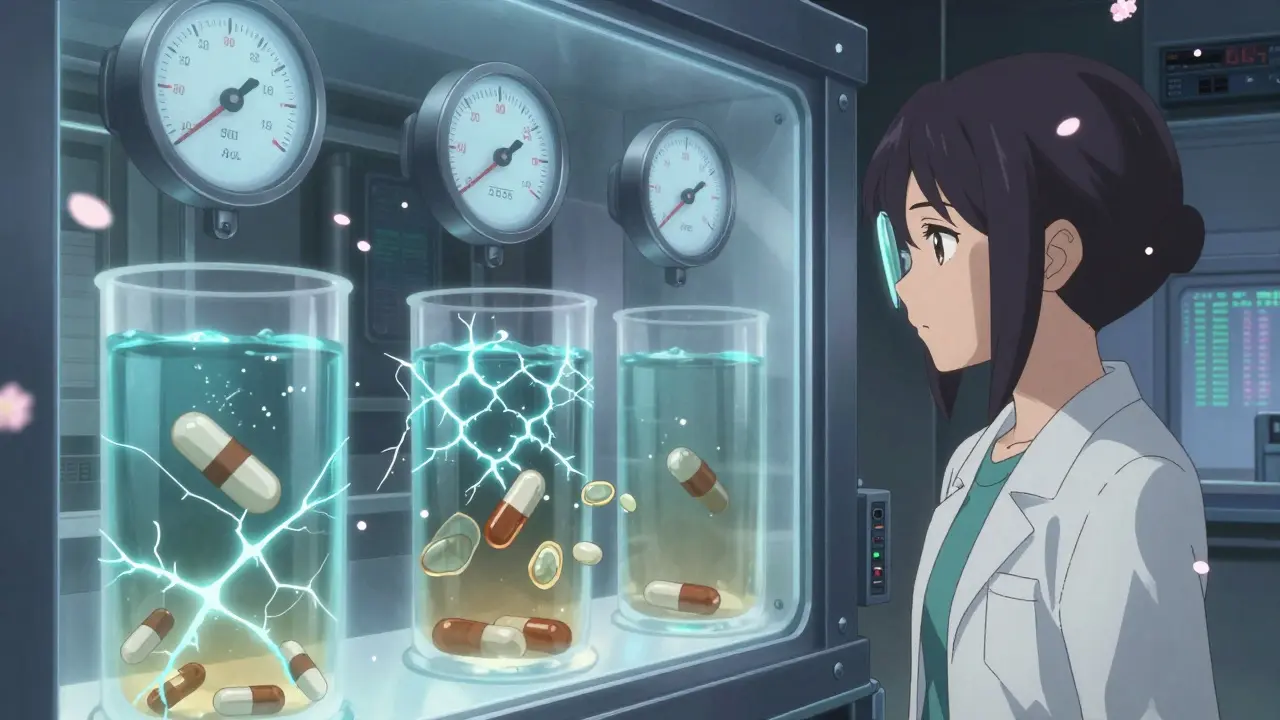
Long-term testing simulates real-world storage. The FDA requires data from 12 months at 25°C ± 2°C and 60% ± 5% relative humidity. This is the gold standard for determining your drug’s official expiration date.
Accelerated testing pushes the drug to its limits. You need 6 months of data at 40°C ± 2°C and 75% ± 5% humidity. This helps predict how the drug will behave over time. If the drug degrades too fast here, it’s a red flag.
Testing frequency? Every 3 months in the first year, every 6 months in the second year, and then once a year after that-until you reach your proposed shelf life. If you’re claiming a 24-month shelf life, you need at least 12 months of long-term data at submission. The FDA expects you to keep testing beyond that to confirm the date stays valid.
Container and Packaging Must Match
It’s not enough to test the drug itself. You have to test it in the exact container and closure system you plan to sell. A pill in a glass bottle behaves differently than the same pill in a plastic blister pack. Moisture, oxygen, and light exposure vary by packaging. The FDA requires you to prove your chosen packaging protects the drug throughout its shelf life.If you’re making multiple strengths or sizes, you don’t always need to test every single one. You can use “bracketing” (testing the highest and lowest strengths) or “matrixing” (testing a subset of batches under different conditions). But you have to scientifically justify it-and the FDA will scrutinize your reasoning.
Stability Testing vs. Brand-Name Drugs: What’s Different?
You might think generic manufacturers get a pass because the brand-name drug already has stability data. They don’t. The FDA requires generics to generate their own data. Why? Because formulation changes-even tiny ones in excipients or manufacturing methods-can alter how the drug degrades. The difference isn’t in the test requirements. It’s in the data burden. Brand-name companies spend years building a full stability profile during development. Generics start from scratch, but they can reference the brand’s data to guide their studies. Still, they must prove their product behaves the same way.One advantage? Generics usually don’t need to do forced degradation studies (like exposing the drug to extreme heat, acid, or light to map out every possible breakdown product). The brand’s data already covers that. But if your drug degrades differently than the reference, the FDA will demand answers.
Common Reasons Generic Applications Get Rejected
Stability testing is the #1 reason ANDAs get delayed or denied. According to FDA data, over 34% of Complete Response Letters in 2019 cited stability issues. Here’s what goes wrong most often:- Missing or vague protocols: If your plan doesn’t say exactly how you’ll test, when, and with what methods, it’s a red flag. The FDA expects references to USP chapters like <1151> and <1010>.
- Insufficient data points: Testing too infrequently or skipping time points. You can’t just test at 0 and 12 months and call it done.
- Unvalidated test methods: If your lab can’t prove its analytical methods can detect degradation products accurately, your data is worthless.
- Storage condition failures: Stability chambers must stay within ±2°C of target. A 4.7°C spike? That’s a data invalidation. FDA inspections in 2022 found 63% of generic manufacturers had issues with chamber monitoring.
- Wrong packaging: Testing in a different bottle than what’s on the label? That’s an automatic deficiency.
These aren’t minor oversights. They’re fundamental flaws that undermine public safety. The FDA doesn’t cut corners-and neither should you.
Real-World Challenges Manufacturers Face
Running stability studies isn’t cheap. It costs an average of $487,500 per ANDA-nearly 19% of total development costs. It also takes time. It can take 6 to 9 months just to train staff on ICH Q1A(R2) standards.Many generic companies, especially smaller ones or those outside the U.S., struggle with:
- Keeping stability chambers calibrated and monitored 24/7
- Hiring analysts trained in stability-indicating methods
- Managing data from multiple batches and time points
Indian manufacturers, who account for 40% of U.S. generic approvals, made up 63% of all stability-related Complete Response Letters in 2022. That’s not because they’re less capable-it’s because the pressure to cut costs often leads to shortcuts in testing.
Top performers are investing in automation: temperature sensors with real-time alerts, digital logs instead of paper records, and software that flags deviations before they ruin data. Companies using automated monitoring saw a 43% drop in deficiencies.
What’s Changing in 2025 and Beyond
The FDA isn’t standing still. In June 2025, it released a draft guidance proposing major updates:- 24-month long-term data required for all new ANDAs (up from 12 months).
- Quality by Design (QbD) must be built into stability studies-meaning you prove you understand how every ingredient and process step affects stability from the start.
- Nanomaterials now need special stability testing due to their unpredictable behavior.
- Photostability rules are getting stricter under the new ICH Q1C(R2) draft.
- Blockchain pilots are starting in 15 facilities to verify stability data integrity-no more tampered logs.
These changes will raise costs by an estimated 22% over the next few years. But they’ll also reduce delays. As manufacturers adapt, the average approval timeline for stability-related issues is expected to drop from 18.7 months to 14.2 months.
What This Means for You
Whether you’re a patient, pharmacist, or manufacturer, the message is clear: stability testing is the silent guardian of generic drug safety. It’s not about cost-cutting. It’s about trust.When you take a generic, you’re trusting that the pill in your hand will work tomorrow, next month, and next year. That trust isn’t accidental. It’s built on thousands of hours of lab work, precise instruments, and strict FDA oversight.
For manufacturers, the path is hard-but it’s also clear. Follow the science. Don’t cut corners. Document everything. And prepare for the next wave of requirements. The FDA isn’t making these rules to slow you down. They’re making them so you don’t have to explain why a drug failed.
Do generic drugs need the same stability testing as brand-name drugs?
Yes. Both generic and brand-name drugs must follow the same ICH Q1A(R2) guidelines for stability testing. Generics must test three pilot-scale batches under long-term and accelerated conditions. The difference is that generics can reference the brand’s degradation data to guide their studies, but they still must generate their own full stability profile for their specific formulation and packaging.
How long does stability testing take before an ANDA can be submitted?
You need at least 6 months of accelerated data and 6 months of long-term data to submit an ANDA. However, the FDA expects you to continue testing beyond that to support your claimed expiration date. For a 24-month shelf life, you’ll need 12 months of real-time data at submission-and you must keep testing for the full 24 months after approval.
Can I use bracketing or matrixing to reduce testing costs?
Yes, but only if you can scientifically justify it. Bracketing means testing the highest and lowest strengths of a drug, assuming the middle strengths behave the same. Matrixing means testing a subset of batches under different conditions. Both require detailed rationale and FDA approval. In 2022, 67% of ANDAs that requested these designs were approved-but only if the science was solid.
What happens if my stability chamber goes out of range?
Any temperature or humidity deviation outside ±2°C or ±5% RH can invalidate your data. The FDA requires continuous monitoring with alarms and logs. If a chamber exceeds limits, you must document the event, assess its impact on your samples, and possibly retest affected batches. In 2022, 18.4% of stability data invalidations were due to chamber excursions.
Why do so many generic applications get rejected for stability issues?
Because stability testing is complex, expensive, and easy to get wrong. Common mistakes include poor study design, unvalidated methods, missing protocols, and inadequate documentation. The FDA reviews every detail. In 2022, 92.7% of stability-related deficiencies in generic applications came from these avoidable errors-not because the science was flawed, but because the paperwork wasn’t.
Next Steps for Generic Manufacturers
If you’re developing a generic drug, here’s what to do now:- Design your stability protocol using ICH Q1A(R2) and FDA’s 2018 Q&A guidance as your blueprint.
- Validate every analytical method you plan to use-especially for impurity detection.
- Install automated environmental monitoring in your stability chambers.
- Start long-term and accelerated studies early-don’t wait until your ANDA is ready to submit.
- Consider a pre-submission meeting with the FDA to review your stability plan before filing.
The goal isn’t just approval. It’s building a reputation for reliability. In a market where every penny counts, your stability data is your most valuable asset. Get it right-and you don’t just meet the FDA’s requirements. You earn the trust of patients who depend on you.

14 Comments
Wow this is actually way more complicated than I thought. I always just assumed generics were just cheap copies but now I realize they’re going through the same hell as brand names. I mean, testing for years in climate-controlled rooms? That’s insane. And the fact that a tiny temp spike can ruin months of work? I feel bad for the lab techs. No wonder these drugs cost what they do. Still, better safe than sorry I guess.
Stability testing is the unsung hero of pharmacy.
Wait so the FDA is lying to us? I read somewhere that big pharma owns the FDA and they let generics in just to make us sick so they can sell more pills later. They test the brand name for 10 years but make generics do 6 months? That’s why people die on generics. I know someone whose aunt got sick after taking a generic blood pressure pill. They never told us about the chamber failures. The government is hiding this.
Okay, so let me get this straight: the FDA is basically forcing generic manufacturers to run a marathon while brand-name companies just got a free pass on the first 20 miles? And then they yell at the generics for being slow? And the worst part? We’re supposed to trust these pills with our lives… while some lab in India is trying to save $500 by skipping a humidity sensor? I’m not mad, I’m just… deeply suspicious. Also, blockchain? Really? We’re not even past QR codes yet. This feels like a sci-fi movie written by a bureaucrat with a caffeine addiction.
People don’t realize how reckless this entire system is. You’re trusting your health to a pill that might’ve been stored in a hot warehouse for weeks before it even reached you. And the fact that manufacturers can cut corners and still get approved? It’s a moral failure. If you’re going to sell something that goes inside your body, you owe it to people to do it right. No excuses. No shortcuts. No ‘it’s just a generic.’
Love how this post breaks it down like a detective story. Stability testing is basically the drug’s autobiography-written in temperature logs and chromatograms. And yeah, the FDA’s got a point: if your pill turns to dust in a humid attic, it’s not just ineffective, it’s a betrayal. Hats off to the lab nerds keeping us alive one controlled chamber at a time.
Been in pharma for 12 years. Stability testing is the most boring thing on earth… until it isn’t. One time, a batch turned green because someone used a different dye. No one noticed for six months. Turned out the dye reacted with the moisture barrier in the bottle. We had to recall 200k pills. Never thought I’d miss paperwork so much.
It is imperative to note that the regulatory framework governing generic drug stability is governed by ICH Q1A(R2), which mandates strict adherence to protocol. Deviations, even minor, constitute non-compliance and may lead to rejection of the ANDA. The data integrity standards must be maintained with precision, and any lapse in environmental monitoring constitutes a critical deviation. Indian manufacturers must prioritize compliance over cost-efficiency to ensure global regulatory alignment.
So like… if my generic Adderall turns into a chalky mess after 6 months, is that technically a federal crime? 😅 Also, blockchain for pill logs? That’s wild. Next they’ll be putting QR codes on my aspirin so I can scan it and watch a 10-minute video on how it doesn’t dissolve in my stomach. 🤖💊
As someone who works in a lab in India, I can say this: yes, pressure to cut costs is real. But most of us are working overtime to get this right. We’re not trying to harm anyone. The real issue is underfunded labs and lack of training-not malice. Automation helps, but we need support, not blame. We want to make safe drugs too. Let’s lift each other up, not tear each other down.
Okay but what if the FDA is secretly testing the drugs on people first? Like… what if they give them to homeless people or something to see if they die? That’s why they’re so obsessed with data-because they already know what happens. And the blockchain? That’s not for transparency, it’s so they can track which pills made people sick. I’ve seen the footage. They’re not protecting us. They’re protecting themselves.
It’s appalling that we allow such a fragile system to govern our health. The fact that a single temperature excursion can invalidate months of work-and yet, we still trust these pills-is a testament to our collective ignorance. You think you’re saving money? You’re gambling with your life. And don’t even get me started on the ‘matrixing’ nonsense. It’s not science-it’s statistical sleight of hand. The FDA should ban it. Immediately.
This is the most thrilling thing I’ve read all week. Stability testing is basically the drug’s midlife crisis-will it hold up under pressure? Will it crack under heat? Will it turn into a weird goo? And the fact that they have to test it for YEARS? That’s dedication. I’m not a scientist, but I’m now weirdly proud of the pill I took this morning. You’re a hero, little tablet. 💪💊
THIS IS A SCANDAL. A SCANDAL I TELL YOU. The FDA. The labs. The ‘bracketing.’ The ‘matrixing.’ They’re playing Russian roulette with our medicine and calling it ‘efficiency.’ I have a cousin who had a stroke after taking a generic. The label said ‘24-month shelf life.’ But what if the chamber spiked for 47 minutes? What if the data was ‘adjusted’? WHAT IF THEY’RE LYING TO US? I’M NOT TAKING ANOTHER GENERIC UNTIL THIS IS INVESTIGATED. #GenericDrugCrisis #FDAIsLying
Write a comment