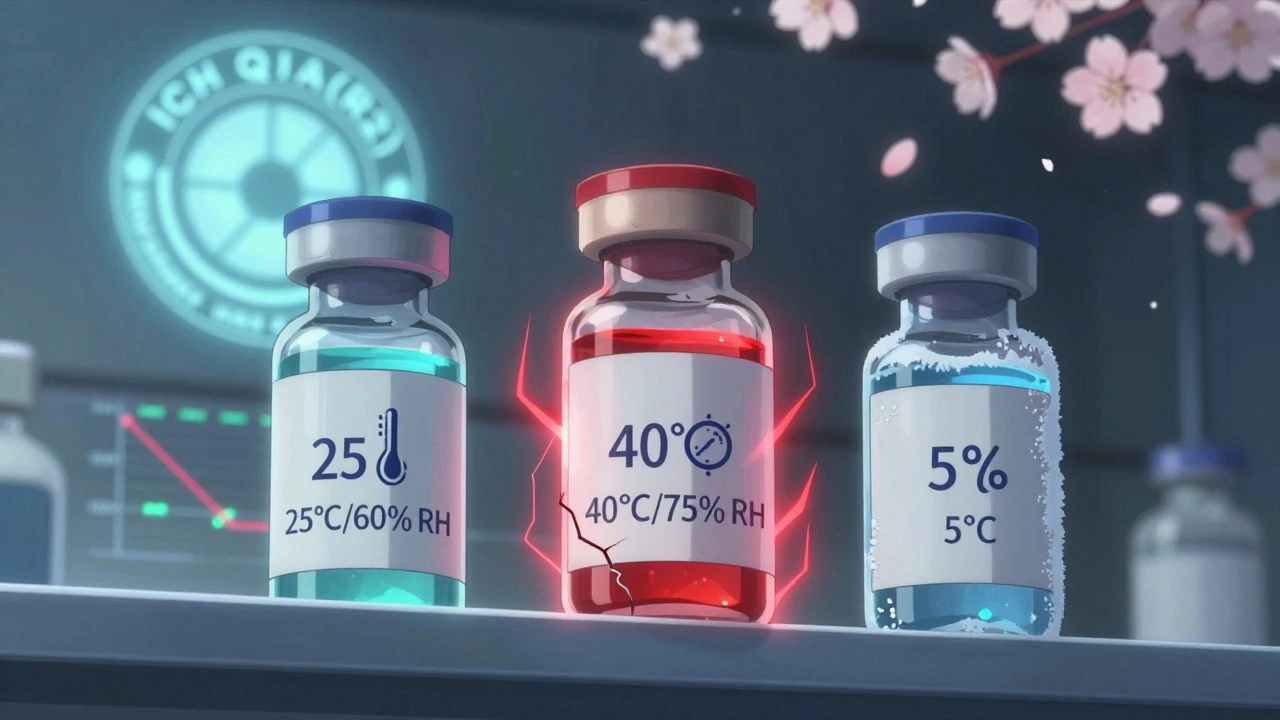
When a pill, injection, or vaccine leaves the factory, it needs to stay safe and effective for months-even years-no matter where it ends up. That’s where stability testing comes in. It’s not optional. It’s not a suggestion. It’s the law. And at the heart of every stability study are two non-negotiables: temperature and time.
Why Temperature and Time Matter
Pharmaceuticals aren’t like canned food. They don’t just sit on a shelf. Heat, humidity, and time can break them down. A drug might lose potency. A liquid might turn cloudy. A tablet might crumble. That’s not just bad for business-it’s dangerous for patients. The global standard for how to test this is ICH Q1A(R2). First published in 2003, it’s still the rulebook today. The FDA, EMA, Health Canada, and nearly every major regulator follow it. That means if you’re making a drug for the U.S., Europe, or Canada, you’re using the same temperature and time conditions. No guessing. No shortcuts.The Three Testing Zones: Long-Term, Accelerated, and Intermediate
There are three main types of stability tests, each with fixed conditions.- Long-term testing is what determines your product’s real shelf life. It runs for years. The two standard conditions are: 25°C ± 2°C at 60% RH ± 5% RH or 30°C ± 2°C at 65% RH ± 5% RH. Which one you pick depends on where your product will be sold. If you’re targeting tropical markets, you go with 30°C/65% RH. If you’re selling in Europe or Canada, 25°C/60% RH is often used.
- Accelerated testing is the stress test. It’s run at 40°C ± 2°C and 75% RH ± 5% RH for 6 months. This isn’t meant to predict real-world performance-it’s meant to find problems fast. If your drug degrades badly here, you know you’ve got a design flaw. This condition was chosen because it’s hot enough to speed up degradation but not so hot that it melts excipients or causes unrelated chemical reactions.
- Intermediate testing is the backup plan. It’s only required if your long-term study is done at 25°C and your accelerated test shows a significant change. Then you run it at 30°C/65% RH for 6 months to bridge the gap. This helps regulators understand if the product will hold up in warmer climates without forcing you to run full 12-month studies everywhere.
How Long Do You Have to Test?
Time isn’t flexible. You can’t just run a 3-month test and call it done.- For long-term studies, you need at least 12 months of data when you submit your application to the FDA. The EMA allows 6 months if you’re using Option B, but that can delay global approval. If you’re aiming for worldwide sales, 12 months is safer.
- Accelerated testing is always 6 months. No exceptions.
- Testing doesn’t stop at 12 months. You keep going-at 18, 24, and even 36 months-to prove your product lasts until its expiration date.
Sampling happens at 0, 3, 6, 9, 12, 18, 24, and 36 months. Early time points are more frequent because that’s when degradation is most likely to show up. If your drug is unstable, you’ll know by month 3 or 6.

Refrigerated and Frozen Products Have Their Own Rules
Not all drugs sit at room temperature. Insulin, vaccines, and some biologics need refrigeration-or even freezing.- For refrigerated products, long-term storage is at 5°C ± 3°C for at least 12 months.
- Accelerated testing for these isn’t 40°C. It’s 25°C ± 2°C at 60% RH for 6 months. Why? Because freezing and thawing are the real threats, not heat. Testing at 40°C would melt ice crystals and create false failures.
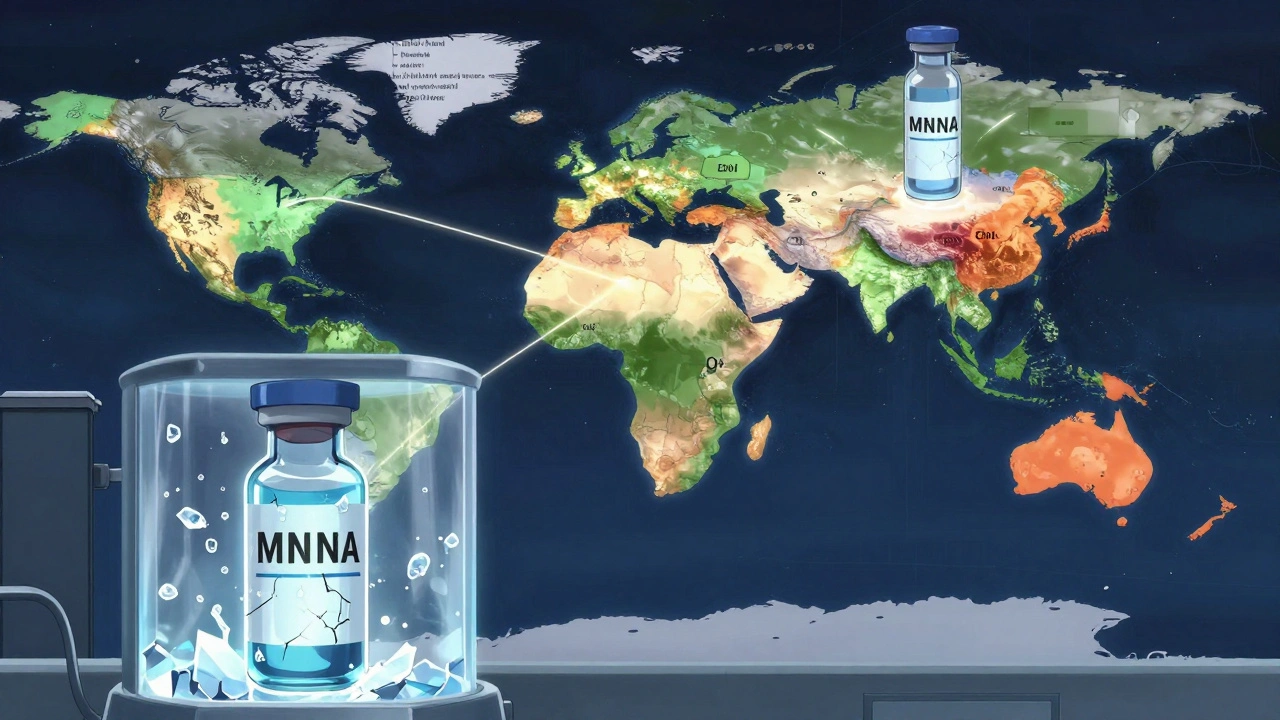
Some products, like mRNA vaccines, are even more sensitive. They require ultra-cold storage. For those, ICH guidelines don’t fully cover the risks. Companies have to design their own studies based on real-world transport data-like how long a shipment spends outside the cold chain.
Global Climates Change the Game
The world isn’t one climate. ICH recognizes five zones:- Zone I (Temperate): 21°C / 45% RH
- Zone II (Subtropical): 25°C / 60% RH
- Zone III (Hot-Dry): 30°C / 35% RH
- Zone IVa (Hot-Humid): 30°C / 65% RH
- Zone IVb (Hotter, Higher Humidity): 30°C / 75% RH
If you’re selling in India, Brazil, or Southeast Asia, you’re in Zone IVa or IVb. That means your long-term study must run at 30°C/65% RH-or higher. Many companies run two parallel studies to cover both temperate and tropical markets. That doubles the cost and time. One study can take 18 months. Two? You’re looking at 30+ months before launch.
What Counts as a “Significant Change”?
This is where things get messy. ICH Q1A(R2) says a product has failed if:- Assay changes by more than 5%
- Any impurity exceeds its specification
- Physical appearance changes (color, texture, clarity)
- Any other critical quality attribute falls out of range
But here’s the problem: “significant change” isn’t defined with hard numbers for every test. A 4.8% drop in potency might be statistically insignificant, but if your spec is 95-105%, regulators will still reject it. One Pfizer quality analyst shared a case where a 0.3% increase in an impurity caused a full recall-even though the impurity was harmless. It was just over the limit.
That subjectivity leads to delays, disagreements, and even recalls. Teva had to pull 150,000 vials of Copaxone® in 2021 because their stability test missed aggregation at 40°C. Merck, on the other hand, used intermediate testing to catch a polymorphic shift in Keytruda® before it reached patients.
Real-World Challenges: Chambers, Humidity, and Human Error
It’s not just about setting the numbers. It’s about keeping them.- Stability chambers must hold temperature within ±0.5°C and humidity within ±2% RH. Most don’t. A 2023 survey found 78% of labs had at least one temperature excursion over ±2°C during a 12-month study.
- Humidity control is a nightmare in dry climates. Some labs install dual-loop systems to reduce RH swings from ±8% to ±3%.
- Mapping a chamber takes weeks. Temperatures can vary by 1.8°C from top shelf to bottom. If your sample sits in a hot spot, your data is garbage.
- Photostability? That’s another layer. ICH Q1B requires testing under UV and visible light. Many companies skip it-until they get a warning letter.
And the paperwork? A single stability dossier can be 500 pages long. Every temperature log, every test result, every change in protocol must be documented. Miss one signature? Your entire study can be invalidated.
What’s Changing? The Future of Stability Testing
The ICH Q1A(R2) guidelines are 20 years old. They were made for aspirin and antibiotics-not mRNA vaccines or antibody-drug conjugates.- Companies are now using predictive modeling. Run tests at 50°C-80°C, and use math to predict 2-year stability in 3 months. The FDA has approved a few of these-but rejected 8 in 2022-2023. It’s still a gray area.
- Real-time release testing (RTRT) is being piloted. Instead of waiting 12 months to test a batch, you monitor the manufacturing process continuously. If every step is perfect, you assume the product is stable. It’s not widespread yet, but it’s coming.
- ICH is working on Q1F, a new update expected in late 2024. It will cover complex products like cell therapies and lipid nanoparticles-things that degrade in ways old tests can’t catch.
By 2030, McKinsey predicts 60% of stability data will come from models, not physical testing. But regulators are slow. They still want jars on shelves, not algorithms on screens.
What Happens If You Get It Wrong?
In 2022, the FDA issued 27 warning letters for stability testing failures. That’s not a typo. Twenty-seven. One company had to recall 200,000 doses of a generic antibiotic because humidity caused clumping. Another lost its license after failing to detect degradation in a biologic.It’s not just recalls. It’s lost revenue. Delayed launches. Damaged reputation. A single stability failure can cost $10 million or more in lost sales and legal fees.
There’s no room for guesswork. You follow the numbers. 25°C or 30°C. 60% RH or 75% RH. 6 months. 12 months. 36 months. You document everything. You validate your chambers. You test early and often.
Because when it comes to patient safety, stability isn’t a science project. It’s the last line of defense.
What are the standard temperature and humidity conditions for long-term stability testing?
The two standard conditions are 25°C ± 2°C at 60% RH ± 5% RH or 30°C ± 2°C at 65% RH ± 5% RH. The choice depends on the target market’s climate zone. For example, products sold in tropical regions use 30°C/65% RH, while those for temperate regions often use 25°C/60% RH.
How long does accelerated stability testing last?
Accelerated testing lasts exactly 6 months under conditions of 40°C ± 2°C and 75% RH ± 5% RH. This is a global standard under ICH Q1A(R2) and is used to identify potential degradation issues quickly.
Do refrigerated products use the same stability conditions as room-temperature products?
No. Refrigerated products are stored long-term at 5°C ± 3°C. Their accelerated test is conducted at 25°C ± 2°C and 60% RH ± 5% RH for 6 months-not at 40°C. This is because freezing and thawing, not heat, are the main risks for these products.
Why is 40°C used for accelerated testing?
40°C was chosen because it’s hot enough to accelerate degradation without causing unrelated physical changes like melting excipients. It simulates extreme shipping conditions, not normal storage. This allows manufacturers to predict shelf life in a shorter time frame.
What happens if a stability study fails?
A failure can trigger regulatory actions like warning letters, product recalls, or withdrawal of marketing authorization. In 2022, the FDA issued 27 warning letters specifically for stability testing deficiencies. Even small deviations-like a 0.3% impurity increase-can lead to recalls if they exceed specifications.
Are ICH stability guidelines the same worldwide?
Yes, ICH Q1A(R2) is harmonized across the U.S. (FDA), Europe (EMA), Canada (Health Canada), Japan, and most other major markets. Minor differences exist-for example, the EMA allows 6 months of long-term data at submission, while the FDA requires 12 months-but the core temperature and time conditions are identical globally.

14 Comments
This is why so many drugs fail in real world conditions. They test in perfect labs but ship through 110°F warehouses. No one talks about the supply chain.
The 40°C/75% RH thing is a joke if your product sits on a truck in Dubai for 3 days.
The real issue isn't the guidelines-it's the enforcement. I've seen labs skip humidity mapping because "it's too expensive." But when a child gets a degraded vaccine because the fridge failed during transit, who pays? Not the lab. Not the distributor. The patient does.
I mean… if you’re not using ICH Q1A(R2) you’re basically doing homebrew pharmacology. It’s not even a debate. The fact that some companies still try to cut corners on stability testing is why we have recalls. And yes, I’ve read the document. All 500 pages. Twice.
Yessss! This is why I love pharma science-so precise, so critical. No room for error. Every decimal point matters. If your impurity is 5.1% and the limit is 5%, you pull it. No questions. Safety first. Period.
In India, many companies use 30°C/65% RH even for export to Europe. It is expensive but safer. We do not want any product failure. Patient safety is above all.
What gets overlooked is that the 12-month requirement isn't just about data-it's about trust. Regulators don't just want numbers, they want proof that you've thought through every possible failure mode. That's why they ask for the 36-month data even if the label says 24 months. It's not about compliance, it's about confidence.
Love this breakdown. So clear. I work in supply chain and this is the stuff we fight for every day. If your stability data is solid, your whole logistics plan gets easier. No more panic when a shipment gets delayed.
The 40°C thing… it’s almost poetic isn’t it? A temperature chosen not because it’s realistic but because it’s *just* enough to break things without breaking the machine. Like a stress test for molecules. We’re testing not just drugs but the limits of chemistry itself.
I’ve seen chambers with ±3°C swings-so close to the ±2°C limit-and yet the data gets submitted anyway. And then the FDA comes in, finds the excursion log, and says, "This study is invalid." It’s not about being perfect-it’s about documenting that you’re trying. But most don’t. They just hope no one notices.
The real bottleneck isn't the testing-it's the analytical validation. If your HPLC method isn't stability-indicating, your entire dataset is garbage. We spent 8 months qualifying our LC-MS/MS for oligonucleotide impurities. No one talks about this part.
This is why I love my job. 😊 Every time we catch a degradation issue early, we prevent a hospital crisis. I’ve seen what happens when a vaccine degrades in transit. It’s not a lab problem-it’s a human problem. We’re the last line. Always.
The U.S. has the strictest rules. Europe lets you submit with 6 months. India? They barely monitor. If you're making drugs for the world, why not just follow the strictest standard? Why play games? We should all be on U.S. standards. Full stop.
I just… I don’t know. Why do we need all this? Why can’t we just trust the manufacturers? Why do we need 36 months of data? Why not let the market decide? It’s like we’re treating patients like lab rats. It’s exhausting. And the paperwork… it’s a nightmare.
This is why I became a pharma tech. Knowing that the pill someone takes was tested for years, in every possible condition, to make sure it won’t fail… that’s powerful. We’re not just making drugs-we’re making safety. ❤️
Write a comment