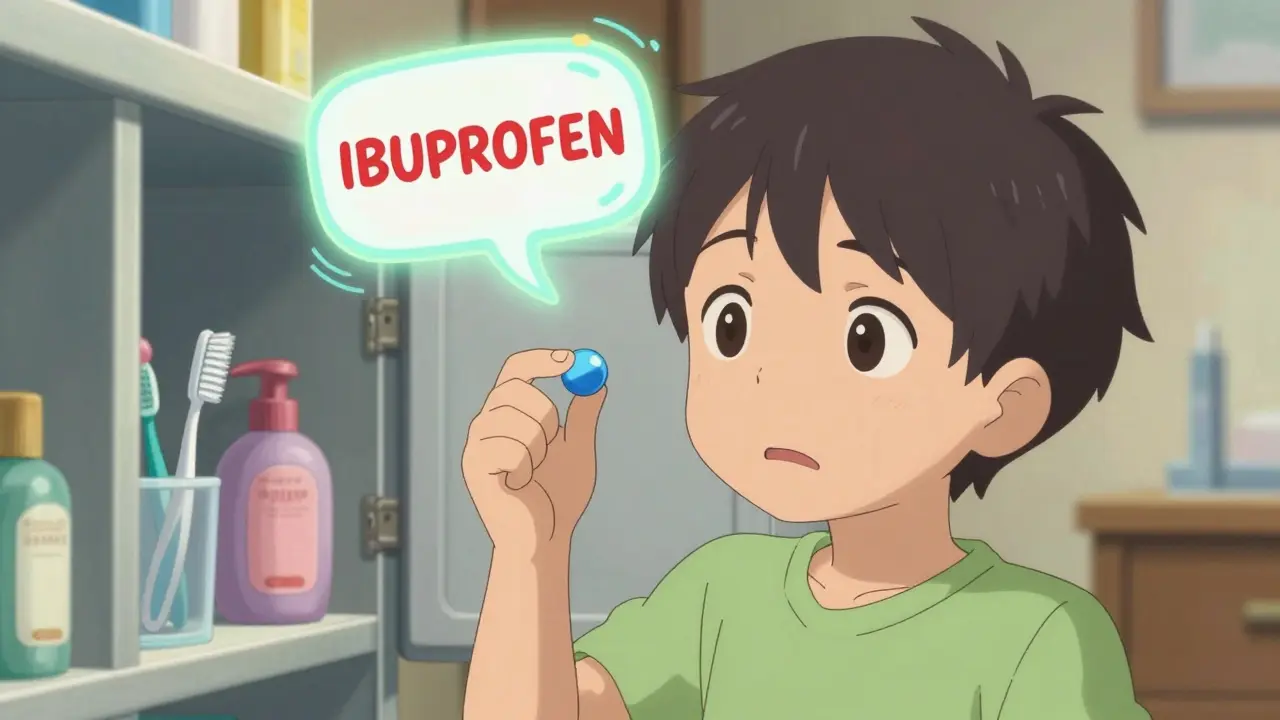
Most parents assume kids don’t need to know the difference between brand-name and generic medicines. But here’s the truth: children are more likely to encounter pills at home than you think. A 2023 study found that 62% of kids under 10 have opened a medicine cabinet without asking - and nearly half of them didn’t know what they were holding. Teaching kids about medicines isn’t about scaring them. It’s about giving them the tools to stay safe.
Why Kids Need to Understand Medicines
Children aren’t just tiny adults when it comes to medicine. Their brains are still learning cause and effect. If a kid sees Mom take a blue pill every morning and thinks, "That’s just a habit," they might try it themselves. Or if they find a bottle labeled "ibuprofen" in the bathroom and assume it’s candy because it looks like a gummy, that’s a real risk.
The goal isn’t to turn kids into pharmacists. It’s to teach them three simple things: Don’t touch medicines without permission, Medicines can be dangerous if used wrong, and Not all pills are the same - even if they look alike.
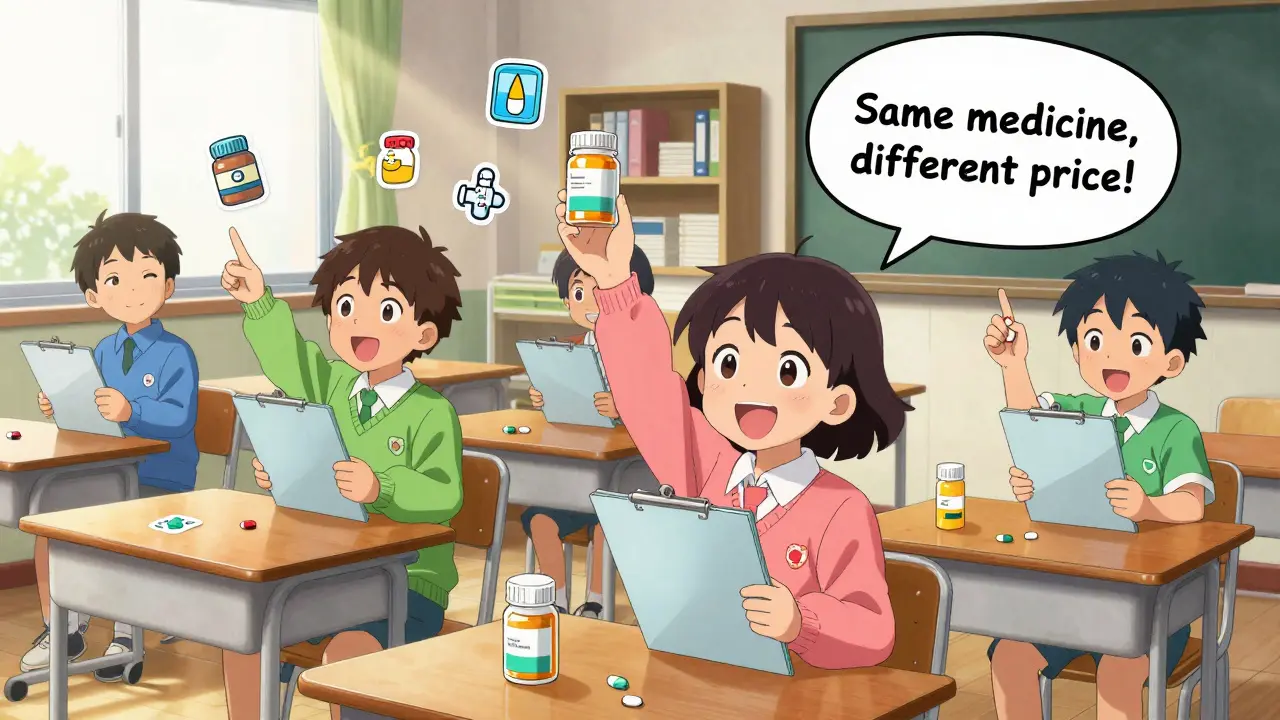
Programs like Generation Rx have been doing this for years. They don’t talk about patents or manufacturing. They use games, drawings, and role-playing. One activity called "Medication Safety Patrol" asks kids to find hidden pills around the classroom and decide if each one is safe to touch. Kids who go through this program are 70% more likely to tell an adult if they find medicine lying around.
What’s the Difference Between Brand and Generic Drugs?
Here’s the easiest way to explain it to a 7-year-old: "Imagine two different brands of toothpaste. One says "Crest," another says "Colgate." Both clean your teeth. But one costs more because of the name on the tube. Generic drugs are like the cheaper toothpaste - same job, different price tag."
For older kids, you can add: "The FDA makes sure generic drugs have the same active ingredient, strength, and how fast they work as the brand name. So if your doctor prescribes "amoxicillin," the pharmacy can give you the brand version or the generic - they’ll both fight the infection the same way."
But here’s what most parents miss: kids don’t care about the science. They care about the label. If they see "Amoxicillin 250mg" on one bottle and "Amoxi-Tab 250mg" on another, they think they’re different. That’s why teaching them to look at the name of the medicine - not the brand - is key. The active ingredient is what matters.
How to Talk to Kids About Medicine Without Scaring Them
Old-school drug education used fear: "One hit and you’re dead." That doesn’t work anymore. A 2022 study in the Journal of School Health found that fear-based lessons actually made kids more curious. Instead, use honesty and facts.
For kids under 8:
- Use toys or stuffed animals to act out "What if you found a pill?"
- Teach them to say: "I’ll ask Mom or Dad first."
- Point out medicine bottles in the house and say: "This is for sick people. Not for playing."
For ages 9-12:
- Let them help you read the label on a prescription bottle. "See this? This says how much to take."
- Compare a brand-name and generic pill side by side. "They’re both amoxicillin. The only difference is the price."
- Use real-life examples: "Your cousin took her medicine and got better. That’s why we take it."
For teens:
- Ask: "Have you ever heard someone say, ‘I took my mom’s Adderall to study’?"
- Explain how misusing prescription drugs is just as dangerous as using illegal ones.
- Share stats: "Over half of teens have never tried drugs. You’re in the majority."
What Schools Are Doing Right
More schools are ditching the old DARE model - the one with police officers telling kids "drugs are bad" - and switching to interactive, science-backed programs. Generation Rx, run by Ohio State University, is used in over 1,500 schools across the U.S. Their materials are free, available in English and Spanish, and designed for every grade from kindergarten to high school.
One 4th-grade class in Texas used the "Medicine Science and Safety" project book to build a pretend pharmacy. Kids sorted pills by type, wrote labels, and even designed warning signs. At the end of the unit, none of them could name a single candy that looked like a pill - but they all knew what to do if they found one.
High schools using the "Safety First" curriculum talk honestly about cannabis, vaping, and opioids. They don’t say "never." They say: "Here’s what we know. Here’s what happens to your brain. You decide." And guess what? Attendance for optional follow-up sessions jumped 45% after they switched.
What Parents Can Do at Home
You don’t need a lesson plan. Just start small.
- Store medicines out of reach - and locked. Even OTC pills like Benadryl or ibuprofen can be dangerous in large doses.
- Never say "This won’t hurt" when giving medicine. Say: "This helps you feel better, but it’s not candy."
- Let kids help you check expiration dates. "This one expired last year. We’ll throw it away."
- When picking up a prescription, say aloud: "This is amoxicillin. It’s for your ear infection. The generic version works the same."
- Use apps like MyTherapy or Medisafe to show kids how medicine schedules work. Make it part of the routine.
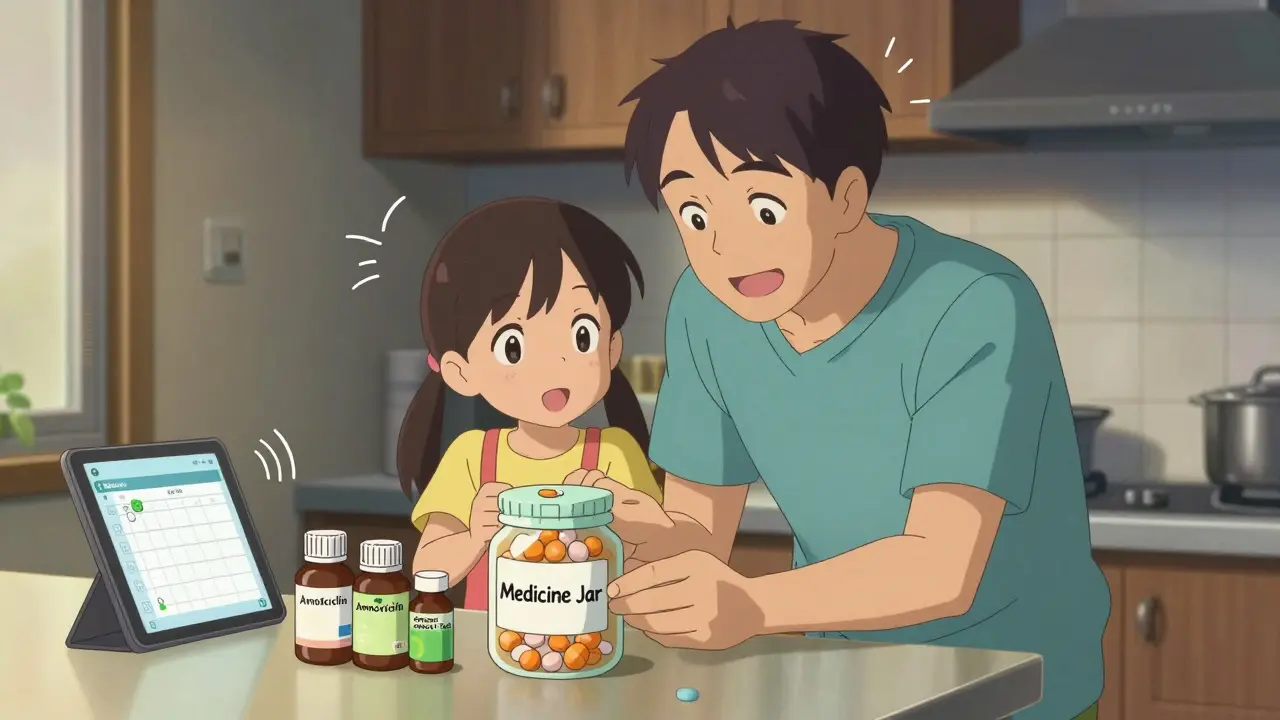
One dad in Halifax started a "Medicine Jar" on the counter. Every time someone took a pill, they put a sticker on the jar. After 30 days, they counted the stickers together. "We took 24 pills this month," he told his 6-year-old. "That’s one for every day we were sick. Now we know why we keep them safe."
Common Mistakes to Avoid
Even well-meaning parents make these errors:
- Using medicine as a bribe. "If you eat your veggies, I’ll give you a gummy vitamin." That teaches kids to associate medicine with reward.
- Keeping old prescriptions. A 2023 survey found 41% of homes with kids had expired or unused pills. That’s a risk.
- Assuming kids understand labels. "This says 5 mL." Kids don’t know what mL means. Show them with a spoon or syringe.
- Only talking about illegal drugs. Prescription misuse is the fastest-growing problem among teens. Don’t ignore it.
The Bigger Picture: Medicine Safety Is Mental Health Safety
Teaching kids about medicines isn’t just about avoiding poison. It’s about building trust. When kids learn that medicines are tools - not magic, not candy, not punishment - they start to see their body as something to care for, not mess with.
Programs that combine medicine safety with emotional health (like SEL - social-emotional learning) see the best results. Kids who understand how to ask for help, manage stress, and say "no" are less likely to misuse drugs later. That’s why the best school programs now teach refusal skills, emotional awareness, and medicine facts all together.
It’s not about being perfect. It’s about being consistent. One conversation. One label read aloud. One time you say, "This is generic, but it works just as well." Those moments add up.
Can kids really understand the difference between brand and generic drugs?
Yes - but not the way adults think. Kids don’t need to know about bioequivalence or FDA approval. They just need to know that two pills with the same name (like "ibuprofen") do the same thing, even if one costs less. Use simple comparisons: "It’s like two different brands of cereal. Same nutrition, different price."
What if my child finds a pill and takes it?
Stay calm. Call Poison Control immediately (1-800-222-1222 in the U.S. and Canada). Don’t wait for symptoms. Keep the pill bottle - even if it’s empty - because the label tells them what was taken. Teach kids to never swallow anything they find, even if it looks like candy. Practice this scenario with role-play so they know what to do.
Are generic drugs less effective for kids?
No. The FDA requires generic drugs to have the same active ingredient, dose, strength, and how quickly they work as the brand name. Studies show they work just as well in children. The only difference is the price - and sometimes the shape or color. That’s why it’s important to teach kids to look at the medicine name, not the brand.
How often should I talk to my child about medicine safety?
Make it part of everyday life. When you hand them a pill, say what it is. When you refill a prescription, let them help you read the label. When you throw out an old bottle, explain why. You don’t need a formal talk. Just keep it real, simple, and consistent. By age 10, most kids can explain what medicine is for and why they shouldn’t touch it without permission.
Is it too early to talk about drug abuse with young kids?
Not if you’re talking about medicine safety first. You don’t need to mention marijuana or opioids to a 6-year-old. But you can say: "Some medicines are strong. If someone takes too many, it can hurt them. That’s why we keep them locked up." Later, as they grow, you can expand the conversation. The earlier you start with safety, the easier it is to talk about bigger risks later.

9 Comments
Been doing this with my 7-year-old in Delhi for a year now. We keep all meds locked but let him help me check expiration dates. He calls them "power pills" and says "only grown-ups get to use them." No drama, no fear. Just clear rules. Works better than any lecture.
Also, we use the same logic for vitamins. "This isn’t candy, it’s medicine for your body." He actually asks now when he sees a pill bottle. That’s huge.
Indian homes are full of leftover antibiotics. We throw them out monthly. No shame. Just safety.
Teaching kids this early? Best thing I’ve done as a dad.
lol so now we gotta turn kids into pharmacists? next they’ll be teaching them how to read the tiny print on the bottle. what’s next? a 5th grade class on bioequivalence? this is how you end up with kids who think ibuprofen is just a flavor.
my cousin’s kid took a whole bottle of children’s tylenol because it "looked like gummies." they had to pump his stomach. now he’s terrified of medicine. perfect.
all this "education" just makes kids curious. i say lock it, don’t talk about it. out of sight, out of mind. they’ll figure it out when they’re teens and start stealing adderall from the bathroom cabinet anyway.
While I appreciate the intent behind this initiative, the underlying assumption-that children require structured pharmacological education-is both empirically unsound and societally dangerous. The FDA’s regulatory framework exists precisely to ensure that pharmaceutical products are safe for public consumption without requiring consumer literacy. Introducing children to drug nomenclature, dosage equivalence, and active ingredients normalizes pharmaceutical engagement at an age when neurological development prioritizes boundary formation, not pharmacokinetic analysis.
Furthermore, the normalization of generic substitution as a pedagogical tool inadvertently promotes cost-based decision-making in healthcare, which may erode trust in regulatory bodies. The FDA’s bioequivalence standards are not a matter of public discourse-they are a matter of professional oversight.
I urge educators and parents to reconsider the transmission of medical authority to minors. This is not empowerment. It is premature commodification of clinical knowledge.
Simple version: pills are not candy. That’s it.
My 5-year-old knows if she sees a pill, she tells me. No questions. No touching. Just "tell Mom."
We don’t explain generics. We don’t talk about FDA. We just say "this helps you feel better, but it’s not food."
And we keep everything locked. Even the aspirin. Even the children’s vitamin.
That’s all you need. No games. No charts. Just rules.
Okay but let’s be real-how many parents actually do this? Like, the "let your kid help read the label" thing? That’s cute in theory. In reality, most people are too tired to even remember to refill the prescription, let alone turn it into a teachable moment.
And don’t get me started on the "Medicine Science and Safety" project book. That’s a whole curriculum? For 4th graders? Who’s paying for this? Who’s training the teachers? This feels like another well-meaning program that burns out after 6 months because no one has time.
Also, why are we teaching kids to care about generic vs brand? That’s a pharmacy billing issue, not a child safety issue. The real problem is unlocked cabinets. Lock it. Done.
I just want to say how deeply moved I am by this article. I’ve spent the last three years trying to teach my daughter about medicine after she found my old anxiety pills and thought they were "magic sleep stones." I didn’t know what to do. I cried. I panicked. I Googled for hours. I felt like such a failure as a parent.
But then I started reading about Generation Rx. I watched their videos. I printed out their coloring sheets. I let her draw the pills. We made a little "medicine altar" on the counter with a lockbox and stickers. She now says, "This is for healing, not for playing."
It’s not perfect. Some days she still sneaks a peek. But now she comes to me. Not because she’s scared. Because she trusts me.
And that’s worth more than any study. More than any statistic. More than any brand name or generic label.
If you’re reading this and you’re struggling? You’re not alone. Start small. Just one conversation. One sticker. One locked box. It changes everything.
So we’re teaching kids to be pharmacy interns now? That’s adorable. Next up: mandatory CPR certification before kindergarten.
Let me guess-the same people who think kids need to know the difference between brand and generic are also the ones who make them memorize the periodic table before they can tie their shoes.
Here’s a radical idea: keep medicine locked. Say "don’t touch" and mean it. No role-playing. No stickers. No pretend pharmacies.
Let them grow up. Let them be kids. Let them be curious. And when they’re old enough to ask "why?"-then you explain.
Not before. Not because some nonprofit thinks they need a curriculum.
Just… let them be children.
Lock it. Don’t explain. Don’t dramatize. Just be consistent. Kids don’t need lectures. They need boundaries. And they’ll follow your lead if you’re calm and clear. No games. No charts. No fear. Just quiet rules.
my kid saw a pill once and asked if it was a lollipop. i said no. he said why. i said because it’s for sick people. he said oh. that was it. no lesson. no video. no sticker chart. just a simple answer. kids are simple. we overcomplicate it.
Write a comment