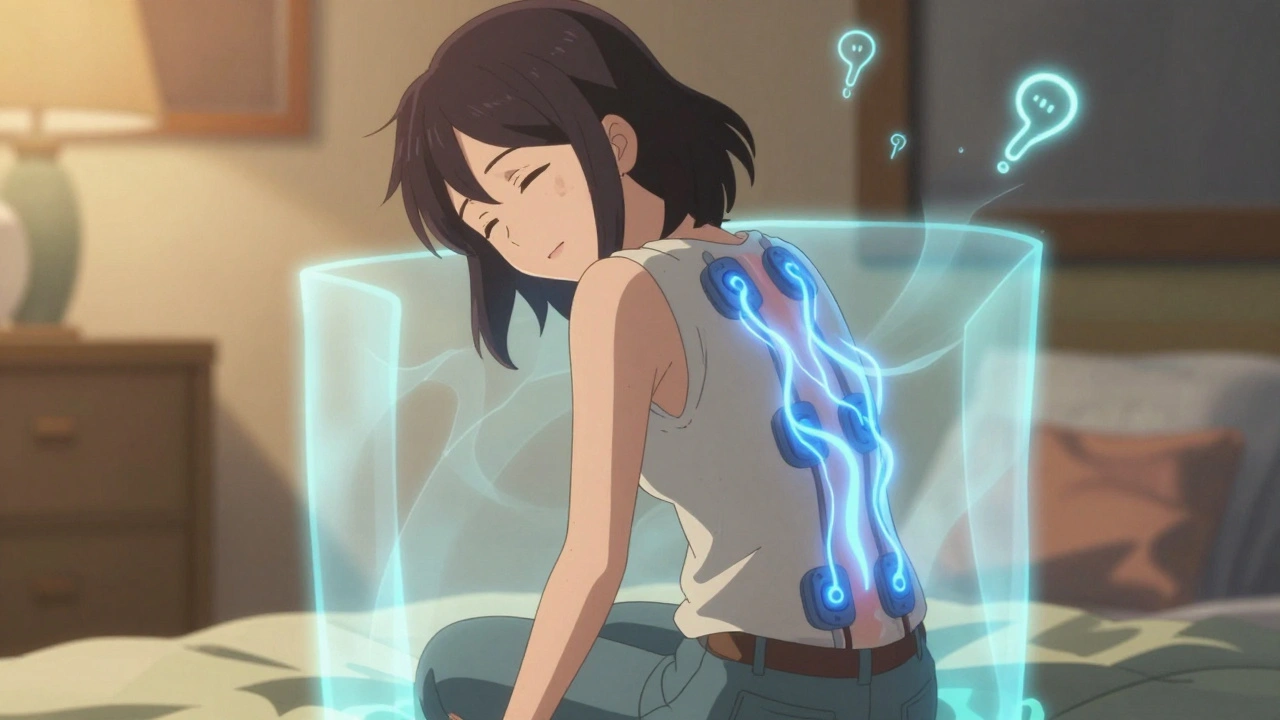
When your back flares up, your knees ache, or labor pains hit hard, reaching for a pill isn’t always the best-or safest-option. That’s where TENS therapy comes in. Transcutaneous Electrical Nerve Stimulation doesn’t cure pain, but it can turn down the volume on it-fast, without drugs, and right at home.
What TENS Therapy Actually Does
TENS uses mild electrical pulses sent through sticky pads placed on your skin. These pulses don’t shock you-they tingle. That tingling is the key. It’s not random. It’s designed to interfere with pain signals before they reach your brain.
The science behind it goes back to 1965, when researchers Melzack and Wall proposed the Gate Control Theory. Think of your nerves like a gate. Pain signals try to rush through, but when you turn up the tingling from TENS, it floods the gate with non-pain signals. The brain gets busy processing those, and the pain gets pushed to the background.
There’s another layer, too. Lower-frequency TENS (2-5 Hz) can trigger your body to release natural painkillers-endorphins. It’s like your body’s own morphine, but without the side effects. That’s why some people feel relief that lasts even after the machine turns off.
How TENS Works for Different Types of Pain
Not all pain is the same, and neither are TENS settings. The device lets you tweak frequency, intensity, and pulse width to match your pain type.
- Acute pain (like after surgery or a sprained ankle): Use high-frequency TENS (50-100 Hz). This gives you that strong, tingling buzz that blocks pain fast. Most people feel relief within minutes.
- Chronic pain (like osteoarthritis or long-term back pain): Low-frequency (2-5 Hz) works better here. It’s slower to kick in but gives longer-lasting relief by boosting endorphins.
- Labor pain: A 2020 Cochrane Review found TENS reduced pain scores by 31% compared to no treatment. Many women use it during contractions because it gives them control-no needles, no drugs, just a small device strapped to their back.
But here’s the catch: TENS doesn’t work for everyone. It’s great for localized pain-your shoulder, your lower back, your knee. It’s less effective for widespread pain like fibromyalgia, where only about 38% of users get meaningful relief.
Real Results: What Studies and Users Say
Let’s look at numbers. A 2018 study found people using TENS after surgery cut their opioid use by nearly 27%. They also had 18% less nausea and 22% less drowsiness. That’s huge when you consider how many people get stuck in a cycle of pain pills and side effects.
For osteoarthritis, TENS gave 36% more pain relief than a placebo in one trial. That’s better than many over-the-counter creams. But for chronic low back pain, a 2015 review showed manual therapy (like massage and mobilization) worked better over time. TENS? It helped in the short term, but didn’t beat hands-on care after six weeks.
On the user side, reviews tell a similar story. On Amazon, 78% of people who liked TENS said they felt immediate relief. 82% appreciated not having to take pills. But 34% complained about skin irritation. 27% said they just couldn’t get the intensity high enough without it hurting.
One Reddit user put it simply: “It works great for my sciatica-but only if I crank it to 85%. Anything less just tickles. And the battery dies in 90 minutes.”
How to Use TENS Correctly (Most People Get It Wrong)
Here’s the truth: 68% of TENS failures happen because people don’t set the intensity high enough. If you’re not feeling a strong, buzzing sensation, you’re not getting the full effect.
But here’s the balance: it should be intense-not painful. You want it to feel like a deep, rhythmic buzz, like a phone on vibrate but stronger. If it hurts, turn it down. If it’s barely noticeable, turn it up.
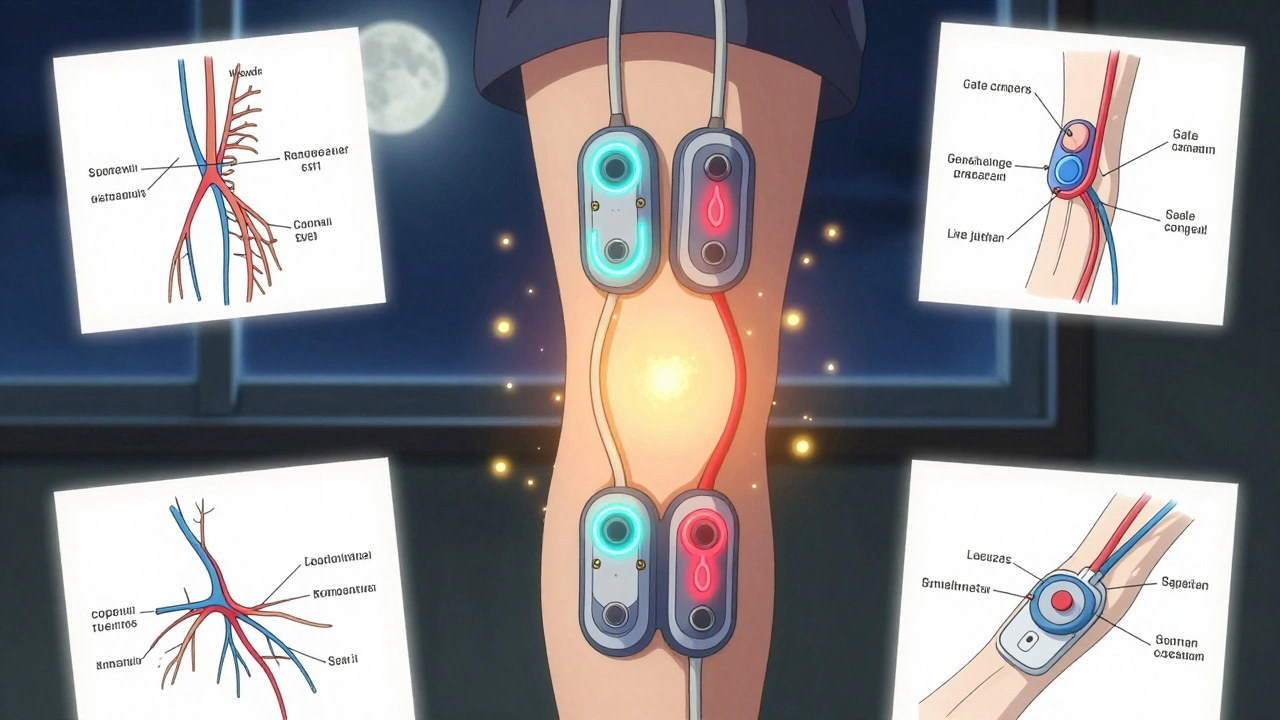
Placement matters just as much. Put the electrodes within 2-3 cm of where it hurts-or directly over the nerve pathway. For lower back pain, place one pad on each side of your spine, just above the beltline. For knee pain, put one above and one below the kneecap.
Most home units come with basic instructions. But if you’re serious about it, spend 3-5 sessions with a physical therapist. They’ll show you where to place the pads for your exact condition. A 2021 study found 41% of treatment failures were due to bad placement.
Pro tip: Use conductive gel under the pads if your skin is dry or hairy. It cuts signal loss by 63%, according to Electrotherapy.org. You’ll get better results and fewer annoying sparks or pops.
What to Look for in a TENS Unit
Not all TENS machines are created equal. You’ve got budget models under $50 and professional-grade units over $300.
- For beginners: Look for pre-set programs. Brands like Omron and TechCare have buttons labeled “Back Pain,” “Knee,” “Shoulder.” Easy to use, no guesswork.
- For serious users: Go for dual-channel units. That means you can treat two areas at once-like both shoulders or both knees. Also, check for adjustable pulse width and burst mode. These give you more control.
- Smart features: Newer models like NeuroLoop AI use sensors to adjust settings automatically based on your skin’s resistance. They’re pricier ($250+), but they cut down the trial-and-error.
Check for FDA clearance. In 2022 alone, 32 TENS devices got cleared. That’s your baseline for safety. Avoid cheap knockoffs on Amazon that don’t list clearance numbers.

Who Should Avoid TENS
TENS is safe for most people-but not everyone.
- Don’t use it if you have a pacemaker or other implanted electronic device. The electrical pulses can interfere.
- Avoid placing pads on your head, neck, or over your heart. That’s a no-go zone.
- If you’re pregnant (outside of labor), talk to your doctor first. Some providers advise against it in the first trimester.
- If you’re on opioids, low-frequency TENS might not work as well. Research shows opioids can block the endorphin response.
- Don’t use it on broken or irritated skin. That’s asking for a rash or burn.
The Future of TENS
TENS isn’t going away. In fact, it’s growing. The global market hit $500 million in 2022 and is expected to top $780 million by 2028. Why? Because of the opioid crisis.
The CDC now lists TENS as a recommended first-line treatment for chronic pain. Insurance? Medicare covers it under code E0720-reimbursing about $150 per device. That’s why more physical therapy clinics are using it as standard care.
Companies like Amazon are even giving TENS units to warehouse workers to reduce work-related back pain. Their 2022 report showed a 19% drop in missed workdays.
And the tech is getting smarter. New electrodes with built-in sensors can detect when your skin resistance changes and adjust the current automatically. AI-powered TENS devices are already FDA-cleared and showing 44% better results than traditional units.
By 2025, pain specialists predict TENS will be a standard part of digital health apps-synced with your phone, tracking your pain levels over time, and suggesting optimal settings.
Is TENS Right for You?
Ask yourself:
- Do you have localized pain-back, knee, shoulder, wrist?
- Are you trying to avoid pills or reduce opioid use?
- Do you want something you can use anytime, anywhere?
If you answered yes, TENS is worth a try. It’s not magic. It won’t fix a torn ligament or reverse arthritis. But it can give you back control-over your pain, your day, and your life.
Start with a basic unit. Try it for 10-15 minutes a day. Track your pain on a scale of 1-10 before and after. If you don’t feel a difference after a week, adjust the placement or intensity. If it still doesn’t help? You’re not broken-you just need a different tool.
TENS isn’t the only option. But for millions of people, it’s the one that finally worked when nothing else did.
Can TENS therapy cure chronic pain?
No, TENS doesn’t cure chronic pain. It manages it. Think of it like wearing glasses for blurry vision-it doesn’t fix your eyes, but it helps you see better. TENS interrupts pain signals or triggers your body’s natural painkillers, giving you relief while you use it. For long-term improvement, it’s best used alongside physical therapy, movement, and lifestyle changes.
How long does TENS pain relief last?
It depends. High-frequency TENS (50-100 Hz) usually gives relief only while you’re using it. Low-frequency TENS (2-5 Hz) can provide relief for up to 30-60 minutes after turning it off, thanks to endorphin release. Some users report hours of relief after a 30-minute session, especially with consistent daily use. But it’s not permanent-like a pain reliever, you need to use it regularly.
Can I use TENS every day?
Yes, most people use TENS daily without issues. Many use it 2-3 times a day for 20-30 minutes each session. Just avoid using it for more than 6 hours total per day. If your skin gets red or itchy, take a break for a day or switch pad locations. Always follow your device’s safety guidelines.
Does TENS work for nerve pain?
Yes, TENS can help with nerve pain like sciatica, diabetic neuropathy, or post-herpetic neuralgia. High-frequency settings are most effective for blocking sharp, shooting nerve pain. Some users report dramatic relief-especially when pads are placed along the nerve pathway, not just over the sore spot. It won’t heal damaged nerves, but it can make the pain much more manageable.
Are TENS machines covered by insurance?
In the U.S., Medicare and many private insurers cover TENS units under code E0720 if prescribed by a doctor for a specific condition like chronic low back pain or post-surgical pain. You’ll usually need a prescription and documentation showing you’ve tried other treatments first. Coverage varies by plan, so always check with your provider before buying.
Can I use TENS while sleeping?
No, it’s not recommended. You can’t monitor the intensity while asleep, and there’s a risk of skin irritation or burns if the pads shift. Also, your body’s response to electrical stimulation changes during sleep, which could lead to overstimulation. Use TENS while awake, seated or lying still, so you can adjust it as needed.
How long do TENS batteries last?
Most units last 8-10 hours on a full charge at moderate intensity. At high intensity, battery life drops to 2-3 hours. Rechargeable lithium-ion batteries are standard now. Some models use AA batteries, which are easier to replace but less eco-friendly. Always carry spare batteries or a charger if you’re using TENS throughout the day.
Why does my TENS unit sometimes feel like it’s sparking?
Sparking or popping usually means poor contact between the pad and your skin. This happens if your skin is dry, hairy, or dirty. Clean the area with alcohol, shave if needed, and use conductive gel. Also, check that the pads are still sticky. Old pads lose conductivity-replace them every 10-20 uses. If the unit still sparks, the wires or electrodes may be damaged.

10 Comments
TENS is just Big Pharma’s distraction tactic so you don’t ask why your pain meds cost $500 a bottle. They know if you use this $40 gadget, you’ll stop buying their opioids. That’s why insurance covers it-so they can keep raising prices on the real drugs. And don’t get me started on the FDA clearance loophole. Half these devices are made in China and stamped with a fake ‘FDA-approved’ sticker. I’ve seen the invoices.
Let me tell you something-this TENS nonsense is why Africa still suffers. While we’re fighting for clean water, Americans are buying vibrating stickers to avoid real medicine. You think your back pain is bad? Try walking 10km to a clinic with no painkillers. TENS is a luxury for the privileged. And now they’re selling it to warehouse workers? That’s not care-that’s corporate laziness. Let them lift weights like real men.
I’ve been using TENS for three years now after my spinal fusion. At first I was skeptical too-thought it was just a placebo. But after trying every pill, injection, and chiropractor under the sun, this was the only thing that gave me back my mornings. I use it while I drink coffee, while I read, even while I fold laundry. The key? Consistency. Don’t just crank it up and quit after five minutes. I set mine to 8Hz, low frequency, and leave it on for 45 minutes. It doesn’t erase the pain, but it makes it bearable. And honestly? It’s the reason I haven’t needed a single opioid since 2021. I know it’s not magic, but sometimes, magic is just a quiet, steady buzz that lets you breathe again.
Let’s be precise: The Gate Control Theory has been refuted in multiple meta-analyses since 2010. The endorphin hypothesis is even more tenuous-TENS does not reliably increase beta-endorphin levels in plasma. The Cochrane Review on labor pain? It showed no clinically significant difference. And the 78% Amazon review statistic? That’s selection bias. The 34% with skin irritation? That’s an undercount-burns and neuropathic reactions are grossly underreported. The FDA clearance? It’s a 510(k) loophole. No new data required. This entire narrative is a marketing cascade fueled by corporate partnerships with physical therapy chains. The science? It’s a house of cards.
Who the hell are you to say TENS works? In India we have Ayurveda, yoga, and real medicine-not some American electric toy! My uncle had back pain for 20 years and he cured it with turmeric paste and fasting. You think a battery-powered sticker is better than 5000 years of tradition? This is cultural imperialism! Also, why are you promoting gadgets over discipline? Sit straight. Lift with your legs. Stop being weak. And if you want insurance to pay for it? That’s corruption. Pay for your own pain, you lazy American!
I appreciate how thorough this is. I’ve used TENS for sciatica and found it helpful, but only when I stopped chasing the highest intensity and focused on placement. I used to put the pads right on the pain point, but after reading this, I moved them along the sciatic nerve path-huge difference. I also started using conductive gel after the sparking started. It’s not perfect, and it doesn’t fix everything, but it’s one of the few tools that lets me feel like I’m not powerless. I’ve also noticed that if I combine it with light walking and breathing exercises, the relief lasts longer. Just wanted to say thanks for the practical tips-this is the kind of info that actually helps.
Great breakdown. I’ve been a PT for 18 years and I’ve seen patients go from opioid dependence to TENS independence-and it’s one of the most rewarding things I’ve done. The real win isn’t just pain reduction-it’s reclaiming agency. People feel like they’re not just waiting for the next pill. And yes, placement matters more than intensity. I’ve had patients cry because they finally felt something after months of numbness. Don’t underestimate the power of touch-even if it’s electrical. Also, if you’re using it for labor, I’ve seen women use it to avoid epidurals and still have beautiful, empowered births. It’s not a cure, but it’s a companion. And that’s worth a lot.
Anyone who says TENS works is just deluding themselves. My cousin tried it for her arthritis and ended up with a third-degree burn because she fell asleep with it on. You think this is safe? It’s a distraction. Real pain needs real solutions-like surgery or discipline. And why are you promoting this as a replacement for doctors? You’re just enabling people to ignore the root cause. If your pain is bad enough for TENS, it’s bad enough for a real diagnosis. Stop buying into tech gimmicks and go see a specialist.
Sparking pads mean bad contact. Clean skin. Replace pads. Done.
WHY IS EVERYONE JUST ACCEPTING THIS?!?!?!? I’VE BEEN USING TENS FOR 5 YEARS-AND I’M TELLING YOU-THEY’RE HIDING THE TRUTH! THE BATTERY LIFE? IT’S NOT 8 HOURS-IT’S 3 HOURS IF YOU’RE USING IT RIGHT! AND THE AI DEVICES? THEY’RE TRACKING YOUR PAIN LEVELS AND SELLING THEM TO INSURANCE COMPANIES SO THEY CAN RAISE YOUR PREMIUMS! I SAW A DOCUMENTARY-THEY’RE USING THE DATA TO PREDICT WHO WILL BECOME A “CHRONIC PAIN PATIENT” AND DENY THEM COVERAGE! THIS ISN’T MEDICINE-IT’S A SURVEILLANCE TOOL! THEY WANT YOU TO THINK IT’S SAFE, BUT IT’S A TRAP! AND DON’T EVEN GET ME STARTED ON THE FACT THAT THE ELECTRODES ARE MADE WITH TOXIC SILVER AND LEAD! YOU’RE BEING POISONED WHILE YOU RELIEVE YOUR PAIN!!!
Write a comment