
Every year, thousands of patients in the U.S. receive the wrong medication-not because the pharmacy made a mistake in filling the prescription, but because the person picking it up wasn’t who they thought they were. This isn’t a rare glitch. It’s a systemic problem rooted in one simple failure: not verifying the patient’s identity with two reliable identifiers before handing over a drug. In pharmacies, where doses can be life-or-death, skipping this step isn’t just careless-it’s dangerous.
Why Two Identifiers? The Real Reason It Matters
The Joint Commission set the rule back in 2003: use at least two patient identifiers before giving any medication. It wasn’t a suggestion. It was a safety mandate. And it’s still enforced today. The goal? To make sure the pill, injection, or inhaler you’re about to receive is meant for you, not someone else with a similar name or birthday.
Acceptable identifiers? Your full legal name, date of birth, medical record number, or phone number. What doesn’t count? Room number, bed number, or the name on the outside of the prescription bottle. Those can be wrong, reused, or misread. One pharmacist in Halifax told me about a case where a man named John Smith got his neighbor’s blood pressure meds because both were in the same building and had similar names. The pharmacist didn’t check the date of birth. The neighbor was 72. John was 48. The medication caused a dangerous drop in his heart rate.
That’s not hypothetical. According to a 2020 study in JMIR Medical Informatics, up to 10% of serious drug interaction alerts go unnoticed because patient records are mismatched or duplicated. That’s roughly 6,000 people a year who get medications that could harm them-just because the system couldn’t tell them apart.
Manual Checks Aren’t Enough
Many pharmacies still rely on pharmacists asking, “What’s your name?” and “When were you born?” Then they compare it to the screen. Sounds simple. But humans make mistakes. Fatigue, distractions, rush hour crowds, and similar names all break this system.
A 2023 survey by the American Society of Health-System Pharmacists found that 63% of pharmacists admit to occasionally cutting corners on verification, especially in community settings where lines are long and time is short. In 42% of those cases, verification wasn’t even documented. That’s a huge problem. If you don’t record that you checked, you can’t prove you did it. And if something goes wrong? You’re left with nothing but your word.
Even double-checking by two staff members doesn’t fix this. A 2020 review in BMJ Quality & Safety found no solid evidence that having two people verify a medication reduces errors. Why? Because if both people are looking at the same screen, reading the same name, and trusting the same flawed data, they’re just confirming each other’s mistake.
Technology Makes the Difference
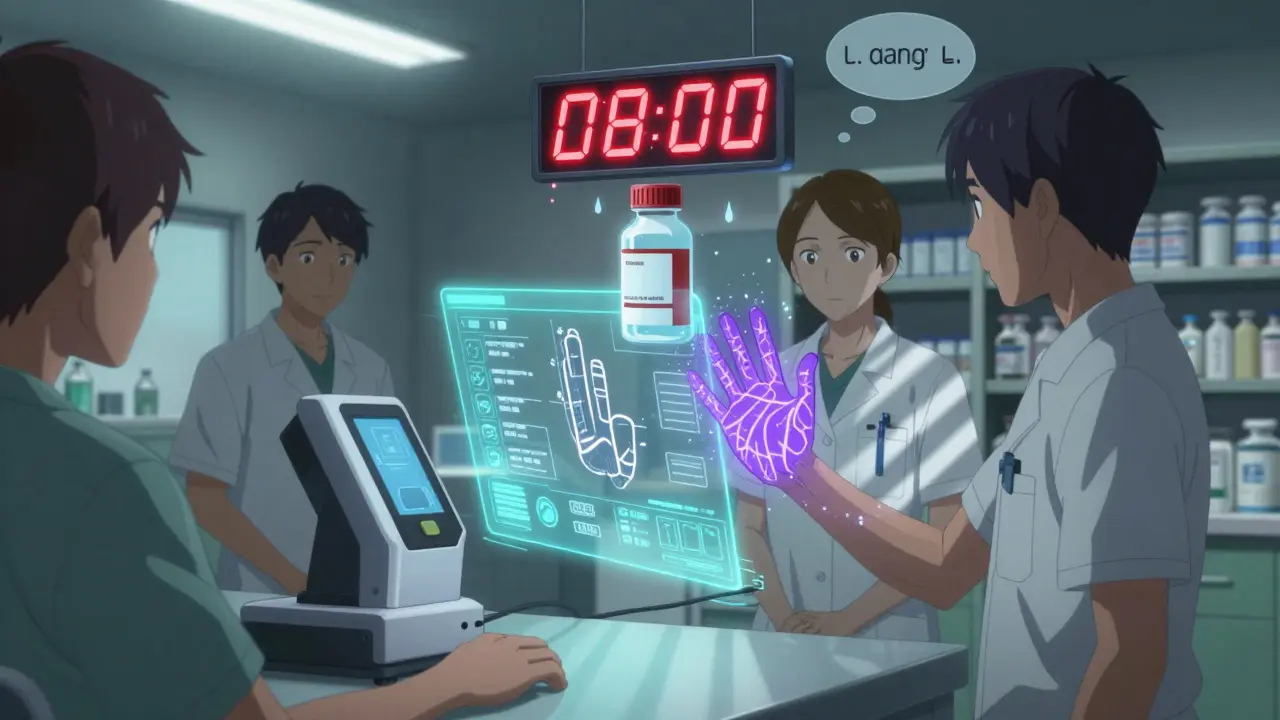
Barcode scanning changed everything. When a pharmacy uses a barcode on the patient’s wristband and the medication package, the system doesn’t just rely on memory or spoken words. It checks: Is this the right patient? Is this the right drug? Is this the right dose? At the right time?
A 2012 study in the Journal of Patient Safety showed a 75% drop in medication errors reaching patients after barcode systems were introduced. That’s not a small gain. That’s life-saving. In one hospital in Ontario, near-miss errors dropped by 60% in just six months after they started scanning both the patient and the medication.
Even better? Biometric systems. Some hospitals now use palm-vein scanners-like Imprivata PatientSecure-that match a patient’s unique vein pattern to their record. In a 2024 Altera Health survey, these systems achieved a 94% match rate. Compare that to hospitals without proper systems, where matching accuracy was only 17%. That gap isn’t just technical. It’s deadly.
And it’s not just about the scanner. Behind the scenes, Enterprise Master Patient Index (EMPI) systems act like a central directory, tying together all of a patient’s records across departments. Without EMPI, a patient might have three different records under slightly different spellings of their name. One for the ER, one for the cardiologist, one for the pharmacy. Each with different allergies, medications, or conditions. That’s how a patient ends up getting a drug they’re allergic to-because the system didn’t know they’d already been prescribed it.
What Happens When You Don’t Get It Right?
The consequences aren’t just clinical-they’re legal, financial, and emotional.
One documented case involved a patient transferred from another hospital, unconscious. The receiving hospital couldn’t find his record because he was registered under his middle name. They created a new file. Days later, they found the original record. It listed a severe allergy to a common antibiotic. He’d been given that same antibiotic in the first 12 hours. He survived-but barely. The error was caught only because a nurse noticed the discrepancy in lab results.
And it’s expensive. The Office of the National Coordinator for Health IT estimates that duplicate records cost large hospitals $40 million a year in reconciliation, correction, and legal costs. The Joint Commission reports that non-compliance with the two-identifier rule is the third most common violation in hospital surveys. And if you fail accreditation? You lose Medicare and Medicaid payments. That’s not a fine. That’s a financial death sentence for many clinics.
How to Get It Right
Implementing this properly isn’t about adding more steps. It’s about making the right steps automatic.
- Use technology: Barcode scanning at dispensing and pickup is the gold standard. If your pharmacy doesn’t have it, push for it.
- Train staff: Don’t just tell them the rule. Show them real cases. Let them see what happens when it fails.
- Document everything: Every time you verify two identifiers, record it in the system. No exceptions.
- Use timeouts: Before high-risk meds (like insulin, heparin, or chemo), pause. Confirm the name. Confirm the DOB. Scan the wristband. Scan the med. Then give it.
- Fix duplicate records: Push for an EMPI system. If your hospital doesn’t have one, ask why. Duplicate records aren’t a tech problem-they’re a safety failure.
Even in small community pharmacies, where budgets are tight, low-cost solutions exist. Many pharmacy software systems now include built-in barcode readers and alert systems that flag mismatched names or birthdays. You don’t need a $2 million biometric system to start saving lives. You just need to stop trusting memory.
The Future Is Here
In January 2025, a pilot program launched in five U.S. regions to test a universal patient identifier-a single, unique number tied to every person’s health record. It’s not mandatory yet. Privacy concerns are real. But the data is clear: without a way to reliably link patients to their records across systems, we’ll keep seeing the same errors.
Dr. David Bates from Harvard put it bluntly: “Using a unique patient identifier to aggregate prescription history can improve the completeness of patient data and catch up to 5% more dangerous drug interactions.” That’s not a small number. That’s hundreds of people a year who don’t die because their record was finally found.
The World Health Organization says standardized ID bands with two identifiers should be used everywhere. The Joint Commission says it’s mandatory. The data says it works. So why do we still see violations?
Because convenience beats safety until someone gets hurt.
It doesn’t have to be that way. Every pharmacist has the power to stop this. Just ask for the name. Ask for the birthdate. Scan the wristband. Confirm the match. Record it. Do it every time. No exceptions. No shortcuts.
Because in pharmacy, there’s no room for “I thought it was him.”
What are the two acceptable patient identifiers in a pharmacy?
The two acceptable identifiers must be unique to the individual and not easily confused. Examples include the patient’s full legal name and date of birth, or their name and assigned medical record number. Phone numbers can also be used if they’re verified as belonging to the patient. Room numbers, bed numbers, or location-based identifiers are not acceptable because they can be reassigned or misheard.
Why can’t I just use the patient’s name and room number?
Room numbers change. Patients move. Two different people can be in the same room on different days. Relying on room number as an identifier is like using a license plate to identify a car-except the plate gets reused every time the car is sold. That’s why The Joint Commission explicitly bans it. The identifier must be tied to the person, not the place.
Is double-checking by two staff members enough?
No. A 2020 review in BMJ Quality & Safety found no strong evidence that having two people verify a medication reduces errors. Why? Because if both people are looking at the same incorrect information-like a mislabeled record or a typo-they’ll both miss the mistake. Technology like barcode scanning removes human bias from the check. Two people reading the same screen isn’t a safety system. It’s a repetition of error.
What’s the most common reason pharmacies fail this safety rule?
The most common failure isn’t ignorance-it’s documentation. In 2023, 37% of non-compliant hospitals didn’t record that they’d verified the two identifiers. Without documentation, there’s no proof the check happened. Even worse, 63% of pharmacists admit to occasionally skipping verification under time pressure. The rule isn’t hard. The culture around it is.
Can biometric systems like palm scans replace name and birthdate?
Yes-and they’re more reliable. Biometric systems like palm-vein scanners match a patient to their record with 94% accuracy, far better than manual checks. But they don’t replace the need for two identifiers. They enhance them. A biometric scan is one identifier. The system still needs to confirm the patient’s name or MRN as the second. Together, they create a fail-safe that’s nearly impossible to bypass.
How does this affect community pharmacies versus hospitals?
Hospitals are more likely to have barcode systems and EMPIs because they’re regulated and funded for them. Community pharmacies often rely on verbal checks due to cost and space limits. That’s why 42% of community pharmacists report verification happens without documentation. But the risk is the same: misidentification leads to wrong meds. The solution isn’t to lower standards-it’s to make technology affordable. Many pharmacy software vendors now offer low-cost barcode add-ons that work with existing systems.
What happens if a pharmacy doesn’t follow the two-identifier rule?
If a hospital or pharmacy fails to comply, they risk losing accreditation from The Joint Commission. That means they can’t bill Medicare or Medicaid. That’s a financial disaster. Beyond that, if a patient is harmed due to misidentification, the pharmacy can face lawsuits, fines, and loss of license. In 2023, non-compliance with this rule was the third most common violation in hospital surveys-meaning regulators are watching closely.
