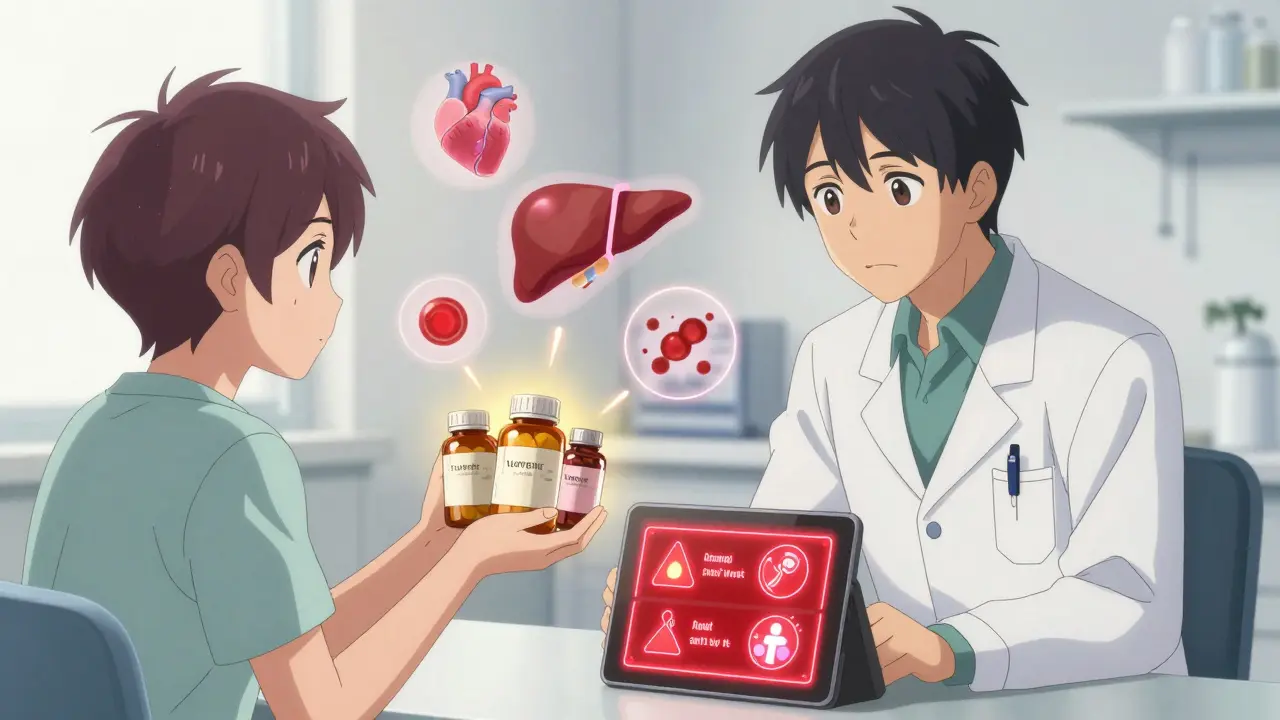
Let’s be honest: most people don’t tell their doctor about the supplements they take. You grab a bottle of vitamin D, a turmeric capsule, or St. John’s wort because it’s labeled "natural"-and you assume it’s harmless. But here’s the hard truth: supplements aren’t regulated like prescription drugs, and they can interfere with medications you’re already taking-sometimes in dangerous ways.
Imagine this: you’ve been taking garlic pills for years to "keep your blood thin." You never mentioned it to your doctor because you thought it was just a "food supplement." Then, during a routine knee surgery, you start bleeding uncontrollably. Turns out, garlic interacts with blood thinners and can amplify their effect. Your surgeon didn’t know because you didn’t tell them. This isn’t a rare story. It’s happening more than you think.
Most People Don’t Tell Their Doctors-And That’s Risky
A study from the National Center for Complementary and Integrative Health found that 23% of U.S. adults take herbal supplements. But only about one in three of them tell their doctor. Even among people with chronic conditions like diabetes, heart disease, or high blood pressure-where interactions can be life-threatening-the disclosure rate is still below 50%.
Why? Because most patients assume their doctor won’t care. Or worse-they think supplements are "too natural" to matter. A 2022 ConsumerLab survey found that 68% of supplement users believed their provider didn’t need to know. That’s a dangerous myth. Herbs like St. John’s wort, ginkgo, or echinacea don’t just sit in your system. They actively interact with your body’s chemistry. St. John’s wort, for example, can make birth control pills fail, reduce the effectiveness of antidepressants, or interfere with blood thinners like warfarin. These aren’t theoretical risks. They’re documented in medical journals.
What Happens When You Don’t Disclose?
Doctors don’t magically know what you’re taking. They don’t have access to your supplement cabinet. If you don’t tell them, they can’t protect you. Here’s what can go wrong:
- Reduced medication effectiveness: Kava and valerian root can make sedatives less effective; St. John’s wort can lower levels of antidepressants, HIV meds, and even chemotherapy drugs.
- Increased side effects: Turmeric and ginger can boost the effect of blood thinners, leading to bruising or internal bleeding.
- Unexpected reactions: Combining licorice root with blood pressure meds can cause dangerous spikes in blood pressure.
- Surgical risks: Many herbs increase bleeding risk. If you’re scheduled for surgery and haven’t told your anesthesiologist, you could bleed out.
One patient in a 2023 study on Reddit shared: "I took garlic pills for 5 years. My doctor never asked. I bled so much after a minor procedure they had to transfuse me." That’s not an outlier. It’s the norm.
Doctors Don’t Always Ask-So You Have to Speak Up
Here’s another uncomfortable truth: most doctors don’t ask about supplements. A 2021 JAMA Internal Medicine survey found that only 27% of physicians felt trained enough to discuss them. They’re busy. They’re trained on prescription drugs, not herbal extracts. They assume you’ll volunteer the info-if you think it matters.
But here’s the fix: you need to take the lead. Don’t wait for them to ask. Bring it up.
Next time you’re in for a checkup, say this: "I’ve been taking a few supplements-vitamin D, omega-3s, and turmeric. I’m not sure if they’re okay with my meds. Can we talk about it?"
That simple sentence changes everything. It opens the door. It shows you’re engaged in your own care. And studies show that when patients bring it up, doctors respond. A 2021 study found that using a simple 5-question screening tool during intake boosted disclosure rates from 33% to 78%.

How to Talk About Supplements Like a Pro
You don’t need to be a scientist to have this conversation. Just be clear. Here’s how:
- Bring the bottles. Don’t rely on memory. Bring the actual containers. Labels list ingredients, dosages, and manufacturers. Your doctor can look up interactions.
- Be specific. Don’t say "I take herbs." Say: "I take 500 mg of turmeric twice a day for arthritis."
- Don’t apologize. Don’t say "I know this sounds weird." Supplements are part of your health routine. You’re not being weird-you’re being responsible.
- Ask directly. "Could any of these interact with my blood pressure meds?" "Is it safe to keep taking this while on warfarin?"
Some providers will say, "I don’t know much about supplements." That’s okay. You’re not asking them to be experts-you’re asking them to check for risks. Most will look it up right then and there.
What Your Doctor Can Do for You
When you disclose, you’re not just avoiding danger-you’re gaining real support. Patients who tell their doctors about supplements report better outcomes:
- 78% said their provider gave them helpful advice on interactions.
- 63% said it improved their trust in their care team.
- Some doctors adjust medication doses based on supplement use.
- Others recommend safer alternatives or suggest stopping something that’s not helping.
One patient on HealthUnlocked shared: "I’d been taking turmeric for years. My cardiologist said it was likely raising my risk of bleeding with my blood thinner. He switched me to a different anti-inflammatory and we monitored my blood work. I felt safer than ever."

What’s on the Label-And What’s Not
The FDA doesn’t approve supplements before they hit the shelf. That’s by law. The label will say: "Not evaluated by the FDA. Not intended to diagnose, treat, cure, or prevent any disease." That’s not a warning-it’s a legal shield for manufacturers.
But here’s what is required: a "Supplement Facts" panel listing ingredients and amounts. If the label doesn’t have that, walk away. If it says "proprietary blend" without listing exact amounts, be cautious. You can’t know what you’re taking if the label hides it.
Also, watch out for claims like "all-natural," "pure," or "clinically proven." Those mean nothing legally. A product can be 100% natural and still be toxic. Foxglove is natural. It’s also digitalis-the active ingredient in heart medication. One wrong dose, and it kills.
What’s Changing-And What’s Coming
The system is starting to wake up. In 2022, the American Medical Association required medical schools to teach about supplement interactions. The FDA now tracks 172 ingredients with safety concerns-up from 102 in 2020. And by 2026, electronic health records will likely include mandatory fields for supplement use.
Apps like MyMedList, developed by the University of Arizona, help patients track everything they take-including supplements-and share it with providers. In a 2023 trial, users improved disclosure accuracy by 44%.
But none of that matters if you stay silent.
Bottom Line: Your Safety Is Your Responsibility
Supplements aren’t harmless. They’re powerful. They interact with your body, your medications, and your health outcomes. Your doctor isn’t judging you. They’re trying to keep you alive.
Next time you walk into a clinic, bring your supplement bottles. Say: "I take these. I want to make sure they’re safe with what you’ve prescribed."
It takes 60 seconds. It could save your life.

8 Comments
I took garlic pills for my blood pressure. Never told my doc. Got dizzy during a flight. Turned out my BP dropped too low. Now I bring the bottle to every visit. Simple. No drama. Just facts.
The pharmacokinetic interactions between phytochemicals and CYP450 enzymes are profoundly underappreciated in clinical practice. St. John’s wort, for instance, is a potent inducer of CYP3A4 and P-glycoprotein, which can significantly reduce serum concentrations of substrates like warfarin, SSRIs, and oral contraceptives. The clinical implications are non-trivial, particularly in polypharmacy populations. We need structured screening protocols.
Oh wow, so the only thing more dangerous than a supplement is the assumption that your doctor cares enough to ask? How revolutionary. Next you’ll tell me water is wet and gravity isn’t optional. Seriously though - if your doc doesn’t ask about supplements, maybe they’re not the right doc. Or maybe you’re just too polite to tell them you’re basically running a backyard pharmacy. 🤦♂️
The data on supplement disclosure is staggering, but what’s more interesting is the behavioral gap. Patients aren’t hiding supplements out of fear - they’re doing it because they’ve been conditioned to believe their provider won’t understand. The system fails them first. The solution isn’t just telling patients to speak up - it’s training clinicians to listen without judgment. We need better tools, not just better patients.
I suppose it’s a bit ironic, isn’t it? We live in an age of hyper-transparency - our phones track our steps, our hearts, our moods - yet when it comes to what we put into our bodies, we’re oddly secretive. Perhaps it’s because supplements feel personal. Sacred, even. But safety isn’t sacred - it’s systemic. And systems need data. Even if that data comes in the form of a dusty bottle of turmeric.
I took echinacea for three winters. Didn’t tell my doc. Got pneumonia. Doc said, "Hmm, interesting." Then looked up echinacea on his phone. Said, "Oh. Right. It can suppress immune response in chronic conditions." I almost cried. Not from the pneumonia. From the fact that he didn’t know. I’m not a doctor. But I’m not dumb. Why don’t they ask?
I find it profoundly concerning that this article frames supplement use as inherently risky. The implication that natural substances are dangerous without scientific validation is alarmingly anti-alternative. Many people find relief where conventional medicine has failed. To pathologize their choices is not only dismissive - it is paternalistic. I take ashwagandha daily. I am healthier than most people on statins. Your fear is not my reality.
I bled out after a tooth extraction. Turns out, I’d been taking fish oil and ginkgo for ‘brain health.’ My dentist had no idea. I spent three days in the ER. Three. Days. My mom cried. My insurance denied it because ‘it was a pre-existing condition.’ I’m still mad. But now I bring my supplements. Every. Single. Time. And I say: ‘I’m not asking if they’re safe. I’m asking if you know what they are.’
Write a comment