
Imagine taking a medication that saves your life, but only if the dose is perfect. Not too high, not too low-just right. Now imagine switching to a cheaper version of that same drug, and suddenly you’re feeling dizzy, tired, or worse. This isn’t a hypothetical nightmare; it’s the reality for patients on Narrow Therapeutic Index (NTI) drugs, which are medications where small changes in blood concentration can lead to serious treatment failure or toxicity. The question isn’t just about saving money. It’s about whether that savings comes at the cost of your health stability.
You’ve probably heard that generics are just as good as brand-name drugs. For most medications, that’s true. But for NTI drugs, the margin for error is razor-thin. Should you stay on the brand? Can you safely switch to a generic? The answer depends on the specific drug, your body’s chemistry, and how closely you monitor your levels. Let’s break down what the science says, what doctors recommend, and how you can make the safest choice for yourself.
What Makes an NTI Drug Different?
To understand why substitution is tricky, you first need to know what makes an NTI drug unique. Most drugs have a wide "therapeutic window." If you take a bit more or less than prescribed, nothing bad happens. You might feel slightly better or slightly worse, but you won’t end up in the hospital. NTI drugs do not have this luxury.
The U.S. Food and Drug Administration (FDA) defines these drugs as those where "small differences in dose or blood concentration may lead to... serious therapeutic failures, or adverse drug reactions" (FDA, 2022). Think of it like walking a tightrope. With regular drugs, you can sway a little left or right and stay safe. With NTI drugs, one wrong step means falling off.
Common examples include:
- Levothyroxine (brand name Synthroid): Used for hypothyroidism. Too little leaves you exhausted; too much strains your heart.
- Warfarin (brand name Coumadin): A blood thinner. Too little risks a stroke; too much causes dangerous bleeding.
- Tacrolimus: An immunosuppressant for organ transplant recipients. Levels must be precise to prevent rejection without causing kidney damage.
- Certain antiepileptics (like phenytoin): Used to control seizures. Fluctuations can trigger breakthrough seizures or toxicity.
Because the gap between "helpful" and "harmful" is so small, even tiny variations in how the drug is absorbed by your body matter. This is where the debate between brand and generic begins.
The Bioequivalence Rule: What Does 80-125% Mean?
When a company wants to sell a generic version of a drug, they must prove it is "bioequivalent" to the brand-name original. Bioequivalence doesn’t mean the pills are identical molecules. It means they deliver similar amounts of the active ingredient into your bloodstream over time.
For standard drugs, the FDA allows a confidence interval of 80% to 125%. In plain English, this means the generic could deliver as little as 80% or as much as 125% of the brand’s peak concentration, and it would still pass approval. For many drugs, this range is harmless. Your body adjusts, and you feel fine.
But for NTI drugs, that 45% swing is terrifying. Imagine your target dose is 100 units. A generic approved under standard rules could give you 80 units one day and 125 the next. For a thyroid patient, that drop from 100 to 80 might mean going from normal energy to severe fatigue. For a transplant patient, that spike to 125 could damage their kidneys.
Recognizing this risk, the FDA tightened the rules in 2014. For NTI drugs, the agency now uses "scaled average bioequivalence" limits. Depending on the variability of the reference drug, the acceptance criteria can be narrowed to 90-111%. This is a much tighter window, designed to ensure that generic NTI drugs behave more consistently. However, even within this narrower band, individual bodies react differently. Two people can take the exact same generic pill, and one thrives while the other struggles.
Brand vs. Generic: What Does the Data Say?
If you ask a pharmacist, they’ll likely tell you that generics are safe. If you ask a patient who had a seizure after switching, they’ll tell you otherwise. Who’s right? Both, depending on the context.
Large-scale studies generally support generic substitution. A 2022 FDA-funded study analyzing nearly 18,000 patients found that a similar proportion of generic versus brand-name levothyroxine users achieved target hormone levels. Another massive review of over 3.5 million patients showed analogous clinical outcomes for chronic diseases when using generics (Desai RJ et al., 2022). These studies suggest that for the *average* population, generics work just as well.
However, averages hide outliers. And with NTI drugs, being an outlier can be dangerous. Research on tacrolimus shows a "lack of sufficient data to support bioequivalence between generic formulations," meaning some patients experience significant fluctuations when switching manufacturers (U.S. Pharmacist, 2022). Similarly, a survey by the Epilepsy Foundation found that 42% of respondents reported seizure breakthroughs after switching to generic antiepileptics, though this self-reported data lacks clinical verification (Epilepsy Foundation, 2022).
The American Medical Association noted in 2007 that while AB-rated generic NTI drugs were generally bioequivalent, the cost savings were substantial ($3,128 per 100 person-years for warfarin), but study limitations prevented a full analysis of adverse events. In short: the data says generics are *mostly* safe, but it doesn’t guarantee safety for *you*.
| Factor | Brand-Name (e.g., Synthroid) | Generic (e.g., Levothyroxine) |
|---|---|---|
| Cost | High ($30-$60/month) | Low ($4-$15/month) |
| Bioequivalence Standard | Reference standard | Must meet 90-111% limits (for NTI) |
| Consistency | High (same manufacturer always) | Variable (manufacturer may change without notice) |
| Insurance Coverage | Often requires prior authorization | Usually preferred/tier 1 |
| Risk of Switching | None (if staying on brand) | Requires monitoring during transition |
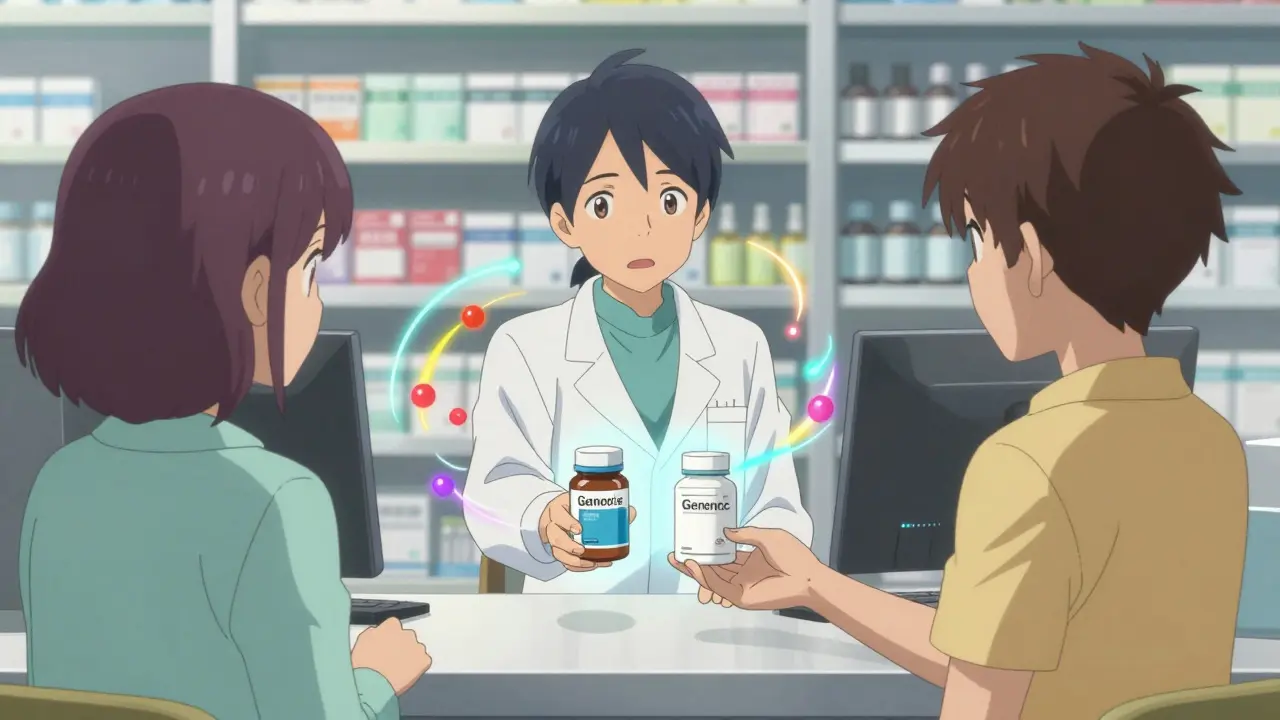
The Hidden Risk: Manufacturer Changes
Here’s the part most patients don’t realize: "Generic" isn’t one single product. There are dozens of companies making generic levothyroxine, warfarin, and tacrolimus. Each uses different inactive ingredients (fillers, binders, dyes) and manufacturing processes.
When your pharmacy switches from Generic Manufacturer A to Generic Manufacturer B, it’s chemically a new drug to your body. The FDA requires them to be bioequivalent, but as Dr. Robert A. Bies, Professor of Pharmacy at the University at Buffalo, testified in 2022, "the conventional 80 to 125 bioequivalence limit may not be sufficient" for some NTI drugs due to large plasma concentration fluctuations (FDA Drug Topics, 2022).
This is why consistency matters more than price for many NTI patients. If you are stable on Generic Brand X, staying with Generic Brand X is often safer than switching to Generic Brand Y, even if Brand Y is slightly cheaper. The goal is to minimize variables. Changing manufacturers introduces a variable that can disrupt your therapeutic balance.
When Should You Stay on Brand?
Not every patient needs the brand-name drug. In fact, for many, generics are perfectly effective and save thousands of dollars over a lifetime. However, there are specific scenarios where sticking with the brand-or a specific generic manufacturer-is medically justified.
You should consider staying on the brand-name version if:
- You have experienced instability on generics. If previous switches caused side effects, breakthrough symptoms, or abnormal lab results, the brand offers the highest consistency.
- You are newly diagnosed and unstable. Some doctors prefer starting on the brand to establish a baseline, then switching to a generic once levels are controlled. Others argue the opposite: start on generic to save costs early. Discuss this with your provider.
- Your insurance covers it. Some plans offer "dispense as written" options for NTI drugs if you pay a higher copay. If the difference is $10 a month but gives you peace of mind, it may be worth it.
- You are on complex regimens. If you take multiple NTI drugs (e.g., a transplant patient on tacrolimus and another immunosuppressant), minimizing formulation variables reduces the risk of interaction surprises.
Conversely, you can likely safely use generics if:
- You are already stable on a specific generic. Do not switch back to the brand unless necessary. Staying with the same generic manufacturer is key.
- You are cost-sensitive. NTI drugs are lifelong treatments for many. The savings from generics can be redirected to other health needs.
- You commit to close monitoring. If you switch, agree with your doctor to check your levels (TSH for thyroid, INR for warfarin, trough levels for tacrolimus) within 4-8 weeks of the change.

How to Manage the Switch Safely
If you decide to try a generic, or if your pharmacy forces a switch due to supply issues, you are not powerless. You can manage the risk through proactive steps.
1. Know Your Manufacturer. Look at your pill bottle. It will list the manufacturer (e.g., "Manufactured by ABC Pharma"). Write this down. If your next refill has a different manufacturer, call your pharmacist immediately. Ask if they can order the previous brand. Many pharmacies can special-order a specific generic manufacturer if requested.
2. Monitor Aggressively. After any switch, do not wait for your next annual checkup. Schedule a lab test sooner. For warfarin, check your INR weekly for the first month. For levothyroxine, check TSH in 6-8 weeks. For tacrolimus, check trough levels frequently. Catching a deviation early prevents crisis.
3. Keep a Symptom Diary. Labs aren’t everything. How do you feel? Note any changes in energy, mood, bleeding, or skin rashes. Patient forums like Reddit’s r/Thyroid highlight that 30% of users report problematic switches requiring dose adjustments, while 5% report severe reactions necessitating a return to brand (Reddit, 2021-2023 thread analysis). Your subjective experience is valid data.
4. Use "Dispense As Written" Wisely. In many states, pharmacists can automatically substitute generics. However, you or your doctor can request "Dispense As Written" (DAW). This tells the pharmacist to fill the prescription exactly as written-brand if brand is prescribed, or a specific generic if specified. Check your state laws; approximately 28 states have restrictions on automatic substitution for NTI drugs (National Conference of State Legislatures, 2022).
The Future of NTI Drug Regulation
The landscape is evolving. The FDA launched the NTI Drug Registry in 2023 to collect real-world evidence on substitution outcomes. Meanwhile, the Agency for Healthcare Research and Quality (AHRQ) is funding a $2.4 million study tracking 50,000 patients across 15 health systems to compare brand and generic NTI drug outcomes (AHRQ, 2023).
Dr. Janet Wright of the American College of Cardiology predicts that by 2025, evidence will support generic substitution for all NTI drugs except perhaps a handful with extreme variability. However, caution remains. Dr. Robert Gross cautioned in 2022 that for high-risk drugs like phenytoin, "the evidence still supports maintaining stable manufacturer sourcing once therapeutic levels are achieved" (FDA Transcript, October 2022).
The trend is moving toward personalized medicine. Instead of a blanket rule saying "generics are always fine" or "brands are always better," the future lies in individualized decisions based on your history, your biology, and your tolerance for risk.
Is generic levothyroxine as effective as Synthroid?
For most patients, yes. Large studies show similar rates of achieving target TSH levels. However, because levothyroxine is an NTI drug, some individuals are sensitive to slight variations in absorption. If you feel well on a specific generic, stick with it. If you experience fatigue or heart palpitations after switching, consult your doctor about returning to the brand or trying a different generic manufacturer.
Can I switch between different generic brands of warfarin?
You can, but you must monitor your INR closely. Warfarin has a narrow therapeutic index, and different manufacturers may have slight differences in bioavailability. About 22% of warfarin users report INR instability during transitions. Always inform your anticoagulation clinic when you switch manufacturers so they can adjust your dosage proactively.
Why do some doctors insist on brand-name NTI drugs?
Some doctors prioritize consistency and liability reduction. Brand-name drugs have a single manufacturer, ensuring no variation in inactive ingredients or production methods. For patients with complex medical histories or those who have failed generic trials, the brand eliminates one variable. Additionally, some specialists believe the tighter control of brand production minimizes the risk of subtherapeutic or toxic levels.
What is the "AB rating" for generic drugs?
The FDA assigns an "AB rating" to generics that are therapeutically equivalent to the brand-name drug. "A" means the generic is considered substitutable, and "B" indicates it meets bioequivalence standards. While an AB rating suggests safety, it does not guarantee identical performance for every individual, especially with NTI drugs where small differences matter significantly.
How much money can I save by using generic NTI drugs?
Savings vary by drug and insurance plan, but generics typically cost 30-85% less than brand names. For example, generic levothyroxine may cost $4-$15 per month compared to $30-$60 for Synthroid. Over a year, this can save hundreds of dollars, which is significant for lifelong therapies. However, weigh this against potential costs of additional lab tests or medical visits if you experience instability.
