PPI & Clopidogrel Interaction Checker
Select a Proton Pump Inhibitor (PPI) below to see how it potentially interacts with Clopidogrel and view the clinical recommendation.
Step 1: Select Medication
Step 2: Interaction Analysis
Please select a medication from the left to see the analysis.
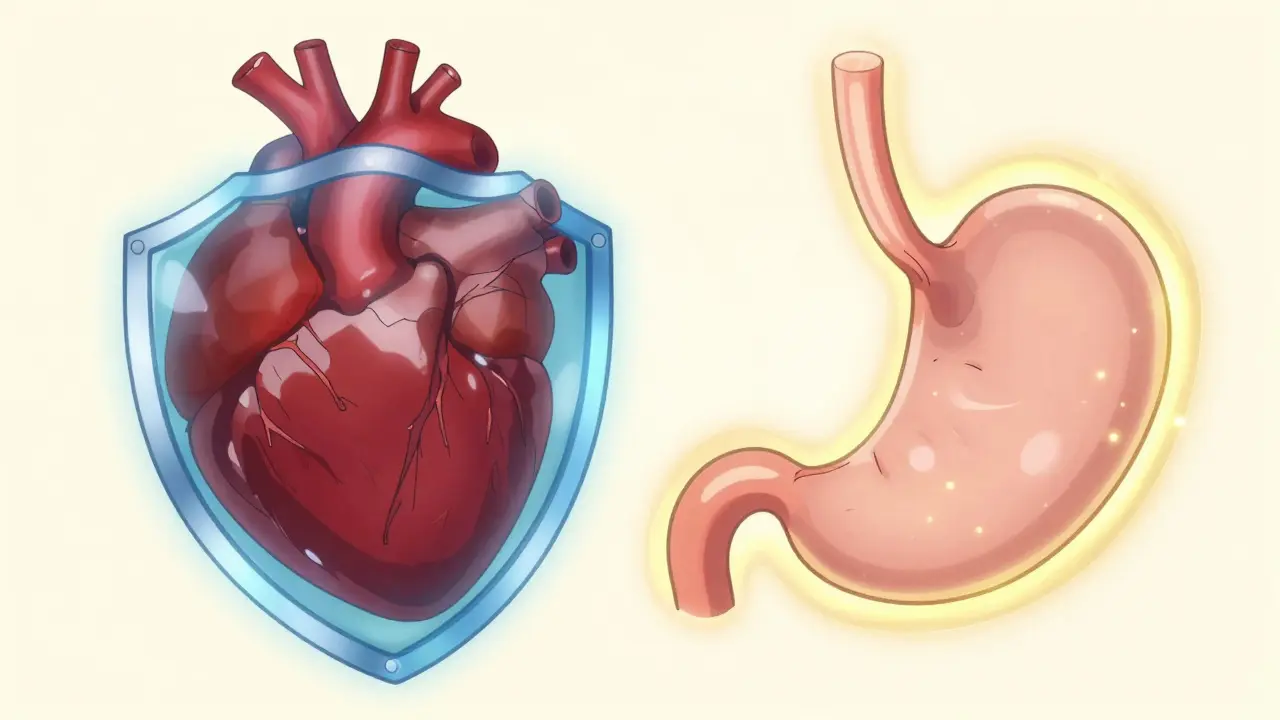
Imagine taking a medication to keep your blood flowing and prevent a heart attack, only to find out that your stomach medication might be canceling it out. This is the core of the debate surrounding Clopidogrel is a thienopyridine antiplatelet agent used to prevent atherothrombotic events like heart attacks and strokes and Proton Pump Inhibitors (PPIs), the common drugs used to treat acid reflux and ulcers. While using both together can protect your stomach from bleeding, it might simultaneously make your heart medication less effective.
The Core Conflict: Stomach Protection vs. Heart Safety
For many patients, especially those on dual antiplatelet therapy (DAPT), the risk of gastrointestinal (GI) bleeding is a serious concern. PPIs are the gold standard for reducing this risk-some data suggests they can cut the chance of bleeding by 69%. However, the problem lies in how the body processes Clopidogrel. Unlike many drugs, Clopidogrel is a "prodrug," meaning it's inactive when you swallow it. It needs to be converted into an active form by an enzyme in your liver called CYP2C19.
Here is where the trouble starts: certain PPIs act like a roadblock for that enzyme. If the CYP2C19 enzyme is blocked, Clopidogrel cannot convert into its active metabolite, and your platelets keep sticking together. In a study cited by the NIH, one patient saw their clopidogrel-induced platelet inhibition completely vanish while taking 20 mg of omeprazole, even when the doses were spaced 12 hours apart. This proves that simply changing the time of day you take your pills doesn't solve the problem.
Not All PPIs Are Created Equal
If you are worried about this interaction, the good news is that not every PPI behaves the same way. Some are "strong" inhibitors of the CYP2C19 enzyme, while others barely touch it. Omeprazole and Esomeprazole are the biggest culprits. They have a high affinity for the enzyme, significantly reducing the concentration of Clopidogrel's active form in the blood.
On the other hand, medications like Pantoprazole, Rabeprazole, and Lansoprazole are much weaker inhibitors. For example, research shows that while omeprazole can drop platelet inhibition to subtherapeutic levels (below 20%), rabeprazole generally keeps it within the safe therapeutic range of 35-45%. This is why many cardiologists now specifically steer patients toward pantoprazole if a PPI is absolutely necessary.
| PPI Medication | CYP2C19 Inhibition | Impact on Clopidogrel | Clinical Recommendation |
|---|---|---|---|
| Omeprazole | Strong | Significant Reduction | Avoid if possible |
| Esomeprazole | Strong | Significant Reduction | Avoid if possible |
| Pantoprazole | Weak | Minimal | Preferred alternative |
| Rabeprazole | Weak | Minimal | Preferred alternative |
| Lansoprazole | Weak | Minimal | Generally safe |
The Great Medical Debate: Does it Actually Matter?
You might be wondering: "If the lab tests show less drug activity, does that actually mean more heart attacks?" This is where the medical community is split. On one side, researchers like Dr. Deepak Bhatt have pointed to data suggesting a 50% increased risk of major adverse cardiac events-including death or myocardial infarction-when PPIs are used with Clopidogrel.
On the other side, other experts argue that the lab results don't translate to real-world danger. They point to the COGENT trial, which found no significant difference in cardiovascular events between patients taking omeprazole and those taking a placebo. Their argument is that for many people, the biological variation in how we process drugs is more important than the interaction itself. Essentially, they believe the "pharmacodynamic" change (the lab number) doesn't always lead to a "clinical" change (a heart attack).
Who Truly Needs a PPI While on Clopidogrel?
Since there is a potential risk, doctors don't just hand out PPIs to everyone. Instead, they use risk stratification. If you have a low risk of stomach issues, you might not need a PPI at all. However, certain "red flags" make PPI therapy essential, even with the clopidogrel interaction risk. These include:
- Being over the age of 75.
- A history of gastroduodenal ulcers.
- Regular use of NSAIDs (like ibuprofen or aspirin), which further irritate the stomach lining.
- An active H. pylori infection.
In these high-risk cases, the danger of a massive GI bleed outweighs the theoretical risk of reduced antiplatelet effects. In these scenarios, the goal isn't to avoid PPIs entirely, but to choose the ones that don't interfere with the liver's CYP2C19 enzyme.
Modern Alternatives and Future Directions
Medical science is moving away from this dilemma. Many doctors are now prescribing Ticagrelor instead of Clopidogrel for patients with acute coronary syndrome. Ticagrelor doesn't require liver activation, meaning it completely bypasses the CYP2C19 enzyme and the PPI interaction entirely. It's a "plug-and-play" medication that works immediately upon ingestion.
We are also seeing the rise of new stomach medications. Vonoprazan, a potassium-competitive acid blocker, is currently being studied as a way to protect the stomach without messing with the heart meds. If these trials prove successful, we may soon have a way to prevent ulcers without ever worrying about whether our blood is thinning enough.
Can I just take my Clopidogrel in the morning and my PPI at night?
Unfortunately, no. Research has shown that separating the doses by 12 hours does not prevent the interaction, especially with strong inhibitors like omeprazole. This is because the inhibition of the CYP2C19 enzyme can persist long after the drug is taken.
Which PPI is safest to use with Clopidogrel?
Pantoprazole and rabeprazole are generally considered the safest options because they have a very weak effect on the CYP2C19 enzyme and are less likely to reduce the antiplatelet effectiveness of Clopidogrel.
Should I stop taking my PPI if I'm on Clopidogrel?
You should never stop a prescribed medication without consulting your doctor. For some patients, the risk of a life-threatening stomach bleed is much higher than the risk of reduced drug efficacy. Your doctor will weigh these risks based on your medical history.
What is the "prodrug" concept mentioned?
A prodrug is a medication that is administered in an inactive form. It only becomes active once it is metabolized by enzymes in the body (in this case, the liver). If the enzyme is blocked, the "active" medicine never reaches the bloodstream.
Is there a test to see if this interaction is affecting me?
Yes, there are platelet reactivity tests (such as VASP phosphorylation tests) that can measure how well Clopidogrel is inhibiting your platelets. However, these are not used for every patient, as their clinical value is still debated among cardiologists.

13 Comments
Ticagrelor is definitely the cleaner choice here since it avoids the CYP2C19 metabolism hurdle entirely. It's often the preferred route in high-risk ACS patients for this exact reason.
It is fascinating how the medical community clings to these 'debates' while ignoring the fundamental reality that pharmacological interactions are absolute. If the enzyme is inhibited, the drug is not activated; period. The COGENT trial is simply an outlier that fails to account for individual genetic variability.
I've seen a lot of patients struggle with this! Just a heads up, make sure you double check the spelling of the med on the bottle because pantoprazole and omeprazole look kinda similar and it makes a huge diffrence in how the heart med works.
Typical big pharma move, pushing us from one drug to another just to keep the patent cycles going! They want you on Ticagrelor because it's more expensive and they can hide the side effects under 'modern alternatives'. It's all about control of the blood flow, literally and figuratively, and they're probably using these liver enzymes to track our biological responses for some database in D.C. Wake up!
The simplistic presentation of this interaction is almost quaint. One must realize that the pharmacokinetic profile of thienopyridines is far more nuanced than a mere table of 'strong' versus 'weak' inhibitors. The sheer audacity of suggesting that a patient could simply 'switch' without a comprehensive metabolic panel is practically negligence. It is quite obvious that most practitioners lack the intellectual rigor to manage these interactions with the precision they require, opting instead for the path of least resistance. Truly, the state of contemporary cardiology is a tragedy of mediocrity.
Such a delicate balance... between the heart and the stomach!!! It is almost poetic how the body's own chemistry creates these contradictions... one must wonder if the cure is sometimes just as complex as the ailment itself...!!!
Honestly, it's just basic biology, but people act like it's some great mystery when the liver is literally the gatekeeper for everything we ingest. If you don't understand the prodrug concept, you're basically just guessing with your health, and that's where most people fail because they want a magic pill without reading the manual. We live in a society where people prefer the convenience of a PPI without realizing they're effectively turning off their heart protection, which is just a peak example of the intellectual laziness that defines our era. You can't expect a system to work when you're actively blocking the only mechanism that makes the medicine useful in the first place. It's not a debate, it's just chemistry, and if your doctor isn't explaining this, they're probably just as clueless as the patient. The lab results are the only thing that doesn't lie, unlike the 'clinical' opinions that change every five years based on who's funding the study.
Omeprazole is basically a placebo for your heart if you're on clopidogrel LOL 🤡. Imagine trusting your life to a drug that your liver refuses to activate because you wanted to stop a little heartburn! Absolute joke! 🙄
This is just common sense. If u take the wrong pill, it dont work. Simple. Most peopel just dont read the labels and then wonder why they have a heart attack. Its laffable really.
It's like a cosmic dance of molecules where one step wrong throws the whole rhythm off. A wild symphony of chemistry!
It's a good idea to stay consistent with whatever plan your doctor sets up.
The CYP2C19 polymorphism is the real key here, likely influenced by environmental toxins that the mainstream media ignores. If your alleles are already compromised, adding a strong inhibitor is basically a bio-hack for a cardiac event.
I wonder if there's a way to naturally support the liver enzymes so they don't get blocked as easily.
Write a comment