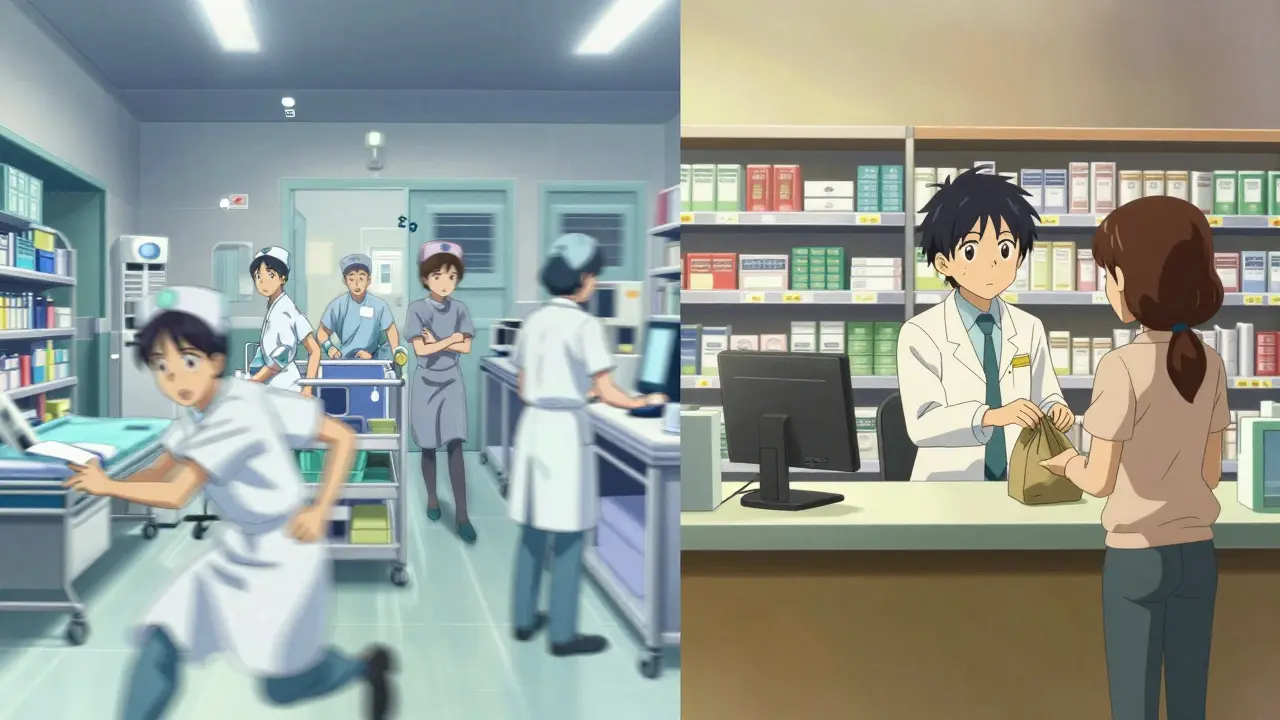
Imagine you pick up a prescription from your local corner pharmacy. You trust the pharmacist has checked it. You take it home. Now imagine you are admitted to a hospital. A nurse prepares your medication. Who is safer? The answer isn't as simple as you might think. Medication errors are mistakes in prescribing, dispensing, or administering drugs that can harm patients. These errors happen everywhere, but they look very different depending on where they occur.
In hospitals, errors are surprisingly common, yet we often hear less about them because there are more people watching for mistakes. In retail pharmacies, errors are rarer per prescription, but once they slip through, there is no one left to catch them before they reach you. This fundamental difference shapes everything from how we measure risk to how we prevent harm.
The Core Difference: Who Catches the Mistake?
The biggest distinction between hospital settings and community pharmacies lies in the final checkpoint. In a hospital, when a pharmacist dispenses a drug, a nurse usually verifies it against the patient’s chart before giving it to you. If the pharmacist made a mistake, the nurse often catches it. This creates a "closed-loop" system with multiple layers of defense.
In a retail pharmacy, the story ends at the counter. Once the pharmacist hands you the bag, you are the last line of defense. There is no second professional checking the bottle before you drive home. According to a 2018 systematic review published in the Journal of Patient Safety, this structural gap means that while hospital error rates might be higher, community pharmacy errors have a much higher chance of reaching the patient undetected. You become the quality control inspector for your own health.
Error Rates: High Frequency vs. Low Detection
When we talk about numbers, the data reveals a stark contrast. In hospitals, medication errors are alarmingly frequent. A landmark study published in JAMA Internal Medicine found that nearly 1 out of every 5 doses (20%) contained an error in typical hospital facilities. More recent data from U.S. Pharmacist (2022) suggests the median error rate during administration ranges from 8% to 25%. Why so high? Hospital patients are complex. They take many drugs, their conditions change hourly, and staff work under intense pressure.
Conversely, retail pharmacies show much lower error rates per transaction. A 2018 meta-analysis estimated the overall community pharmacy dispensing error rate at just 1.5%. However, do not let that small percentage fool you. With roughly 3 billion prescriptions filled annually in the U.S., even a tiny error rate translates to millions of mistakes. The National Institutes of Health (NIH) noted that while actual dispensing errors might be 1 per 10,000 prescriptions, transcription errors-where instructions are written wrong-are far more common and dangerous.
| Metric | Hospital Settings | Retail Pharmacies |
|---|---|---|
| Average Error Rate | 8% - 25% (per dose) | ~1.5% (per prescription) |
| Primary Error Type | Administration & Timing | Transcription & Dosing |
| Last Checkpoint | Nursing Staff | Patient |
| Detection Mechanism | Multi-layered verification | Pharmacist review only |
Types of Errors: What Goes Wrong Where?
The nature of the mistakes also shifts based on the environment. In retail pharmacies, the most common issues are incorrect medication, wrong doses, and bad directions. A classic example involves transcription errors. Imagine a doctor prescribes estradiol "twice per week," but the pharmacy technician types "twice per day." Without a clinical decision support system (CDSS) flagging this, the patient could overdose significantly. The NIH found that over half of community pharmacy errors were clinical problems related to dosage or drug interactions.
In hospitals, the errors are often procedural. Because nurses administer the drugs directly, mistakes frequently involve timing (giving a pill too early or late), wrong routes (injecting instead of swallowing), or identifying the wrong patient. The complexity of acute care means that even if the drug is correct, the context of its use might be flawed. For instance, a patient might need a lower dose due to kidney failure, but the standard hospital protocol doesn’t adjust for it quickly enough.
Why Errors Happen: Human Factors and Systems
It is tempting to blame individual carelessness, but research shows that systems fail us long before humans do. In community pharmacies, cognitive overload is the enemy. A study of 429 pharmacies found that organizational conditions, physical environment, and automated-dispensing technology accounted for 80% of errors. When a pharmacist is rushing to meet wait-time targets, surrounded by ringing phones and customers asking questions, their brain makes shortcuts. These shortcuts lead to mistakes.
Hospitals face different pressures. Communication breakdowns between doctors, nurses, and pharmacists are major culprits. Handwritten notes, illegible scripts, and verbal orders contribute heavily to confusion. Additionally, understaffing during peak hours forces staff to skip verification steps. The absence of intermediate checks in retail settings amplifies these human vulnerabilities, whereas hospitals rely on redundant checks that can sometimes create complacency.
The Cost of Mistakes: Economic and Health Impact
Medication errors carry a heavy price tag. The Academy of Managed Care Pharmacy (AMCP) estimates that medication error morbidity and mortality cost the U.S. economy $77 billion annually. When you include all misadventures, that number jumps to over $177 billion. In hospitals alone, treating drug-related injuries costs at least $3.5 billion a year.
But the financial cost pales in comparison to human suffering. Thousands of patients die each year from preventable medication errors. In retail settings, the consequences can be delayed. A patient might not realize they are taking the wrong dose until they experience severe side effects days later. In hospitals, the harm is often immediate and visible, leading to longer stays or ICU admissions. Dr. David Bates from Harvard Medical School noted that hospital errors are more frequent but have more safety nets, while community errors are less frequent but more likely to go unchecked.
Prevention Strategies: Technology and Culture
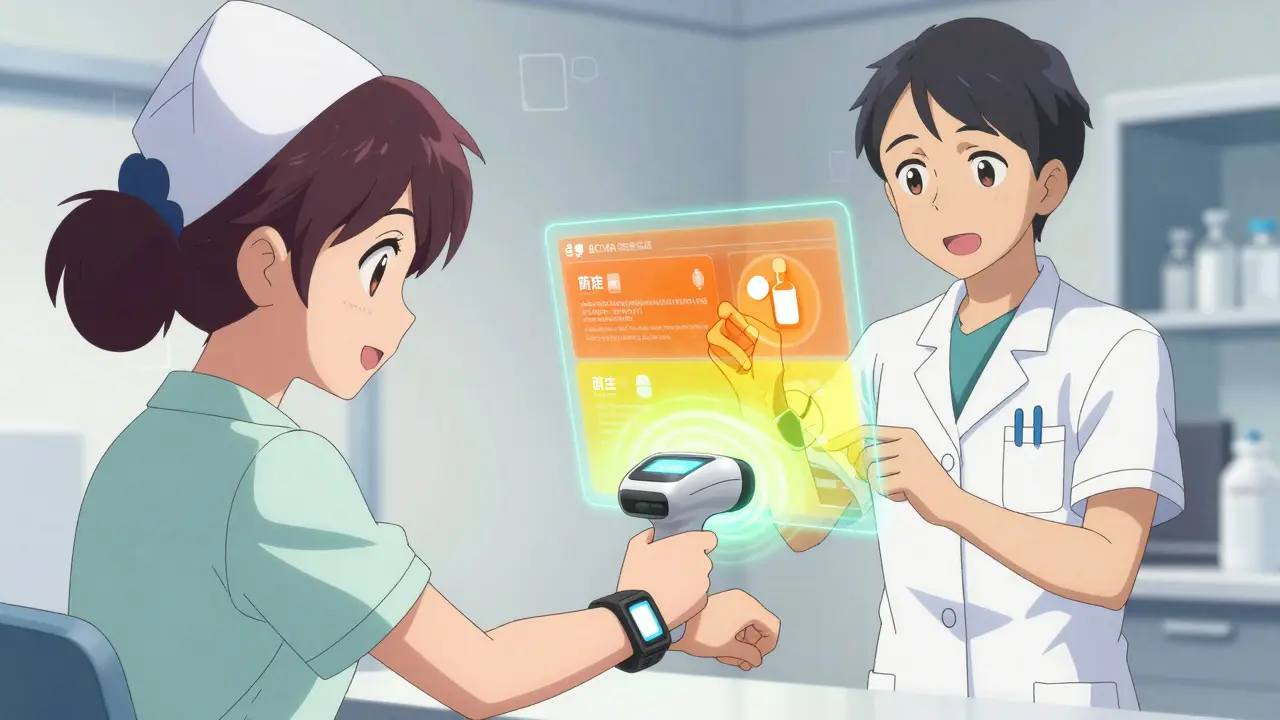
We are not powerless against these errors. Technology plays a huge role. In hospitals, barcode medication administration (BCMA) systems have reduced errors by up to 86%. Nurses scan the patient’s wristband and the drug, ensuring the right person gets the right medicine at the right time. Mayo Clinic reported a 52% reduction in errors after integrating electronic health records with pharmacy systems.
For retail pharmacies, Clinical Decision Support Systems (CDSS) are becoming essential. These software tools alert pharmacists to potential interactions or dosing errors during transcription. CVS Health implemented AI-powered verification systems that cut dispensing errors by 37%. However, technology is only part of the solution. We need a cultural shift. Both settings must move toward non-punitive reporting. If staff fear punishment for admitting a near-miss, they will hide it. As the Journal of Patient Safety states, we need environments where staff feel safe recording errors without blame or shame.
What Patients Can Do
Since you are the last checkpoint in retail pharmacy settings, your vigilance matters. Always ask questions. If a new prescription looks different from your usual, call the doctor. Read the label carefully. Does "twice daily" match what you expect? If you are in a hospital, speak up. Ask the nurse to confirm your name and the medication name before they give it to you. Don’t assume silence means safety. Active engagement is your best defense against systemic failures.
Are hospital medication errors more dangerous than retail pharmacy errors?
Not necessarily. While hospital patients are sicker and errors can have immediate severe consequences, hospital systems have multiple layers of verification (doctors, pharmacists, nurses) that often catch mistakes before they cause harm. Retail pharmacy errors are less frequent but have fewer safety nets, meaning they are more likely to reach the patient undetected, potentially causing delayed but serious harm.
How common are medication errors in community pharmacies?
Research estimates the dispensing error rate in community pharmacies is around 1.5%. While this sounds low, given the billions of prescriptions filled annually, it translates to millions of errors. Most of these are caught by internal checks, but a significant number still reach patients, primarily involving incorrect doses or transcription mistakes.
Why do hospitals have higher error rates than retail pharmacies?
Hospitals deal with acutely ill patients who require complex, rapidly changing regimens. The high volume of interventions, combined with communication challenges between multiple healthcare providers and the stress of emergency situations, leads to a higher frequency of errors. However, these errors are often detected earlier due to continuous monitoring.
Can technology completely eliminate medication errors?
Technology significantly reduces errors but cannot eliminate them entirely. Barcode scanners and AI-driven decision support systems have proven effective, reducing errors by up to 86% in some hospital settings. However, human factors like fatigue, distraction, and system design flaws still play a role. A combination of technology, robust protocols, and a strong safety culture is required.
What should I do if I suspect a medication error?
If you suspect an error, stop taking the medication immediately if possible and contact your pharmacist or doctor right away. Keep the packaging and any remaining pills. Report the incident to the healthcare provider involved. In retail settings, you can also report errors to your state board of pharmacy. Early detection prevents further harm and helps improve system safety.
