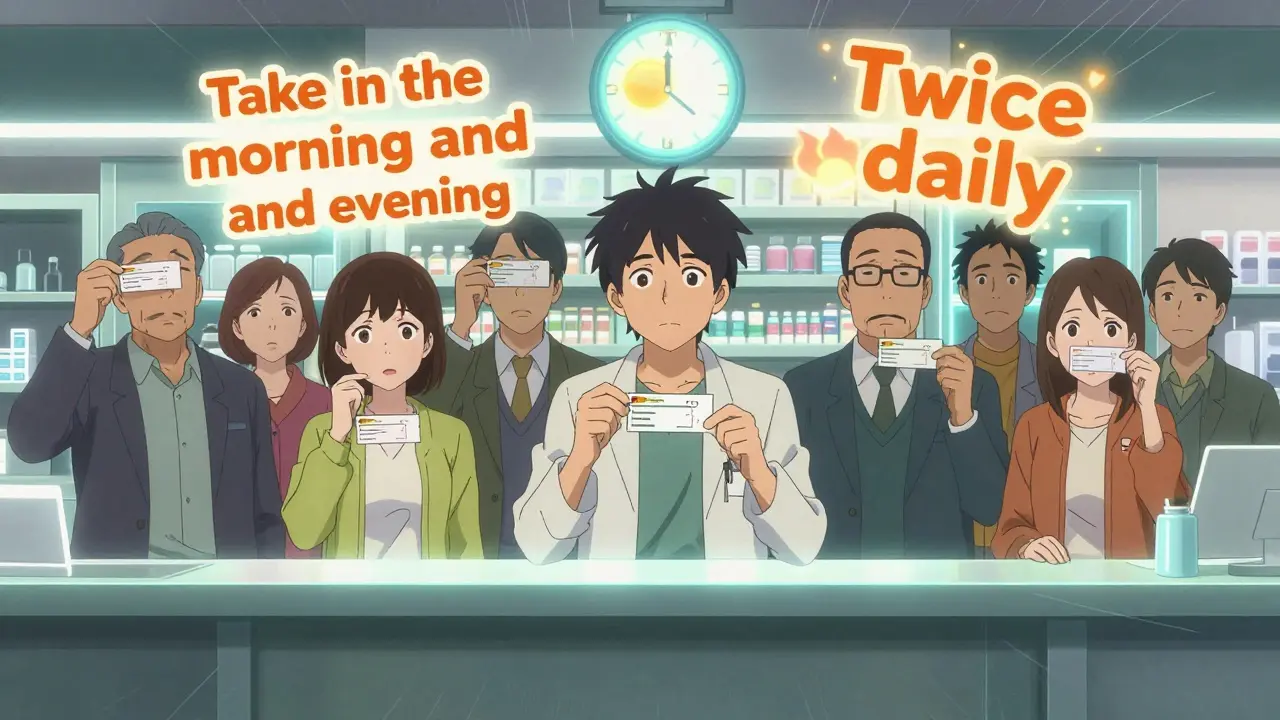
Ever stared at your prescription label and wondered, what does 'twice daily' really mean? You’re not alone. Millions of people take medications every day, but many don’t fully understand when or how to take them. A 2023 Consumer Reports survey found that 41.3% of adults have been confused by their medication instructions. That confusion isn’t just annoying-it’s dangerous. The FDA reports that nearly half of all medication errors tied to prescription labels come from unclear timing instructions. The good news? You can learn to read these labels like a pro-and avoid common mistakes that put your health at risk.
What 'Twice Daily' Actually Means (And Why It’s Not Enough)
You’ve probably seen it: "Take 1 tablet twice daily." Sounds simple, right? But here’s the problem: that phrase doesn’t tell you when to take it. Does it mean 8 AM and 8 PM? Or 7 AM and 7 PM? What if you work nights? What if you forget one dose and take both at once the next day? The FDA has been pushing for clearer language since 2014. Instead of "twice daily," they recommend: "Take 1 tablet in the morning and 1 tablet in the evening." Why? Because "morning" and "evening" are more meaningful to most people than "b.i.d." (the medical abbreviation for twice daily). A 2021 study at Massachusetts General Hospital found patients who got explicit timing instructions were 34.7% more likely to take their meds correctly. But here’s the catch: not every pharmacy follows this. A 2023 study in Patient Education and Counseling found that 82.7% of retail pharmacy labels still use vague terms like "twice daily." CVS Health got it right in 93% of cases after updating their system in 2022. Walgreens? Only 38%. Independent pharmacies? Just under 30%.Why "Take With Food" Isn’t Just a Suggestion
Many prescriptions say "Take with food" or "Take on an empty stomach." These aren’t casual tips-they’re medical requirements. Take levothyroxine, a common thyroid medication. If you take it with coffee, calcium supplements, or even a bowl of oatmeal, your body absorbs less of it. A Harvard Health Letter report found that 32.7% of patients taking levothyroxine didn’t realize they needed to take it on an empty stomach, leading to ineffective treatment. Metformin, used for type 2 diabetes, is another example. Taking it with food reduces stomach upset. A patient on PatientsLikeMe reported that switching from "Take 2 tablets daily" to "Take 1 tablet with breakfast and 1 with dinner" cut their nausea in half. That’s not coincidence-it’s science. Food slows absorption, which helps your body handle the drug better. The FDA requires that these instructions be clearly stated on the label. But here’s where things get messy: some labels still say "take with meals" without specifying which one. If your label says that, ask your pharmacist: "Should I take it with my first meal or my largest meal?"Understanding "As Needed" Medications
"Take as needed for pain" sounds flexible-and it is. But flexibility doesn’t mean unlimited use. Many people don’t realize these medications have a daily maximum. For example, acetaminophen (Tylenol) has a safe limit of 3,000-4,000 mg per day, depending on liver health. That’s about 6-8 extra-strength tablets. But if you’re also taking a cold medicine that contains acetaminophen, you could easily double up without knowing it. A 2023 Consumer Reports survey showed that 67.8% of people didn’t know the maximum daily dose for "as needed" pain meds. That’s how liver damage starts. Always check the active ingredients on every bottle you take. If you’re unsure, write down the name of each medication and ask your pharmacist to check for overlaps.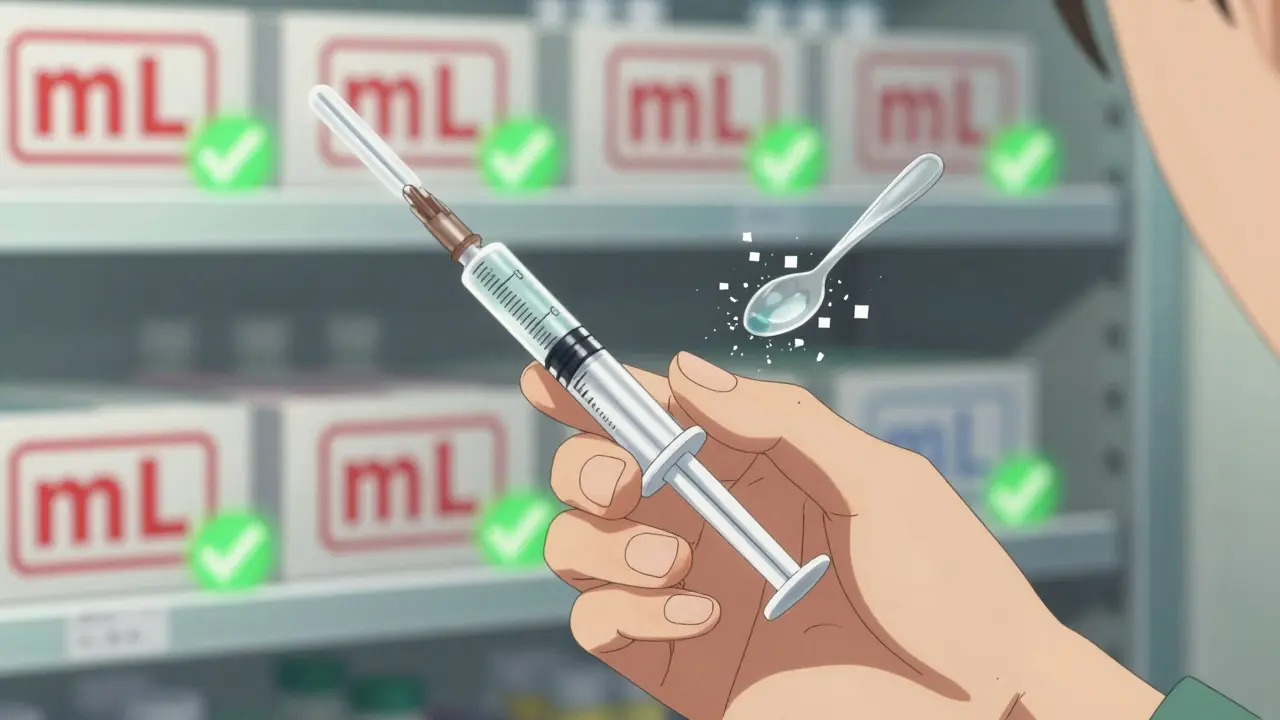
Why Metric Units Matter: mL vs. Teaspoons
If you’re taking liquid medicine-like antibiotics for kids or cough syrup-you’ve probably seen "take one teaspoon" on the label. That’s outdated. Since 2020, the U.S. Pharmacopeial Convention has required that all oral liquid medications use milliliters (mL) on labels, not teaspoons or tablespoons. Why? Because a household teaspoon can hold anywhere from 3 to 7 mL. A standard measuring spoon? About 5 mL. But a pharmacy dosing cup? Exactly 5 mL. A 2022 NIH study found that 27.4% of patients made dosing errors when using kitchen spoons. That’s why the FDA’s 2021 audit showed 63.8% of labels still used non-metric units-despite the rule. Always use the dosing cup or syringe that comes with the bottle. Never guess with a kitchen spoon. If yours didn’t come with one, ask your pharmacist for a free dosing syringe. They’re accurate, easy to use, and often come with markings for half-doses.What to Do When Your Schedule Doesn’t Fit "Morning" and "Evening"
What if you work the night shift? Or your kids are up at 6 AM and you’re not? The FDA’s explicit timing instructions assume a typical 9-to-5 schedule. But life isn’t that simple. A 2022 study from Northwestern University found that 22.3% of night-shift workers misinterpreted "morning" and "evening" instructions. One patient, a nurse working 11 PM to 7 AM, took her blood pressure pill at 7 AM-thinking that was "morning"-but her body was still in nighttime mode. Her blood pressure spiked. The fix? Talk to your pharmacist. Say: "I work nights. Can you write my schedule based on when I’m awake?" Most will adjust it. Instead of "Take in the morning," they can write: "Take when you wake up and 12 hours later." That’s still clear, still safe, and fits your life.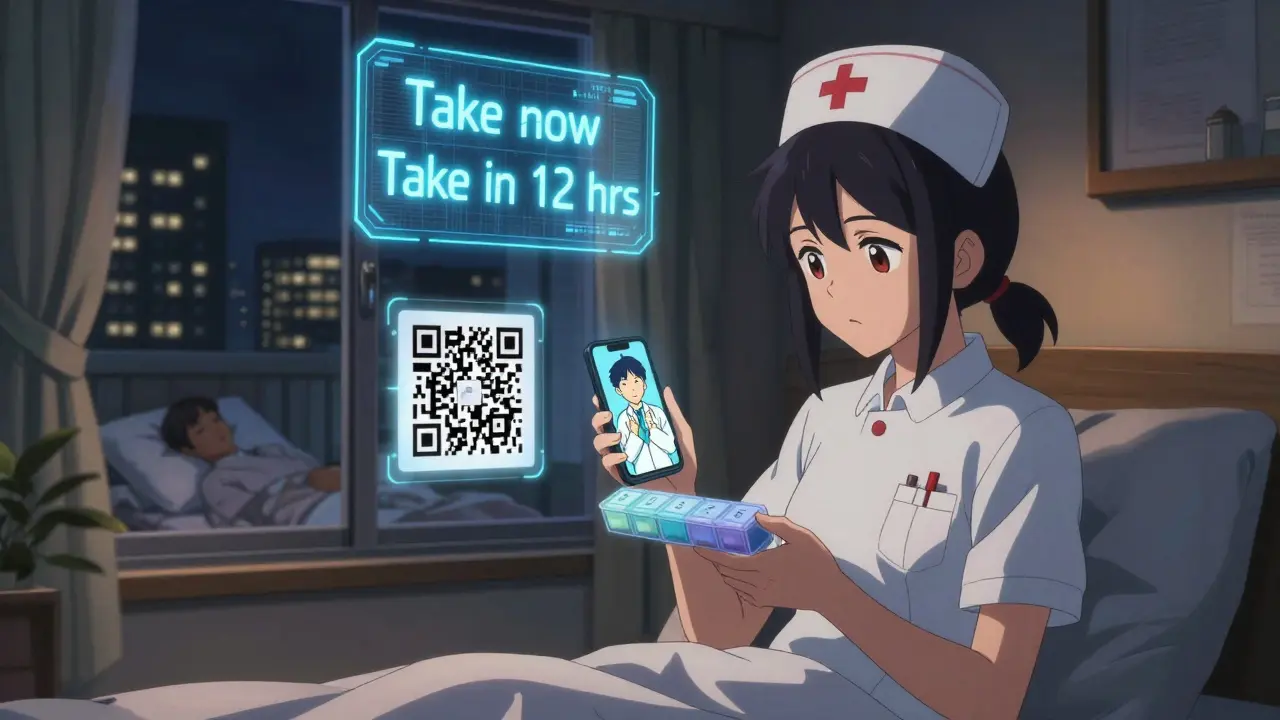
What to Look for on Your Label (A Quick Checklist)
Before you leave the pharmacy, check your label for these five things:- Exact times: Does it say "in the morning" and "in the evening," or just "twice daily"?
- Unit of measure: Is it in mL (milliliters), not teaspoons or tablespoons?
- Food instructions: Does it say "with food," "on empty stomach," or nothing at all?
- Daily maximum: For "as needed" meds, is there a limit like "Do not exceed 4 doses in 24 hours"?
- Special warnings: "Avoid alcohol," "May cause drowsiness," "Take at bedtime"?
Why This Matters More Than You Think
Medication errors aren’t just about forgetting a pill. They’re about taking the wrong dose at the wrong time, mixing drugs, or not knowing how food affects absorption. The Institute of Medicine estimates that medication errors cause 7,000 deaths in the U.S. every year. Most of these are preventable. The FDA is pushing hard for change. By January 2027, all prescription labels will need to include a "Medication Schedule Grid"-a visual chart showing exactly when to take each dose each day. Some states, like California, already require pictograms on labels showing a clock with arrows pointing to morning and night. New technology is helping too. Some pharmacies now offer QR codes on labels. Scan it with your phone, and you’ll see a video showing how to take the medicine. A 2023 FDA pilot found this reduced timing errors by over 50%.What You Can Do Today
You don’t need to wait for the system to fix itself. Here’s what you can do right now:- When you pick up a new prescription, read the label out loud to yourself.
- If it says "twice daily," ask: "What times should I take it?"
- Use a pill organizer with morning, afternoon, evening, and night slots.
- Set phone alarms labeled "Take blood pressure pill" or "Take metformin with lunch."
- Keep a simple list of all your meds, doses, and times. Show it to your doctor at every visit.
What does 'twice daily' mean on a prescription label?
'Twice daily' means two doses in a 24-hour period, but it doesn't say when. The FDA recommends clearer wording like 'Take one tablet in the morning and one in the evening.' This helps patients take their medicine at consistent times, improving safety and effectiveness.
Should I take my medicine with food or on an empty stomach?
It depends on the medication. Some drugs, like levothyroxine, must be taken on an empty stomach because food blocks absorption. Others, like metformin, are easier on the stomach when taken with food. Always follow the label’s instructions. If it’s unclear, ask your pharmacist for specifics.
Why do prescription labels now use mL instead of teaspoons?
Household teaspoons vary in size (3-7 mL), leading to dangerous dosing errors. The FDA and U.S. Pharmacopeia now require milliliters (mL) on all liquid medication labels because pharmacy dosing tools are precise. Always use the measuring cup or syringe that comes with the bottle.
Can I take 'as needed' pain meds whenever I want?
No. 'As needed' doesn’t mean unlimited. Most over-the-counter pain relievers like acetaminophen or ibuprofen have strict daily limits-often 3,000-4,000 mg for acetaminophen. Taking too much can damage your liver or kidneys. Always check the maximum daily dose on the label or ask your pharmacist.
What should I do if my work schedule doesn’t match 'morning' and 'evening'?
Tell your pharmacist your schedule. If you work nights, they can adjust instructions to say 'Take when you wake up and 12 hours later.' This keeps the timing consistent with your body’s rhythm, not a standard 9-to-5 day.
Are there tools to help me remember when to take my meds?
Yes. Use a pill organizer with labeled slots, set phone alarms with clear names like 'Take insulin,' or scan QR codes on newer labels that show video instructions. Some pharmacies also offer text reminders. Ask your pharmacist what options are available.

11 Comments
This is why America’s healthcare system is a joke. Pharmacies still using 'twice daily' like it's 1998? My grandma took her pills at 7 AM and 7 PM because the label said so-and she almost died when the pharmacist 'forgot' to clarify it was with food. Someone’s getting sued over this. 🤬
Let’s be real-this whole article is just a fancy PSA for pharmacists who can’t write clearly. The FDA’s 'morning and evening' fix? Pathetic. What if you’re a shift worker? What if you’re in a different time zone? What if you’re a single parent who wakes up at 4 AM? This isn’t about clarity-it’s about lazy bureaucrats who think people are dumb enough to follow a clock, not a lifestyle. Also, 'as needed' means exactly what it says. If you’re in pain, take it. Stop policing people’s pain management.
Hey everyone, i just wanted to say thank you for this post, it really helped me understand why my mom’s thyroid med wasnt working right. She was taking it with her morning coffee and i had no idea that could block absorption. Now we use a little glass of water and wait 30 mins before breakfast. Its such a small change but it made a big difference. Also, i live in india and here most pharmacies still write '1 tsp' on bottles, even though they give you a plastic syringe. Maybe this is a global issue? We need more awareness, not just in the US. I shared this with my cousin who’s a nurse, she said they’re trying to train staff better but its slow. Keep pushing for clear labels, it saves lives. ❤️
Let’s not pretend this is about patient safety. This is corporate liability engineering. The FDA didn’t mandate 'morning and evening' because they care about you-they did it because they got sued 17 times in 2021 by people who took meds wrong. The 82.7% statistic? That’s cherry-picked. Independent pharmacies have less funding, less tech, less legal teams. CVS updated their system because they got a class-action settlement. Walgreens? They’re still using legacy software from 2007. And QR codes? That’s not innovation-it’s a way for Big Pharma to track your pill-taking habits and sell data to insurers. You’re being manipulated under the guise of 'safety.'
Oh, so now we’re educating the masses on how to read a label? How quaint. I suppose next they’ll teach us how to tie our shoes and not confuse 'b.i.d.' with 'q.i.d.'-because clearly, the average American can’t handle a single Latin abbreviation without having a panic attack. At least in Europe, we just get a laminated card with a clock and little pills drawn on it. No blog posts. No 2,000-word essays. Just a picture. Maybe we should just give everyone a pill organizer with a face on it that smiles when they take it correctly. 🤡
I’ve been on 7 different meds over the last 5 years and this is the first time anyone’s actually explained why timing matters. I used to take my metformin at bedtime because I forgot in the morning-and then I’d feel sick all day. Switching to 'with breakfast and dinner' changed everything. Also, I had no idea kitchen spoons could be so inaccurate. I just used a regular spoon for my kid’s antibiotics until I read this. Now I use the syringe. I’m not smart, but I’m learning. Thanks for not talking down to us.
As someone who grew up in a household where medicine was passed down like family recipes-with no labels and no instructions-I can’t stress enough how vital this is. My father took his blood pressure pill with grapefruit juice because 'it tasted better.' He didn’t know it could cause kidney failure. We lost him too soon. This isn’t just about reading labels. It’s about breaking cycles of ignorance. Thank you for writing this. I’m sharing it with my community center next week.
How utterly, depressingly, and tragically predictable. We live in a society where the most basic act of self-preservation-taking medication correctly-requires a 12-point checklist, a QR code, and a PhD in pharmaceutical semantics. The fact that we’ve reduced human health to a compliance algorithm is not progress. It’s collapse. And yet, here we are, applauding ourselves for not using a teaspoon. Bravo. 🎉
Just wanted to say thank you for this. I’m a veteran and sometimes the VA labels are so confusing, I end up calling the nurse line just to double-check. I appreciate that someone took the time to explain this clearly. I’ve started using a pill box and setting alarms. Small things, but they help. I hope more people see this. We all deserve to feel safe taking our meds.
Let’s not forget who’s really behind this: the pharmaceutical giants. They don’t care if you take your pill at 8 AM or 8 PM-they care that you take it every day. The 'morning and evening' fix? It’s designed to keep you dependent. If you miss a dose, you panic. If you’re confused, you call the pharmacy. That’s more calls, more visits, more data, more profit. And the QR codes? They’re not for you-they’re for the insurance companies to monitor your adherence and raise your premiums if you ‘fail.’ This isn’t education. It’s surveillance dressed in a lab coat.
Use the syringe. 😊
Write a comment